Sokak Kızı

Street Girl (Sokak Kızı) (translated)

Movie · 1962 · 15 people

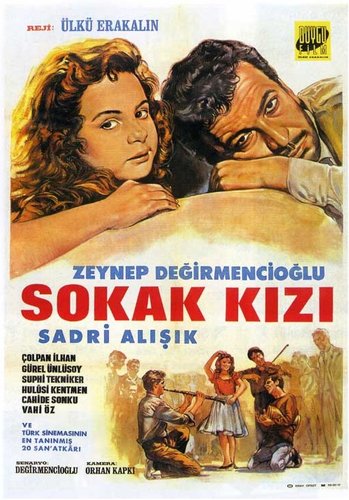
A Yeşilçam melodrama in black and white, Sokak Kızı ("Street Girl") dates from 1962. Osman F. Seden directed it from a screenplay by Bülent Oran, and Kemal Film produced it. Necati İlktaç shot it and Metin Bükey wrote the music. Fikret Hakan and Fatma Girik lead the cast, and the film follows a young man torn between money and the heart in 1960s Istanbul.

In this world, two factory owners decide to marry off their children to merge their businesses and leave the fortune to their grandchildren. Nihat, a painter and musician, is engaged to Serpil under pressure from his father Hüdai Bey. When the merger requires emptying a poor neighbourhood called Telsizler, Nihat objects to that as well. A small accident near the factory brings him to Sami, a meatball vendor, and Nihat, wanting out of his money-obsessed circle, settles in the neighbourhood posing as a signboard painter and Sami's relative. There he meets Fıstık, a street vendor who does any job to support her siblings, Ahmet, a poetic truck driver, Hüsnü the butcher and Tarık, the local team's captain.

Self-sacrifice and sharing are set against capital's calculations, and a song called "Sokak Kızı", sung by Fıstık, sits at the heart of the story.

DirectorOsman Fahir Seden
Production companyKemal Film
Street Girl (Sokak Kızı) Street Girl (Sokak Kızı)

Reactions

You can pick up to 3 reactions.

Cast
Through different eyes

Yeşilçam Nostalgic A viewer raised on the classics, looking for warm storytelling and strong acting.

A rich man's son slipping into a poor neighbourhood and finding true values there is one of Yeşilçam's favourite fairy tales, and Sokak Kızı tells it sincerely. The street meatball seller, the truck driver with a poet's soul, the butcher, the captain of the local team... Bülent Oran's writing turns those lovely neighbourhood people into warm portraits. Placing the song Fıstık sings right at the heart of the story is a reminder of how precious music was to the melodramas of those years. The longing for a world where money was thought of as mere dirt on the hands may be naive, but it is the kind that still touches the heart today.

History & Society Lens Asks about the period, the social background and what the work reflects.

The film sets up the tension between capital and neighbourhood in 1960s Istanbul in a very clear scheme: two factory owners plan to merge their businesses through a marriage, and the price is clearing out a poor neighbourhood in Telsizler. Given that urban redevelopment is still a live debate, it is striking that this conflict was already the stuff of melodrama in the sixties. Yet the neighbourhood is painted as an almost flawless community; while poverty is ennobled through sacrifice and sharing, its real hardships stay somewhat in the background, in my view. Still, it is a valuable example of the class sensibility of its time.

Cinephile Looks at script, editing and directing choices; keeps a distance from formula films.

Sokak Kızı uses Yeşilçam melodrama's busiest template: the rich young man who hides his identity and mingles with the poor. With such a familiar pattern, curiosity shifts from what will happen to where the identity game will lead, and that is where the script carries its weight. Bülent Oran draws the moral contrast sharply, money on one side and sacrifice on the other, with little in between. The black-and-white photography and Metin Bükey's music give the neighbourhood scenes texture. But in my view several of the many supporting characters remain types; the meatball seller, the truck driver, the butcher and the volleyball player work more as the neighbourhood's colours than as individuals, and that weakens the dramatic tension.

These are not reader reviews: they are short editorial takes written from different viewer perspectives with AI assistance. Reader reviews are below.

Reviews (0)

Log in Log in to write a review.

Comments