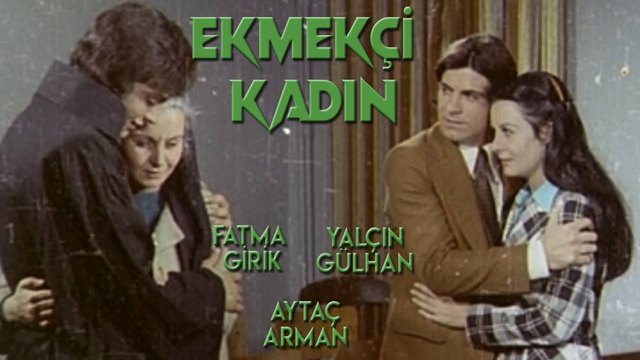
Ekmekçi Kadın

The Bread Seller Woman (Ekmekçi Kadın)

Movie · 1965 · 3 people

Zafer Davutoğlu directed the 1965 black-and-white Yeşilçam melodrama Ekmekçi Kadın (The Bread Seller Woman), with Osman F. Seden as screenwriter and producer for Kemal Film. Adapted from Xavier de Montépin's 1884 French novel La Porteuse de Pain, it tells of a wronged mother seeking her children. The story was also filmed in Turkey in 1938 and 1972.

It begins in Istanbul in the winter of 1943. Widowed after a workplace accident, Ayşe Çelik is left with two small children, Metin and Zeynep, and finds work in a factory. Her beauty becomes her curse: Nazmi, a foreman who claims to have been her husband's friend, is obsessed with her and, rejected, burns down the factory, kills and frames Ayşe. She gets life in prison and her children are scattered. Twenty-one years later paths cross again: Metin is a lawyer, Zeynep grew up in an orphanage as Leyla, and Nazmi, under a new name, is a wealthy industrialist from Egypt. Türkân Şoray plays Ayşe, İzzet Günay Kemal, Çolpan İlhan Sevim and Kenan Pars Nazmi, with Kadir Savun and Nubar Terziyan also in the cast.

Kenan Kurt was the cinematographer. The key confrontation scene uses the 1964 melody Quando Ritornerà Da Me, where the 1972 remake would use another piece.

DirectorZafer Davutoğlu
Production companyKemal Film

Reactions

You can pick up to 3 reactions.

Cast

Through different eyes

Yeşilçam Nostalgic A viewer raised on the classics, looking for warm storytelling and strong acting.

Montépin's novel reached Turkish screens more than once, and the 1965 version stays with you for the weight Türkân Şoray carries on her shoulders. A mother jailed for a crime she did not commit and torn from her children is Yeşilçam's favourite material, and here it is handled with conviction. The hard black-and-white images suit that bleak Istanbul winter of 1943, and the melody of Quando Ritornerà Da Me in the confrontation scene is a small gift for anyone with an ear for it. Kenan Pars's Nazmi is a villain in the grand Yeşilçam manner; you want to talk back to the screen. A warm return for anyone who misses the old melodramas.

Cinephile Looks at script, editing and directing choices; keeps a distance from formula films.

Osman F. Seden's script inherits the whole machinery of the French serial novel intact: a frame-up, a life sentence, scattered children, a twenty-one-year time jump and a villain who returns rich under a new name. The structure leans far too heavily on coincidence; having everyone's paths cross again years later is the easy dramatic way out. Still, Zafer Davutoğlu keeps the narrative from sprawling, and Kenan Kurt's black-and-white framing shows poverty without prettifying it. The real weight rests on Türkân Şoray's performance, which lets grief accumulate on her face without tipping into excess. Consistent for viewers who accept the genre's rules up front, overly predictable for anyone hoping to be surprised.

Family Viewer Asks whether the whole household can watch it; cares about humour and heart.

This is a proper tearjerker, so keep the tissues close. The subject is heavy, though: a factory fire, a murder, a mother wrongly sent to prison and children taken from her. It may be too dark and sad for young children. Teenagers and grandparents will watch it comfortably. What stays with you is a mother's love for her children. A good evening choice for a family that enjoys old films.

These are not reader reviews: they are short editorial takes written from different viewer perspectives with AI assistance. Reader reviews are below.

Reviews (0)

Log in Log in to write a review.

Comments