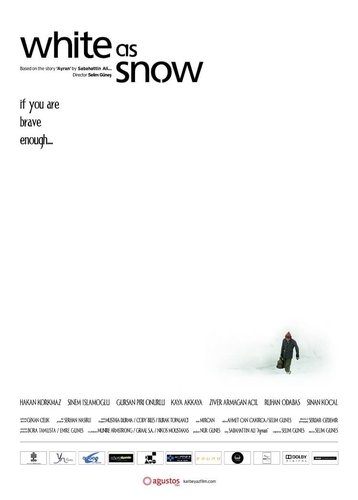
Kar Beyaz

White as Snow (Kar Beyaz)

Movie · 2010 · 5 people

Inspired by Sabahattin Ali's short story "Ayran", the Turkish drama Kar Beyaz (White as Snow) was written and directed in 2010 by Selim Güneş, who is also a photographer. Its premiere came at the 47th Antalya Golden Orange Film Festival in September 2010, and the 46th Chicago International Film Festival selected it as well. At about 82 minutes, it reached Turkish cinemas on 13 May 2011.

The story focuses on one day in the life of young Hasan, who lives in a village in the Eastern Black Sea region. When his father, a blacksmith, goes to prison, the family sinks into hardship and his mother works as a caretaker in town, so Hasan sells buttermilk to feed his siblings. On a cold winter day he comes to a roadside teahouse to sell to passing minibus passengers. Its keeper Recep awaits word from Fatma, the sweetheart family pressure took from him, while old Kadir sells winter pears to earn his bread. Ziver Armağan Açıl, Gürsan Piri Onurlu and Kaya Akkaya appear in the cast.

The film won Best Film Music at Antalya and, in Ankara, the Mahmut Tali Öngören Special Award plus prizes for promising new screenwriter and best supporting actress. Critics were divided; one argued the short story was not enriched enough to sustain a feature.

DirectorSelim Güneş

Reactions

You can pick up to 3 reactions.
Cast

Kaya Akkaya Kaya Akkaya Actor · 46 years old Hakan Korkmaz Gürsan Piri Onurlu Ruhan Odabas Sinem Islamoglu

Through different eyes

Cinephile Looks at script, editing and directing choices; keeps a distance from formula films.

The most interesting choice in Kar Beyaz is squeezing the story into a single day and building it around lives that cross at the roadside teahouse. The structure stays faithful to the economy of Sabahattin Ali's story; the news Recep is waiting for and old Kadir's pears run as small lines parallel to Hasan's day. Yet the critics' split is understandable: the simplicity that creates intensity in a short story sometimes turns into a diluted waiting game at feature length, and the side lines seem to stall the main story more than they enrich it. The visual sensitivity you would expect from a director who comes from photography may be the work's strong suit, but in my view the script does not add enough layers on top of the story.

History & Society Lens Asks about the period, the social background and what the work reflects.

What the film really says is that the teahouse is a small map of a village economy: a child sells buttermilk, an old man sells winter pears, and everyone hopes for a few coins from the passing minibuses. The way a family slides into hardship the moment the father goes to prison, with the mother pushed into caretaking work in town and the child to the roadside, shows plainly that the weight of poverty falls hardest on children. The family pressure that separated Recep and Fatma is another face of the same social order. Carrying Sabahattin Ali's social-realist eye into an Eastern Black Sea winter turns child labour from a statistic into a face.

Family Viewer Asks whether the whole household can watch it; cares about humour and heart.

The hero is a small boy, but this is not a children's film. The story of Hasan selling buttermilk in the cold to look after his siblings is a sad one. Little ones may get bored by the slow pace. With older children, though, it is a good starting point for talking about poverty and child labour. The grandparents at home may enjoy scenes of village life that feel familiar.

These are not reader reviews: they are short editorial takes written from different viewer perspectives with AI assistance. Reader reviews are below.

Reviews (0)

Log in Log in to write a review.

Comments