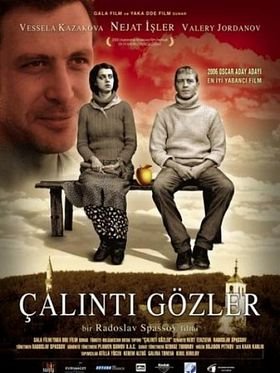
Stolen Eyes (Çalıntı Gözler)

Stolen Eyes (Çalıntı Gözler) (translated)

Movie · 2006 · 15 people

The impossible love between a Christian man and a Muslim Turkish woman drives Çalıntı Gözler (Bulgarian: Otkradnati ochi), a drama set in 1980s Bulgaria. A Bulgarian-Turkish co-production with much Turkish dialogue, it is set during the "Revival Process", when the country's Turkish minority was forced to change its names. It opened in Turkey on February 10, 2006.

Ivan is an official who carries out the name-change procedures and is responsible for the stamps that validate new identity papers. Ayten, a teacher, steals those stamps in her own protest against the assimilation campaign, and the incident ties the two together, forcing Ivan to choose between duty and conscience. When Ayten's child is killed during a protest by special forces, Ivan is shaken. The two end up in the same hospital and begin to turn old enmity into affection. Valeri Yordanov plays Ivan, Maria Kavardjikova plays Valya and Nejat İşler plays the brother, with Vesela Kazakova also in the cast.

Radoslav Spasov directed and co-wrote the script with Neri Terzieva. Plamen Somov shot it and Bozhidar Petkov composed the music. The film was Bulgaria's entry for the 78th Academy Awards, and Vesela Kazakova won Best Actress at the 27th Moscow International Film Festival.

DirectorRadoslav Spasov

Reactions

You can pick up to 3 reactions.

Cast

Nejat İşler Nejat İşler Actor · 54 years old Brother Vesela Kazakova Valeri Yordanov Itzhak Fintzi Stoyan Aleksiev Maria Kavardjikova Maria Statoulova Deyan Donkov Đoko Rosić Anani Yavashev Veliko Stoyanov Nikolai Urumov Veselin Rankov Rangel Vulchanov Stefan A. Shterev

Through different eyes

AI-assisted editorial takes written from different viewer perspectives. They are not reader reviews; those are below.

History & Society Lens Asks about the period, the social background and what the work reflects.

Stolen Eyes is set against the so-called Revival Process, which forced Bulgaria's Turks to change their names in the 1980s, and the fact that it is a Bulgarian-Turkish co-production gives that extra meaning. Telling an assimilation policy through the official in charge of the stamps that validate new identities and the teacher who steals them brings state policy down to the conscience of ordinary people. An important film for those who carry this period in their family memory. Tying the political conflict to a love story risks softening the weight of the repression; on its own it is not enough for anyone wanting to understand the period more closely.

Cinephile Looks at script, editing and directing choices; keeps a distance from formula films.

Bulgaria's submission for the 78th Academy Awards also won critical recognition through Vesela Kazakova's Best Actress award at the Moscow International Film Festival. Radoslav Spasov and Neri Terzieva's script chooses to draw two figures from opposing sides together through a shared loss. That is a strong dramatic axis, but also a choice that risks sliding into melodrama: a turn from enmity to affection easily loses credibility if it is not built step by step. Having much of the dialogue in Turkish is a smart decision that carries the film's subject into the language itself. The length, too, is well judged for a subject this heavy.

Family Viewer Asks whether the whole household can watch it; cares about humor and heart.

The subject is heavy: a minority forced to change their names, protests and the death of a child. This is not a film for young children. But watching it with teenagers and older relatives curious about what Bulgaria's Turks went through can be a good chance to talk about that period as a family. There is no humor; it is a sad, thought-provoking story.

Reviews (0)

Log in Log in to write a review.

Comments