A Talking Picture

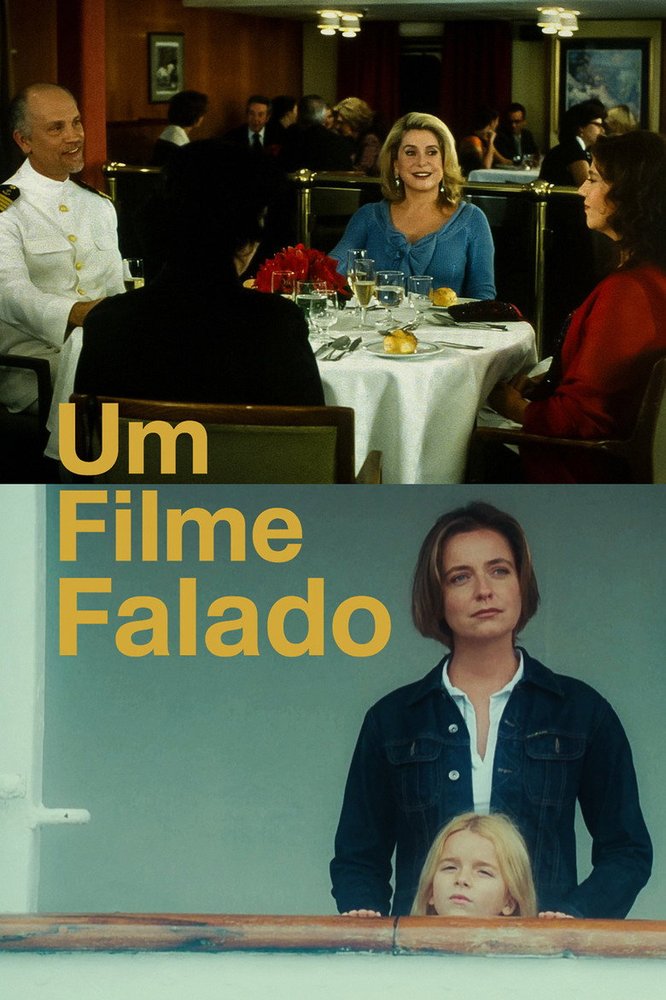
A Talking Picture (Um Filme Falado)

Movie · 2003 · 7 people

Portuguese filmmaker Manoel de Oliveira wrote and directed A Talking Picture (Um Filme Falado in Portuguese), a drama made in 2003. A Portugal-Italy-France co-production, it is a multilingual film, spoken in French, Italian and English, and runs about 96 minutes. Catherine Deneuve, John Malkovich, Irene Papas, Stefania Sandrelli and Leonor Silveira head the cast, joined by Luís Miguel Cintra and Ricardo Trêpa.

It opened in France on 15 October 2003 and in Portugal two days later, on 17 October, reaching Spain only in May 2004. The film was also shown at the Venice Film Festival, and its German release title carries the subtitle Reise nach Bombay, pointing to a voyage.

The theatrical manner in Oliveira's cinema had become pronounced with O Acto da Primavera (1963). His second fictional feature, O Passado e o Presente (1971), drew severe criticism for it, yet in his later films the approach became a deliberately cultivated choice. Through its title and its structure, Um Filme Falado displays that theatricality openly, and the director himself implicitly takes up and explains the question of the "spoken" film. It is also the last film of the Greek actress Irene Papas, who withdrew from public life afterwards and died in 2022.

DirectorManoel de Oliveira

Reactions

You can pick up to 3 reactions.

Cast

Only cast members with a profile on this site are listed.

Catherine Deneuve Catherine Deneuve Film actor · 83 years old Stefania Sandrelli Stefania Sandrelli Actor · 80 years old John Malkovich İrini Papas Leonor Silveira Luís Miguel Cintra Ricardo Trêpa
Through different eyes

Cinephile Looks at script, editing and directing choices; keeps a distance from formula films.

Theatricality in Oliveira's cinema was first attacked as a flaw and gradually became a deliberate style; Um Filme Falado reads almost like a manifesto of that journey. Starting with its title, the film entrusts its storytelling to words more than images, and it displays the choice openly instead of hiding it. That stillness can be tiring for an unaccustomed eye, but it is not clumsiness; the director builds the idea of a spoken film into the structure itself. The interweaving of French, Italian and English reinforces the choice, because language here is part of the subject rather than just a vehicle. Not for everyone, but a dense experience for patient viewers who know Oliveira's work or want to.

History & Society Lens Asks about the period, the social background and what the work reflects.

The interweaving of French, Italian and English takes the film beyond the borders of any single national cinema, and its Portuguese-Italian-French backing supports that multicultural identity. The reference to a voyage to Bombay in its German title signals a story shaped around a journey, and placing characters from different languages side by side suggests a search for a common tongue. The film is also an ending: being the Greek actress Irene Papas's last film lends it the air of a farewell. Bringing together names from different generations of European cinema, the cast is a small piece of history in its own right.

Family Viewer Asks whether the whole household can watch it; cares about humour and heart.

This is not the right pick for a family movie night. As the title suggests, the film is built largely on talk and moves across three languages. Children, and teenagers expecting a fast story, will most likely get bored. It suits patient adults with a taste for art cinema. If you want something everyone can watch together, choose another film.

These are not reader reviews: they are short editorial takes written from different viewer perspectives with AI assistance. Reader reviews are below.

Reviews (0)

Log in Log in to write a review.

Comments