Speriamo che sia femmina

Let's Hope It's a Girl (Speriamo che sia femmina)

Movie · 1986 · 15 people

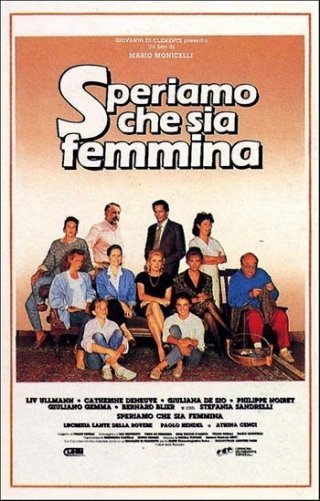
Mario Monicelli directed the 1986 Italian-French comedy-drama Speriamo che sia femmina (Let's Hope It's a Girl). Running about two hours, it deals with uncertainty about the future, withdrawal from responsibility and the failure of marriages and love affairs, and at the end sets against them a kind of feminist utopia. It won David di Donatello awards in seven categories, among them Best Film, Best Director and Best Script, and Nastri d'Argento in six.

At its centre is a former aristocrat who, divorced, keeps the family villa in Tuscany running with her female relatives. The order of this all-female household breaks down when her former husband turns up with a plan to renovate the place. The cast includes Liv Ullmann, Catherine Deneuve, Giuliana De Sio, Philippe Noiret, Bernard Blier, Stefania Sandrelli, Giuliano Gemma and Athina Cenci.

Monicelli wrote the script with Tullio Pinelli and Leonardo Benvenuti. Among the Davids, Cenci took Best Supporting Actress and Blier Best Supporting Actor; production and editing were honoured too. It ranked 13th among the most-watched films in Italy in 1986, with more than 400,000 admissions. Critics saw a charming star comedy; some found it overlong and lacking in intellectual depth.

DirectorMario Monicelli

Reactions

You can pick up to 3 reactions.

Cast

Only cast members with a profile on this site are listed.

Catherine Deneuve Catherine Deneuve Film actor · 83 years old Stefania Sandrelli Stefania Sandrelli Actor · 80 years old Liv Ullmann Philippe Noiret Giuliana De Sio Bernard Blier Giuliano Gemma Athina Cenci Paolo Hendel Lucrezia Lante Della Rovere Adalberto Maria Merli Nuccia Fumo Paul Müller Carlo Monni Enio Drovandi
Through different eyes

Cinephile Looks at script, editing and directing choices; keeps a distance from formula films.

Monicelli gathers a large star cast into a single villa and directs it almost like a chorus; just seeing Liv Ullmann, Catherine Deneuve and Stefania Sandrelli in one film is a draw in itself. At its best the film carries on the bittersweet tradition of Italian comedy, treating failed marriages and the flight from responsibility with a light touch rather than heavy drama. That lightness, however, isn't enough to carry the film's full length, and the critics who found it overlong and short on intellectual depth have a point. That the script and editing were also honoured at the David di Donatello awards is a reminder of how highly it was regarded in its day.

History & Society Lens Asks about the period, the social background and what the work reflects.

The film looks at the transformation of the family through women's eyes. A divorced former aristocrat keeping the family villa going with her female relatives is the story of a new order built in the absence of men. Her former husband turning up with a renovation plan is a neat irony that shows how fragile this order is. The feminist utopia the film proposes may look a little optimistic today, but it paints a thought-provoking picture, from 1980s Italy, of a fading aristocracy and solidarity among women.

Family Viewer Asks whether the whole household can watch it; cares about humour and heart.

A calm, grown-up comedy about a large family of women. What stands out isn't belly laughs but separations, family relationships and solidarity. Young children may find it slow and talky. But it's the kind of film grandmothers, mothers and grown-up daughters can watch together and talk about afterwards.

These are not reader reviews: they are short editorial takes written from different viewer perspectives with AI assistance. Reader reviews are below.

Reviews (0)

Log in Log in to write a review.

Comments