Dancing Arabs - A Borrowed Identity

Dancing Arabs - A Borrowed Identity

Movie · 2014 · 3 people

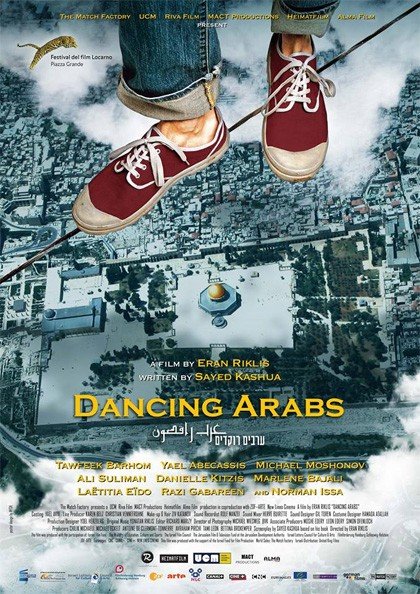
Eran Riklis directed Dancing Arabs - A Borrowed Identity, an Israeli-French-German drama made in 2014. It runs about 104 minutes, in Arabic and Hebrew. It is based on Sayed Kashua's 2002 novel Dancing Arabs, which the author adapted himself. Through a young man's eyes it portrays the tense relationship between Israelis and Palestinians. The title Dancing Arabs was later extended with the subtitle "A Borrowed Identity" to avoid provocation.

The hero is Eyad, a Palestinian teenager from the Israeli town of Tira. His intelligence earns him a place at an elite Jewish high school in Jerusalem, into a world far from his own. There he meets a Jewish classmate, Naomi, and a closeness grows that neither side welcomes. On compulsory community service he meets Yonatan, who has muscular dystrophy, and his mother Edna, and an unlikely friendship forms. Hiding who he is to be accepted, Eyad slowly loses his footing between his real self and his assumed identity.

The cast includes Ali Suliman, Khalifa Natour, Tarik Kopty, Yaël Abecassis and Michael Moshonov. The film was chosen to open the Jerusalem Film Festival in May 2014 and was also shown at Locarno. The military operation that began in Gaza in July delayed its completion by four months. It opened in Germany on 21 May 2015.

DirectorEran Riklis

Reactions

You can pick up to 3 reactions.

Cast

Only cast members with a profile on this site are listed.

Through different eyes

History & Society Lens Asks about the period, the social background and what the work reflects.

Dancing Arabs - A Borrowed Identity treats the question of identity through a young man's everyday life rather than drowning it in slogans. Eyad's move from Tira to an elite Jewish high school in Jerusalem shows how education can open a door while pulling a person away from their roots. That his closeness with Naomi is welcomed by neither side is a reminder that prejudice runs in more than one direction. The friendship with Yonatan and his mother Edna adds an unexpected layer of humanity. Sayed Kashua adapting his own novel gives the script a voice from the inside. Rather than taking sides, the film tries to understand an individual squeezed between two worlds.

Cinephile Looks at script, editing and directing choices; keeps a distance from formula films.

Eran Riklis places a politically heavy subject inside a coming-of-age mould, a choice that makes the film accessible and, at times, too safe. Sayed Kashua's script, drawn from his own novel, builds Eyad's concealment of his identity step by step. But the three strands, the closeness with Naomi, the friendship with Yonatan and school life, are not always balanced with equal weight, and some transitions feel rushed. The movement between Arabic and Hebrew is a smart element that carries the theme into the form itself. Opening the Jerusalem Film Festival and screening at Locarno show the festival world's interest. Less a bold piece of film language than a well-built, sincere piece of storytelling.

Family Viewer Asks whether the whole household can watch it; cares about humour and heart.

This film is about youth, school, friendship and love. You can watch it with teenagers. Eyad hiding who he is to fit in at his new school is a good way to start a talk with young people. The friendship with Yonatan is very sincere too. But the subject is heavy: there is prejudice, exclusion and illness. Younger children may find it too serious. It suits watching together with high-school-age kids best.

These are not reader reviews: they are short editorial takes written from different viewer perspectives with AI assistance. Reader reviews are below.

Reviews (0)

Log in Log in to write a review.

Comments