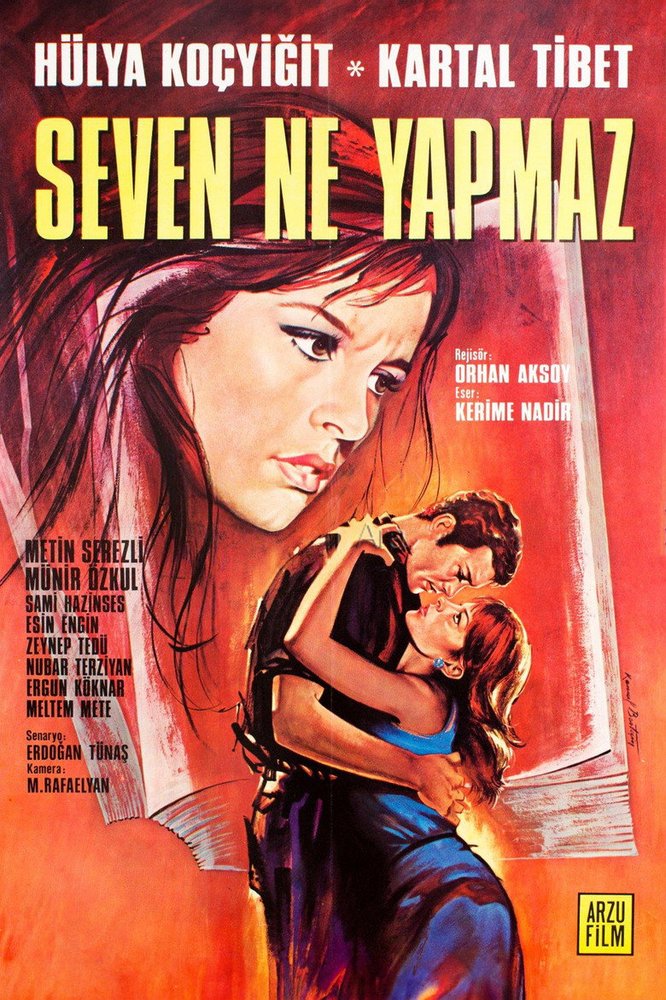
What Wouldn't a Lover Do? (Seven Ne Yapmaz)

What Wouldn't a Lover Do? (Seven Ne Yapmaz) (translated)

Movie · 1970 · 9 people

Music plays a central part in Seven Ne Yapmaz, a romantic drama and Turkish film from 1970. It was directed by Orhan Aksoy from a screenplay by Erdoğan Tünaş, who adapted a work by Kerime Nadir. Arzu Film produced it, with Nahit Ataman as producer. Hülya Koçyiğit and Kartal Tibet play the leads.

The story centres on Fikret, a young musician who arrives in Istanbul to join an orchestra put together by his army comrades. His first job is to play at the birthday party of Sevda, the fiancée of a rich shipowner named Osman. He then takes a nightclub job, where Sevda comes to hear him. Osman notices the bond and hurts Fikret, and for that reason Sevda leaves her fiancé and starts a new relationship with the musician. Refusing to accept the loss, Osman tries to pull the couple apart. The film deals with two lovers who are separated and, in time, brought back together.

Hülya Koçyiğit plays Sevda, Kartal Tibet is Fikret and Metin Serezli is Osman. The supporting cast includes Münir Özkul as Kazım Baba, Nubar Terziyan as Ferit Bey, and Zeynep Tedü. The music is by Metin Bükey and the cinematography by Mike Rafaelyan. As was usual then, Kartal Tibet was dubbed by Hayri Esen and Hülya Koçyiğit by Jeyan Mahfi Tözüm.

DirectorOrhan Aksoy
Production companyArzu Film

Reactions

You can pick up to 3 reactions.

Cast

Through different eyes

Yeşilçam Nostalgic A viewer raised on the classics, looking for warm storytelling and strong acting.

Pairing Hülya Koçyiğit and Kartal Tibet in a Kerime Nadir adaptation means capturing the very heart of Yeşilçam's romantic vein. Separated lovers, a jealous rich rival in the way, a longing that makes them wait for reunion: for audiences of those years this pattern was a familiar but heartfelt fairy tale. Putting music at the centre of the story, with the hero performing on a nightclub stage, gives the film the warm air of its era. Today's eyes may find it naive, but the faith in loyalty and devotion inside that naivety is what still makes the old films precious.

History & Society Lens Asks about the period, the social background and what the work reflects.

The story's conflict rests on a familiar contrast of 1970s Turkey: a wealthy shipowner on one side, a young musician trying to earn a living with an orchestra his army friends put together on the other. Fikret coming to Istanbul for work and a future reflects the period's movement towards the big city, while the nightclub stands out as a place of both entertainment and contact between classes. Osman's refusal to accept being left, and his efforts to split the couple, show the power money seeks over relationships. The film may not interrogate that contrast in depth, but it is a good window onto the values of its time.

Cinephile Looks at script, editing and directing choices; keeps a distance from formula films.

Erdoğan Tünaş's screenplay, adapted from Kerime Nadir, sticks to the familiar skeleton of the period's romantic melodramas: separation, an ill-intentioned rival, a long-delayed reunion. The skeleton is sound but leaves little room for surprise, and a character like Osman runs a high risk of remaining a one-dimensional obstacle. Building the music into the story is a smart move, since the nightclub scenes draw their justification from the narrative itself, though the song numbers can stall it at times. Then there is the dubbing practice of the day: Hayri Esen voicing Kartal Tibet and Jeyan Mahfi Tözüm voicing Hülya Koçyiğit is a reminder that the performances on screen are really the joint work of two artists, which has to be factored in when judging the acting.

These are not reader reviews: they are short editorial takes written from different viewer perspectives with AI assistance. Reader reviews are below.

Reviews (0)

Log in Log in to write a review.

Comments