My Sweet Pepper Land (Tatlı Biber Diyarım)

My Sweet Pepper Land (Tatlı Biber Diyarım) (translated)

Movie · 2013 · 4 people

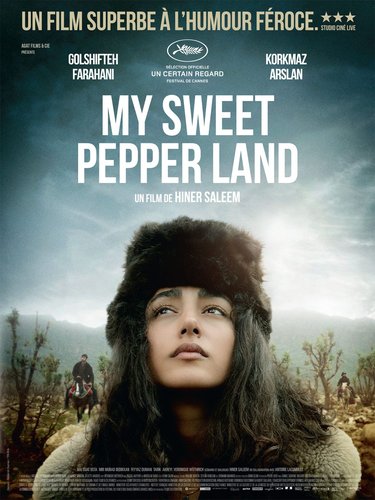
A 2013 drama, My Sweet Pepper Land (Tatlı Biber Diyarım) was written and directed by the Kurdish-born, France-based Hiner Saleem together with Véronique Wüthrich. A co-production of Iraq, France and Germany, it is shot mainly in Kurdish, with some Arabic and Turkish dialogue. The film is reported to have cost 2.6 million euros. It screened in the Un Certain Regard section of the 2013 Cannes Film Festival and was nominated at the Asia Pacific Screen Awards for directing and for best actress.

The story is set around the fall of Saddam Hussein, in a remote region where Iran, Turkey and Iraq meet. Baran (Korkmaz Arslan), a former Peshmerga who has finished his duty in Erbil, takes a new post in this tense border village, but the locals do not want him. Determined to solve problems, he meets Govend (Golshifteh Farahani), a young teacher shunned by her community. Both work for the freedom of their own people, and the partnership grows into a fragile closeness and a love story. Suat Usta, as Reber, and Mir Murad Bedirxan, as Tajdin, also appear.

DirectorHiner Saleem

Reactions

You can pick up to 3 reactions.

Cast

Through different eyes

AI-assisted editorial takes written from different viewer perspectives. They are not reader reviews; those are below.

Cinephile Looks at script, editing and directing choices; keeps a distance from formula films.

Hiner Saleem leans on a classic template to tell the story of a former peshmerga arriving in a tense border village and a teacher shunned by her own people: a stranger comes to town and the established order pushes back. The skeleton is familiar, but the film makes it interesting by moving it to a corner squeezed between three borders, where Kurdish, Arabic and Turkish overlap. Its selection for Cannes' Un Certain Regard and its directing nomination at the Asia Pacific Screen Awards suggest that this offbeat tone found its audience. The balance between the love story and the struggle to impose order is not always found; the latter promises the stronger conflict, yet the film at times leans too heavily on the romance.

History & Society Lens Asks about the period, the social background and what the work reflects.

The film reads the days of Saddam Hussein's fall from a remote village where the borders of Iran, Turkey and Iraq meet, asking how a great political upheaval reaches the lives of people on the margins. What is striking is the resistance the locals show the newcomer just as a new order is meant to take hold: change may be declared in the capital, but it does not simply arrive in a border village. A young woman who teaches in the village and is shunned by her own people also puts gender at the heart of the story. Its most valuable point is the suggestion that freedom does not mean the same thing for a people as for a woman within that people.

Action & Thriller Fan Puts pace, tension and set pieces first; little patience for slow drama.

A former peshmerga fresh from his post in Erbil, a new assignment nobody wants him in, and a border village running on high tension: tailor-made for a thriller. But the film turns that set-up into a fragile drama of love and resistance rather than a showdown. The pace is quiet; its real strength is the atmosphere.

Reviews (0)

Log in Log in to write a review.

Comments