Lili Marleen

Lili Marleen

Movie · 1981 · 15 people

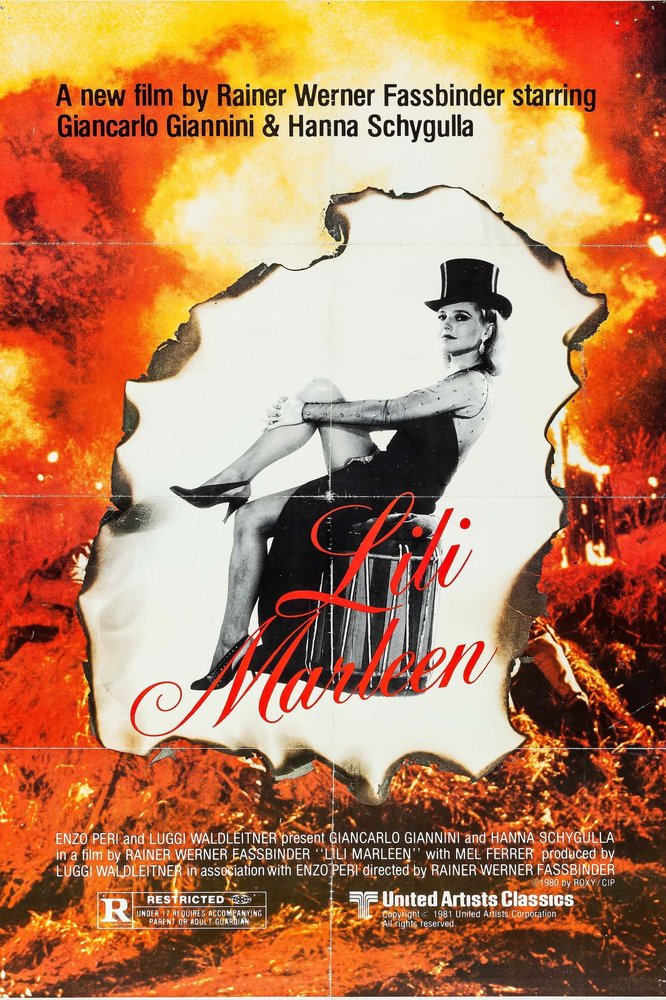
Rainer Werner Fassbinder directed Lili Marleen, a West German drama from 1981. Running about two hours, it joins a Third Reich love story to a singer's rise to fame. It draws very freely on Der Himmel hat viele Farben, the memoir of Lale Andersen, the first singer of the song of the title.

The story opens in 1938. Willie, a young German singer played by Hanna Schygulla, falls for Robert Mendelsson, a Jewish composer and conductor from Zurich who belongs to a circle helping Jews flee Germany. Willie wants to stay but has to return to Germany, where her song is heard by soldiers on both sides throughout the war, and she becomes the darling of the nation; fame and war, however, pull the lovers apart. Giancarlo Giannini and Mel Ferrer are the prominent names beside Schygulla, and Udo Kier is also in the cast.

The leads are modelled on Lale Andersen and the Swiss composer Rolf Liebermann. Hans Leip wrote the song's words in 1938 and Norbert Schultze composed the tune; it was hugely popular with soldiers on both sides in the Second World War. Fassbinder wrote the screenplay with Joshua Sinclair. Andersen's last husband, Arthur Beul, said the film bears little relation to her real life.

DirectorRainer Werner Fassbinder

Reactions

You can pick up to 3 reactions.

Cast

Only cast members with a profile on this site are listed.

Hanna Schygulla Hanna Schygulla Actor · 82 years old Udo Kier Udo Kier Actor · died at 81 Giancarlo Giannini Mel Ferrer Karl-Heinz von Hassel Erik Schumann Hark Bohm Gottfried John Willy Harlander Karin Baal Christine Kaufmann Roger Fritz Adrian Hoven Alexander Allerson Barbara Valentin

Through different eyes

Cinephile Looks at script, editing and directing choices; keeps a distance from formula films.

Fassbinder makes a song the engine of the story: the same tune being heard by soldiers on both sides of the front binds a love story to the machinery of fame and propaganda. It is a strong structural idea that lets him use the melodrama mould while also questioning it. The very free use of Lale Andersen's memoir should be read as a choice, not a flaw; the film is less a biography than a parable about the bargain fame strikes with a regime. Even so, over nearly two hours the love strand and the fame strand don't always carry equal weight, and the script seems at times to concede to a flatter kind of storytelling.

History & Society Lens Asks about the period, the social background and what the work reflects.

The most thought-provoking side of Lili Marleen is the place of popular culture in wartime. While one song is loved by German and Allied soldiers alike, the woman who sings it becomes the darling of the nation in Nazi Germany. The film centres on the contradiction of a singer turned into the regime's showpiece while the man she loves belongs to a circle helping Jews escape, and the question of an artist's complicity cannot be avoided. But this is no historical record: Andersen's last husband, Arthur Beul, said the film had little to do with her real life, a reminder of the limits of fiction inspired by real people.

Yeşilçam Nostalgic A viewer raised on the classics, looking for warm storytelling and strong acting.

Two lovers parted by war and a song on everyone's lips: on paper, a melodrama setup Yeşilçam loved as well. With Hans Leip's words and Norbert Schultze's melody, Lili Marleen was a song cherished on both sides of the front, and it is fitting that it carries the film's emotional core. Yet here love is told in the shadow of Nazi Germany and at the price of fame. Lovers of classic cinema hoping for a warm tale of reunion may find themselves in a much darker, more unforgiving world.

These are not reader reviews: they are short editorial takes written from different viewer perspectives with AI assistance. Reader reviews are below.

Reviews (0)

Log in Log in to write a review.

Comments