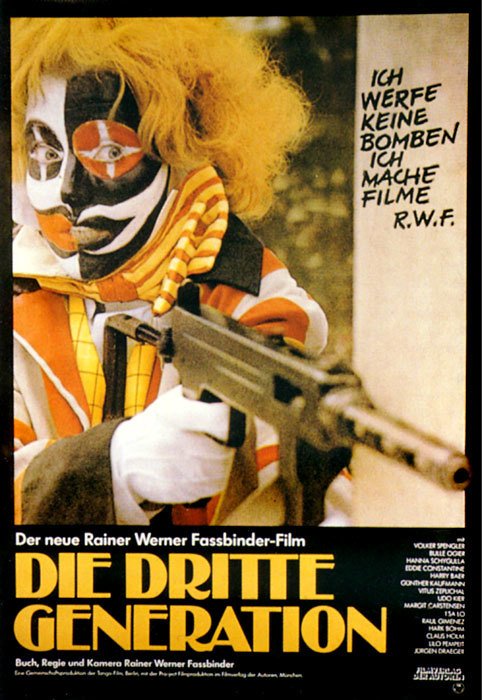
The Third Generation

The Third Generation (Die dritte Generation)

Movie · 1979 · 15 people

Rainer Werner Fassbinder completed the black comedy Die dritte Generation (The Third Generation) in West Germany in 1979. It satirises the extreme left-wing terrorism that preoccupied Europe in the late 1970s, mixing crime-film mechanics with political mockery. The picture runs about 105 minutes and premiered at the Cannes Film Festival on 13 May 1979.

The story is set in Berlin, where a cell of underground militants plots to kidnap an industrialist, only for their scheming to come to nothing and leave the group ineffectual. The group is made up of Berlin intellectuals. The cast includes Hanna Schygulla, Margit Carstensen, Eddie Constantine, Bulle Ogier, Harry Baer and Udo Kier, with Günther Kaufmann, Volker Spengler and Hark Bohm also appearing.

Fassbinder wrote the screenplay and, besides directing, served as his own cinematographer. Shooting ran between 1978 and 1979. The film reflects the director's impressions of the Red Army Faction (RAF). Billed in its subtitle as a "comedy in six parts" about social games, full of suspense and logic, cruelty and madness, it opens each part with an epigraph taken from graffiti in a public restroom.

DirectorRainer Werner Fassbinder

Reactions

You can pick up to 3 reactions.

Cast

Only cast members with a profile on this site are listed.

Hanna Schygulla Hanna Schygulla Actor · 82 years old Udo Kier Udo Kier Actor · died at 81 Margit Carstensen Eddie Constantine Bulle Ogier Harry Baer Günther Kaufmann Liselotte Eder Volker Spengler Vitus Zeplichal Y Sa Lo Hark Bohm Claus Holm Jürgen Draeger Peer Raben
Through different eyes

Cinephile Looks at script, editing and directing choices; keeps a distance from formula films.

Fassbinder does not just write the script here; he also serves as his own cinematographer, and the film's deliberately scattered, layered texture bears the mark of a single hand. Opening each part with an epigraph from public-restroom graffiti and billing itself as a comedy in six parts are the first signs of the ironic distance it keeps from the audience. Hollowing out the crime-film template around a group whose action never comes off is a bold move; the tension comes from absurdity rather than action. That is also where the drawback lies: the irony is so rigid that getting close to the characters is nearly impossible. Impressive as an intellectual experiment, but deliberately cold, and not a film that rewards everyone's patience.

History & Society Lens Asks about the period, the social background and what the work reflects.

The film was made in the thick of the far-left terrorism that preoccupied Europe in the late 1970s, and it reflects the director's impressions of the Red Army Faction. Fassbinder's choice is striking: he shows the militants not as romantic heroes or frightening enemies but as Berlin intellectuals whose plans never work. Choosing an industrialist as the target puts the relationship between capital and armed opposition at the centre of the satire. As its subtitle suggests, the film invites us to read political violence as part of a kind of social game rather than an ideal. For anyone curious about West Germany at the time, a contentious but thought-provoking testimony.

Action & Thriller Fan Puts pace, tension and set pieces first; little patience for slow drama.

On paper it has everything: underground militants, a plan to kidnap an industrialist, the streets of Berlin. But anyone expecting a tight thriller will be let down. Fassbinder builds a satire in which the plans fail and the group never quite gets moving; irony takes the place of excitement. If you want fast pacing, chases or a big climax, it is too talky and scattered. If political black comedy is your thing, that is another matter.

These are not reader reviews: they are short editorial takes written from different viewer perspectives with AI assistance. Reader reviews are below.

Reviews (0)

Log in Log in to write a review.

Comments