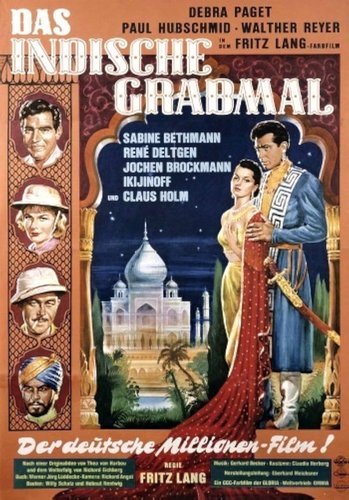
The Indian Tomb (Das indische Grabmal)

The Indian Tomb (Das indische Grabmal)

Movie · 1959 · 14 people

A 1959 adventure picture from Fritz Lang, Das indische Grabmal (The Indian Tomb) was a co-production of West Germany, Italy and France. It forms the back half of Lang's two-part "Indian Epic": the story begins in The Tiger of Eschnapur, released the same year, and picks up exactly where that film stops. Producer Artur Brauner's CCC Film made it, and it first played on March 5, 1959, at the Universum cinema in Stuttgart.

The story comes from a novel written in 1918 by Lang's former wife Thea von Harbou, which had already been filmed in 1938 by Richard Eichberg. The screenplay is credited to Lang, Werner Jörg Lüddecke and von Harbou. Debra Paget, Paul Hubschmid, Walther Reyer, Claus Holm, Valéry Inkijinoff and Sabine Bethmann lead the cast.

Interiors were shot at the Spandau studios in West Berlin, on sets designed by art directors Helmut Nentwig and Willy Schatz. In 1960 American International Pictures took the rights to both films and merged them into one heavily cut, 90-minute feature, Journey to the Lost City, which grossed $500,000 in the United States. Once both parts had been dubbed into Spanish, they were exhibited as two separate films, the second a direct continuation of the first.

DirectorFritz Lang
Production companyCCC Film

Reactions

You can pick up to 3 reactions.

Cast

Names without a link have no profile here yet.

Guido Celano Guido Celano Actor · died at 83 Gen. Dagh Debra Paget Paul Hubschmid Walther Reyer Claus Holm Valéry Inkijinoff Sabine Bethmann René Deltgen Jochen Brockmann Richard Lauffen Jochen Blume Luciana Paluzzi Victor Francen Panos Papadopulos

Through different eyes

AI-assisted editorial takes written from different viewer perspectives. They are not reader reviews; those are below.

Cinephile Looks at script, editing and directing choices; keeps a distance from formula films.

Shooting the interiors on designed sets at the Spandau studios defines both the film's strength and its limit: the India on screen is less a real place than a stylized fairy-tale stage. That artifice gives Lang's framing an architectural order, though to an eye looking for realism it may feel like cardboard. The main warning is this: the film does not stand alone but picks up exactly where The Tiger of Eschnapur stops, so starting here means joining the story halfway. It is also best to avoid the version in which American International Pictures merged both films and cut them down; the pair can only be judged fairly as a whole.

Action & Thriller Fan Puts pace, tension and set pieces first; little patience for slow drama.

Lost cities, tombs, adventure in distant lands: the idea of an Indian Epic still sounds cool today. But to be honest, for anyone used to modern pacing, adventure films of the 1950s usually move at a much calmer rhythm, with long, drawn-out scenes. An interesting stop for those curious about where the genre came from; for pure adrenaline seekers it may feel heavy.

History & Society Lens Asks about the period, the social background and what the work reflects.

A 1959 film about India, co-produced by West Germany, Italy and France, inevitably also reflects how Europe looked at the East. It is striking that the story comes from a novel written in 1918 and had already been filmed in 1938: the same exotic imagery was reproduced in German cinema across four decades. An India built in a studio stages less a real country than the East a European audience imagined. Keeping that orientalist frame in mind lets you take the film not only as an adventure but as a document of a period's outlook.

Reviews (0)

Log in Log in to write a review.

Comments