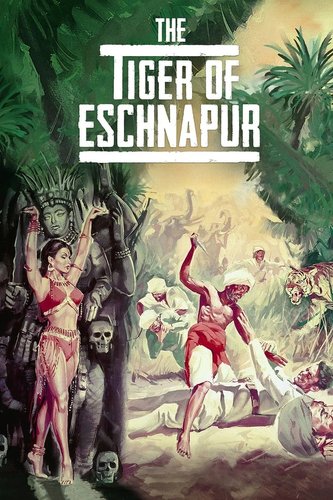
The Tiger of Eschnapur (Der Tiger von Eschnapur)

The Tiger of Eschnapur (Der Tiger von Eschnapur)

Movie · 1959 · 14 people

Der Tiger von Eschnapur (The Tiger of Eschnapur) is a 1959 German-Italian-French adventure drama about a German architect who comes to India to build for a maharaja, and the dancer who comes between the two men. Fritz Lang directed it. With this film and its sequel Lang returned to directing in Germany; together the two make up the work known as his "Indian Epic".

The maharaja has commissioned schools and hospitals, and the dancer is a Eurasian woman whose presence changes both men's lives. The first sets it up and Das indische Grabmal (The Indian Tomb) follows, released in March 1959. The cast includes Debra Paget, Paul Hubschmid, Walther Reyer, René Deltgen, Luciana Paluzzi, Sabine Bethmann and Guido Celano.

The film is a heavily altered remake of the two-part 1921 silent classic Das indische Grabmal and of the 1938 Der Tiger von Eschnapur, and draws on Thea von Harbou's novel. Lang, Werner Jörg Lüddecke and von Harbou share screenplay credit. It premiered on January 21, 1959, at the Palast-Theater in Hanover, and parts were shot in India among the palaces and scenery of Udaipur in Rajasthan.

DirectorFritz Lang

Reactions

You can pick up to 3 reactions.

Cast

Names without a link have no profile here yet.

Guido Celano Guido Celano Actor · died at 83 Debra Paget Luciana Paluzzi Paul Hubschmid Claus Holm Sabine Bethmann Walther Reyer René Deltgen Jochen Brockmann Valéry Inkijinoff Richard Lauffen Jochen Blume Victor Francen Alexander Golling

Through different eyes

AI-assisted editorial takes written from different viewer perspectives. They are not reader reviews; those are below.

Cinephile Looks at script, editing and directing choices; keeps a distance from formula films.

This film should be thought of not on its own but as one half of a two-part whole with Das indische Grabmal; as the first part, its main job is to set up the story and the characters. So the sense of an unfinished structure that never reaches its own climax is understandable, but still a weakness. Lang marking his return to Germany with material inherited from the silent era is a meaningful choice; rebuilding a familiar story, he seems to put the weight on the visuals rather than the narrative. The location shooting among the palaces of Udaipur adds a texture no studio set could give. The naivety of the romantic-adventure template may look dated today; still, for anyone after a visual feast, it is a fairy tale from Lang's hand.

History & Society Lens Asks about the period, the social background and what the work reflects.

A German architect coming to India to build schools and hospitals on a maharaja's commission frames the film's world through European eyes from the outset. The East is told through palaces, exotic scenery and a Eurasian dancer caught between two men, a textbook case of the orientalist frame Western cinema long used when looking at India. That the material goes back to the 1921 silent classic and to Thea von Harbou's novel also explains why the gaze stays in such old molds. It is worth watching with that frame in mind today; the film is a document less about India than about Europe's dream of India.

Action & Thriller Fan Puts pace, tension and set pieces first; little patience for slow drama.

Despite the adventure label, this is a romantic melodrama first. The palaces, the exotic locations and the tiger in the title promise thrills, but the story builds slowly around the tension between two men and a dancer. And as the first half of a two-part whole, the real showdown seems saved for the sequel. Pace seekers get palaces and romance in this first part; the showdown needs the second film.

Reviews (0)

Log in Log in to write a review.

Comments