Satyricon

Satyricon (Fellini Satyricon)

Movie · 1969 · 3 people

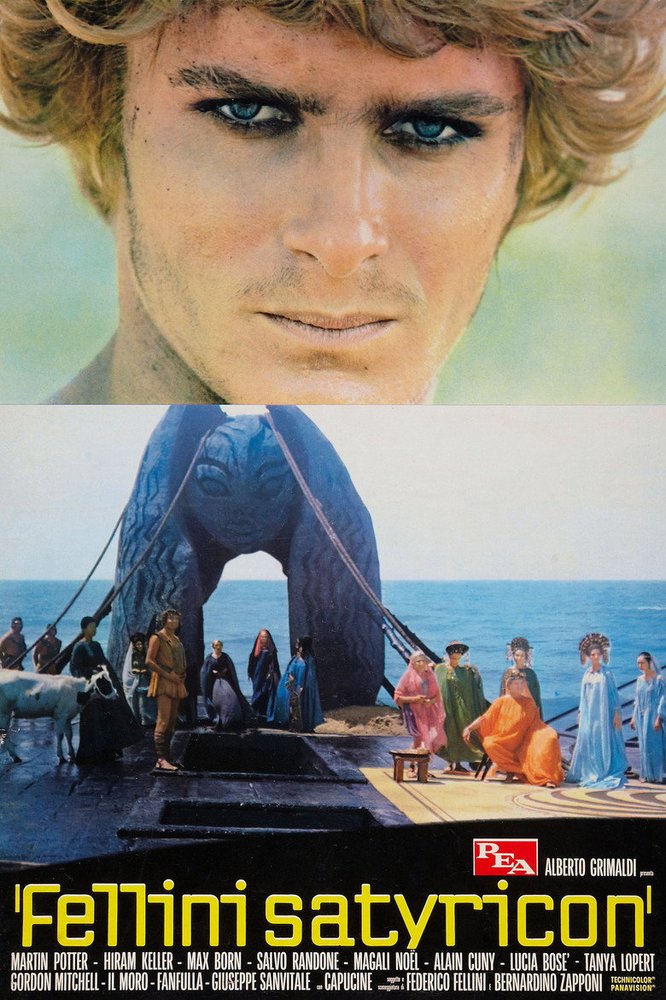
Federico Fellini directed Satyricon (Fellini Satyricon), a 1969 Italian-French film that many count among his strangest; he described it as a mysterious, suggestive fairy tale. It treats the debauchery of pre-Christian Rome as an analogue of the modern age. It was entered in the 30th Venice International Film Festival, where it won the Pasinetti Award.

The source is the satirical work Satyricon by the Roman writer Petronius, who lived under Nero and whose text survives only in fragments. Fellini adapted it very freely, in nine episodes. Encolpius (Martin Potter) and his friend Ascyltus (Hiram Keller) try to win the heart of the young Gitón (Max Born) in a surreal Roman landscape. Their path runs through pleasure-loving company and conversations about religion, life and sexuality. The cast also includes Salvo Randone, Magali Noël, Capucine, Alain Cuny, Gordon Mitchell and George Eastman.

Fellini wrote the script with Bernardino Zapponi and Brunello Rondi; Alberto Grimaldi produced, and filming took place at Cinecittà. Giuseppe Rotunno was the cinematographer, Ruggero Mastroianni the editor and Nino Rota the composer, with the Turkish composer İlhan Mimaroğlu contributing to the music. The film earned Fellini his third Oscar nomination for Best Director and a Golden Globe nomination for Best Foreign Language Film. It is also known as The Degenerates.

DirectorFederico Fellini
Production companyProduzioni Europee Associati

Reactions

You can pick up to 3 reactions.

Cast

Only cast members with a profile on this site are listed.

Through different eyes

Cinephile Looks at script, editing and directing choices; keeps a distance from formula films.

Perhaps Fellini's strangest film. Satyricon, which he described as a mysterious, suggestive fairy tale, turns Petronius's text, surviving only in fragments, into a loose nine-episode structure. The fragmentation is deliberate: in place of narrative continuity there is a dream logic carried by Giuseppe Rotunno's images and a surreal Rome built at Cinecittà. Ruggero Mastroianni's editing sets the episodes side by side rather than linking them, which at times makes the film tiring and disjointed. Nino Rota's score, with a contribution from İlhan Mimaroğlu, creates an unusual sound world. Spellbinding for viewers who want images more than story; a test of patience for anyone expecting conventional narrative.

Family Viewer Asks whether the whole household can watch it; cares about humour and heart.

This is in no way a family film. It deals with debauchery, sexuality and excess in ancient Rome, and many will find it very strange and unsettling. I wouldn't recommend watching it with children, or even teenagers. Adults who love art-house cinema may find it a unique experience, but if you want something to watch together as a family, pick another film.

Yeşilçam Nostalgic A viewer raised on the classics, looking for warm storytelling and strong acting.

Say Fellini and one first thinks of that poetic, humane world; Satyricon shows a completely different face. Nino Rota's music reaches out like a familiar hand, yet the film's cold, strange atmosphere rarely touches the heart. Using the debauchery of pre-Christian Rome as a mirror of the modern age is thought-provoking, but it is hard to connect with the characters. It deserves respect as a bold experiment by a master; in my heart, though, other Fellini films stand higher.

These are not reader reviews: they are short editorial takes written from different viewer perspectives with AI assistance. Reader reviews are below.

Reviews (0)

Log in Log in to write a review.

Comments