La Femme et le Pantin

La Femme et le Pantin

Movie · 1959 · 3 people

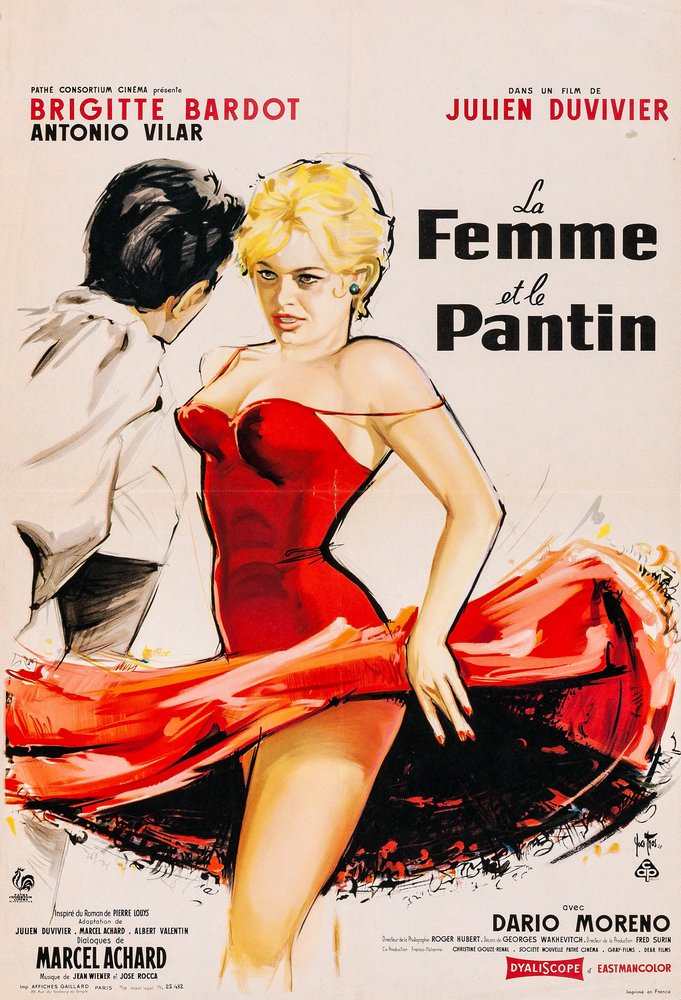
Julien Duvivier directed La Femme et le Pantin (The Female; Italian title Femmina), a French-Italian drama from 1959. It is the fourth film adaptation of Pierre Louÿs's 1898 novel The Woman and the Puppet, filmed in 1935 with Marlene Dietrich as Der Teufel ist eine Frau. In Britain and the Philippines it was released as A Woman Like Satan. Marcel Achard, Duvivier and Albert Valentin wrote the screenplay.

The story is set in Spain. Matteo Diaz, a man of influence and advancing years, falls for Eva, a young dancer who is the daughter of the former writer Stanislas Marchand. At first she gives his love no answer. Matteo does everything for her until he has forgotten his dignity, and in the end Eva surrenders to him. Brigitte Bardot plays Eva, António Vilar is Matteo, Lila Kedrova is Manuela and Jacques Mauclair is Stanislas; Dario Moreno, Jess Hahn and Dominique Zardi also appear.

The part let Bardot meet the expectations the wider public attached to her image. Many then saw her as the embodiment of the femme fatale, so everyone senses the ending from the start. Eva walks the streets proudly so that her attractiveness is noticed, and she clearly knows it, while the unlucky Matteo does not even try to hide his obsession.

DirectorJulien Duvivier

Reactions

You can pick up to 3 reactions.

Cast

Only cast members with a profile on this site are listed.

Through different eyes

Cinephile Looks at script, editing and directing choices; keeps a distance from formula films.

Directed by Julien Duvivier, this is the fourth screen adaptation of Pierre Louÿs's novel, and it inevitably competes with the shadow of the 1935 version starring Marlene Dietrich. The screenplay by Marcel Achard, Duvivier and Albert Valentin moves the story to Spain and traces the line between passion and lost dignity. The film is built largely on Brigitte Bardot's image, and Bardot lives up to what that image promised. That is exactly where the problem starts: the femme fatale mould is fixed so firmly from the outset that dramatic curiosity weakens and you sense early on where things are heading. António Vilar's Matteo tries to carry the pitiable side of a man who makes no effort to hide his obsession. The work of a master director, but one that polishes the genre's clichés more than it transcends them.

Yeşilçam Nostalgic A viewer raised on the classics, looking for warm storytelling and strong acting.

For those who love the heavy, velvety air of old European cinema, Duvivier's name alone is a guarantee. Bardot's Eva is a proud, alluring young woman who gets herself noticed simply by the way she walks down the street, while Matteo is a man so surrendered to his passion that he forgets his dignity. Stories like this also bring to mind the lovelorn heroes of Yeşilçam. To be frank, though, the film doesn't quite reach the heart; you pity the characters but find it hard to connect with them. In portraying the destructiveness of passion, it lacks a little warmth. Still, for those who know Pierre Louÿs's novel, it is an intriguing adaptation.

History & Society Lens Asks about the period, the social background and what the work reflects.

This 1959 film is an interesting document of how women were imagined at the time. For the wider public, Bardot was then the very embodiment of the femme fatale, and the film is built on that image. Set in Spain, the relationship between an influential man of advancing years and the young dancer daughter of a former writer can be read in terms of power, age and gender. Eva walking proudly through the streets, well aware of her allure, suggests a woman who directs the gaze rather than merely being its object. Even so, the film never really frees her from the mould of the seductress, and to today's eyes that outlook looks quite dated.

These are not reader reviews: they are short editorial takes written from different viewer perspectives with AI assistance. Reader reviews are below.

Reviews (0)

Log in Log in to write a review.

Comments