Dava

The Trial (Dava)

Movie · 1962 · 3 people

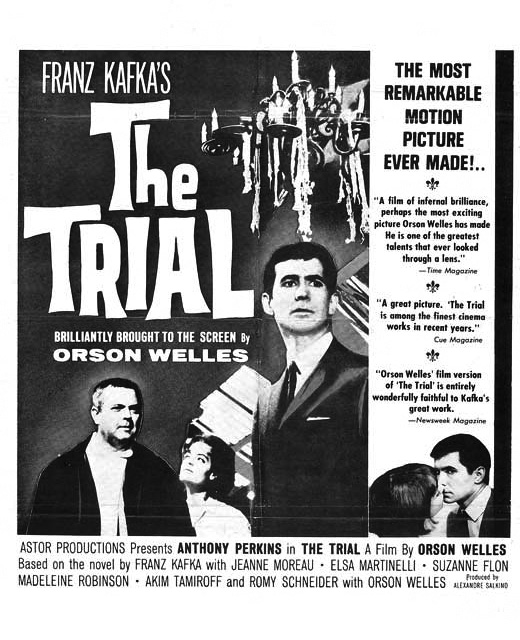
Dava (Le Procès, released in the US as The Trial) is Orson Welles's 1962 black-and-white adaptation of Kafka's posthumously published 1925 novel, a French, West German and Italian co-production. Welles wrote the script; Alexander Salkind produced. The film opens with Welles telling Kafka's parable "Before the Law" over pinscreen images made by Alexandre Alexeieff and Claire Parker. The roughly 118-minute film premiered on December 22, 1962, through Astor Pictures.

Josef K. (Anthony Perkins), a bank clerk, wakes to policemen in his room and learns he is being prosecuted; nobody names the charge. Trying to prove his innocence, he is pulled into a suffocating, illogical bureaucracy. Jeanne Moreau (Marika Burstner), Romy Schneider (Leni) and Elsa Martinelli (Hilda) play women who enter his life and case; Welles plays his lawyer, the chief antagonist. Akim Tamiroff and Michael Lonsdale also appear.

For the shoot, the abandoned Gare d'Orsay in Paris became a giant courtroom, whose black-and-white images set the gloomy mood. Edmond Richard shot it; Jean Ledrut composed. It cost $1.3 million and grossed $998,779. Welles called it his best film right after finishing it; reactions on release were mixed, but its standing has grown, and Roger Ebert is among those calling it a masterpiece.

DirectorOrson Welles
Production companyParis-Europa Production, Hisa-Film, Finanziaria Cinematografica Italiana

Reactions

You can pick up to 3 reactions.

Cast

Only cast members with a profile on this site are listed.
Through different eyes

Cinephile Looks at script, editing and directing choices; keeps a distance from formula films.

Orson Welles's Kafka adaptation is a daring work that builds bureaucracy's absurdity through space and image more than through plot. Turning the abandoned Gare d'Orsay into a giant courtroom, together with Edmond Richard's black-and-white photography, creates a suffocating atmosphere. The parable 'Before the Law', told over Alexeieff and Parker's pinscreen images at the opening, sets the tone from the start. Anthony Perkins's Josef K. carries the helplessness of a man trying to defend himself against a charge nobody names, and Welles casting himself as the lawyer, the chief antagonist, is an intriguing choice. Reactions on release were mixed, but its standing has grown over time. The unbroken nightmare logic may tire some viewers; it remains an ambitious piece of cinema.

History & Society Lens Asks about the period, the social background and what the work reflects.

The Trial is about the individual's helplessness before a system he cannot make sense of. A bank clerk prosecuted without ever being told the charge is a powerful allegory of how modern bureaucracy can isolate a person. Kafka's novel, published posthumously in 1925, is carried by Welles some forty years later into the Europe of the sixties, and the fact that it is a French, West German and Italian co-production brings to mind the anxieties post-war Europe shared. An abandoned railway station turned into a courtroom is a striking image of public space handed over to institutional power. The film still prompts thought today about law and individual rights.

Action & Thriller Fan Puts pace, tension and set pieces first; little patience for slow drama.

Honestly, this is not an easy watch for thriller fans. A man is put on trial without knowing the charge and gets lost inside the system; the idea is brilliant and promises nightmare-level tension. But across roughly 118 minutes of dialogue and strange bureaucratic mazes, the pace can sag a lot. The black-and-white images are impressive, but pick a day when you're feeling patient.

These are not reader reviews: they are short editorial takes written from different viewer perspectives with AI assistance. Reader reviews are below.

Reviews (0)

Log in Log in to write a review.

Comments