Monsieur Klein

Monsieur Klein

Movie · 1976 · 3 people

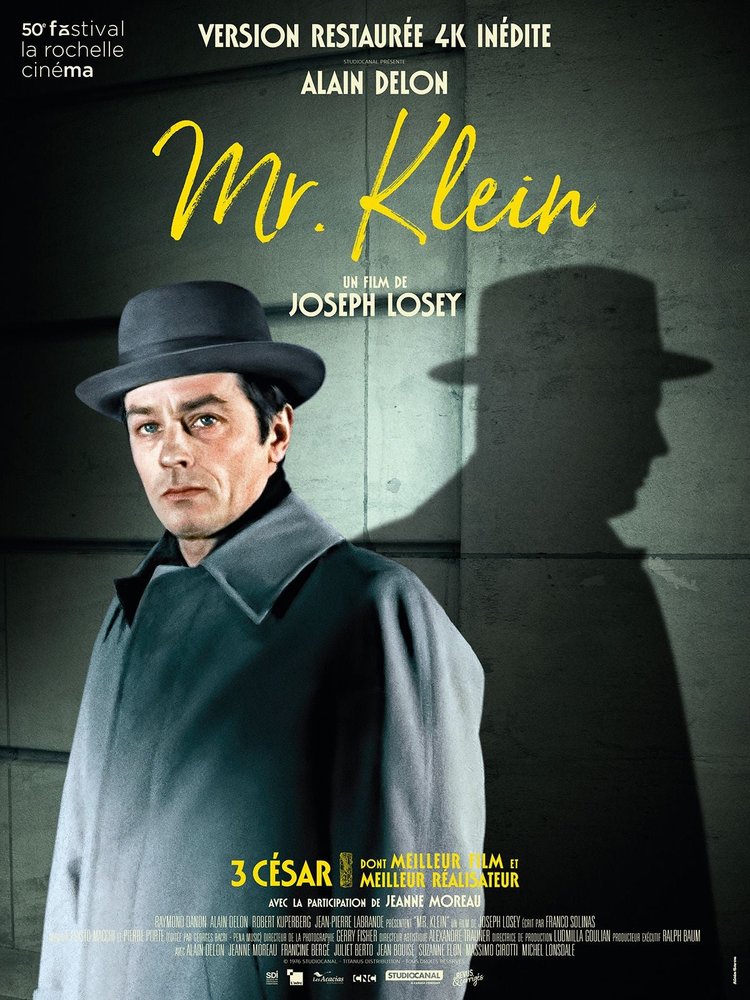
Alain Delon both stars in and co-produced Monsieur Klein, a French-Italian mystery drama that Joseph Losey directed in 1976; other sources classify it as a drama and crime film. Costa-Gavras began the screenplay and Franco Solinas completed it. The film premiered at the Cannes Film Festival in 1976, where it competed for the Palme d'Or at the 29th edition; the prize went to Taxi Driver. It opened in France on 27 October 1976. The 123-minute film drew wide critical acclaim and won three César Awards at the 1977 ceremony: Best Film, Best Director (Losey) and Best Production Design (Alexandre Trauner). Delon was nominated for Best Actor.

The story is set in occupied France, in Paris. Its hero, Robert Klein, is an apparently Gentile art dealer who is mistaken for a Jewish man of the same name and cannot prove who he is. That uncertainty pulls him toward the machinery of the Holocaust. The narrative has a Kafkaesque air. Jeanne Moreau plays Florence and Michael Lonsdale is in the cast; Juliet Berto, Suzanne Flon, Massimo Girotti, Michel Aumont, Jean Bouise and Gérard Jugnot also appear.

DirectorJoseph Losey

Reactions

You can pick up to 3 reactions.

Cast

Only cast members with a profile on this site are listed.

Through different eyes

Cinephile Looks at script, editing and directing choices; keeps a distance from formula films.

Joseph Losey's film treats mistaken identity not as a suspense game but as a Kafkaesque nightmare. Mistaken for a Jewish man who shares his name, Robert Klein draws closer to the machine the longer he fails to prove who he is, and the story's real tension comes from that uncertainty. The script, begun by Costa-Gavras and finished by Franco Solinas, moves forward through questions rather than answers. That Alexandre Trauner's production design won a César shows the care taken in recreating occupied Paris. Delon's decision to produce as well as star suggests how much he believed in this difficult project. The 123-minute length and deliberate ambiguity may tire some viewers, but that fatigue is part of what the film means.

History & Society Lens Asks about the period, the social background and what the work reflects.

Monsieur Klein uses a case of mistaken identity to make us think about how the persecution of Jews in occupied Paris ran through bureaucracy. An apparently Gentile art dealer's inability to prove who he is shows how frightening an order can be when identity is reduced to a document, a record. The film's Kafkaesque air invites us to see the machinery of the Holocaust less as the wickedness of individuals than as a system that simply runs. That raises an uncomfortable question about where ordinary people stood in relation to such an order during the war years. For those curious about this dark chapter of history, it is heavy but illuminating.

Yeşilçam Nostalgic A viewer raised on the classics, looking for warm storytelling and strong acting.

Seeing Alain Delon and Jeanne Moreau in the same film is a feast in itself for lovers of older cinema. But Monsieur Klein is not a warm film; to eyes used to Yeşilçam's tender dramas it may feel cold, distant and rather heavy. The story of a man in occupied Paris who cannot prove his identity is the kind of nightmare anyone who has read Kafka will recognise. Expect no emotional consolation; expect a moral jolt. A work that competed at Cannes and won three Césars, it does not let the patient viewer leave without thinking.

These are not reader reviews: they are short editorial takes written from different viewer perspectives with AI assistance. Reader reviews are below.

Reviews (0)

Log in Log in to write a review.

Comments