Beau Travail

Beau Travail

Movie · 1999 · 10 people

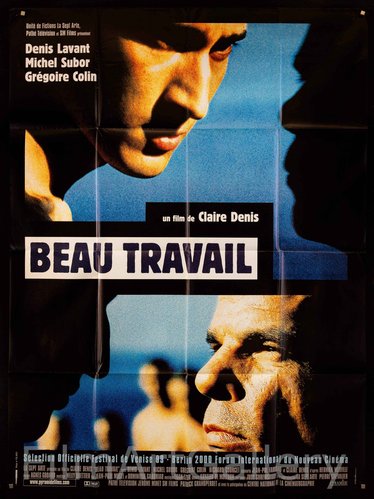
Claire Denis directed Beau Travail, a French psychological drama from 1999. Denis co-wrote the screenplay with Jean-Pol Fargeau, moving Herman Melville's novella Billy Budd, written in 1888, into the present. With its almost dialogue-free storytelling and poetic imagery it is counted among the most respected works of arthouse cinema; Sight and Sound's 2022 poll ranked it seventh best film of all time.

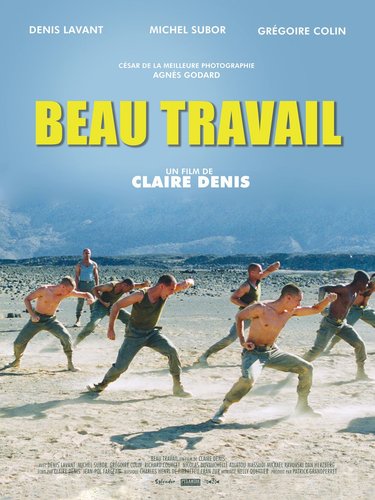
The story is set among French Foreign Legion soldiers training in the desert of Djibouti. Its narrator is the former officer Galoup (Denis Lavant), who recalls from Marseille his hard but happy days and his admiration for his commander Bruno Forestier (Michel Subor). When Sentain (Grégoire Colin), a promising young recruit, joins the unit, jealousy takes hold of Galoup and brings both men to ruin. The film shows the soldiers' masculine world with a homoerotic undertone and blends the narrative with music and dance.

The soundtrack uses passages from Benjamin Britten's 1951 opera drawn from Melville's novella. A co-production of Pathé and Arte France Cinéma, it premiered in Venice on 4 September 1999, and opened in the United States on 21 January 2000. It won the César for Best Cinematography.

DirectorClaire Denis
Production companyPathé
Beau Travail Beau Travail

Reactions

You can pick up to 3 reactions.

Cast

Only cast members with a profile on this site are listed.

Grégoire Colin Grégoire Colin Film actor · 51 years old Bernardo Montet Dan Herzberg Denis Lavant Michel Subor Nicolas Duvauchelle Richard Courcet Marta Tafesse Kassa Adiatou Massudi Mickael Ravovski

Through different eyes

Cinephile Looks at script, editing and directing choices; keeps a distance from formula films.

Beau Travail is one of the rare films to show that a literary adaptation can be made with bodies rather than words. Moving Melville's Billy Budd into the present, Denis and Fargeau strip the storytelling almost entirely of dialogue; jealousy, admiration and ruin are read from the movement of the soldiers' drills, from music and from dance. Galoup's retrospective narration from Marseille wraps events in the subjective, unreliable air of a confession. Passages from Britten's opera, drawn from the same source, build an elegant bridge between film and novella. Its César for cinematography makes sense: the film's real power comes from the frame. In my view the only problem is that such elliptical storytelling may lose impatient viewers within the first half hour, but its place in the Sight and Sound poll is well earned.

History & Society Lens Asks about the period, the social background and what the work reflects.

The film studies the French Foreign Legion's training camp in the Djibouti desert as a closed male world. Hierarchy, discipline and the constant testing of the body serve as a container for both a sense of belonging and repressed feelings. The homoerotic undertone hints at how rigid, and at the same time how fragile, this world's idea of masculinity is. Focusing on the daily life of a French military unit stationed in Africa, far from Europe, adds a quiet historical layer; the film doesn't argue it openly but leaves it to the viewer. Galoup's jealousy can also be read less as a personal flaw than as a tension produced by the institution itself.

Action & Thriller Fan Puts pace, tension and set pieces first; little patience for slow drama.

Legion soldiers, desert, training camp: on paper it looks like a war film, but it isn't. No combat, no chases; the tension is entirely internal, running on jealousy and admiration. There's barely any dialogue, but the pace is slow too, with long, rhythmic scenes. For anyone after military action it's a test of patience. For those willing to try something different, it's an intriguing experience.

These are not reader reviews: they are short editorial takes written from different viewer perspectives with AI assistance. Reader reviews are below.

Reviews (0)

Log in Log in to write a review.

Comments