Anatomy of a Marriage: My Days with Françoise

Anatomy of a Marriage: My Days with Françoise (Françoise ou la Vie conjugale)

Movie · 1964 · 15 people

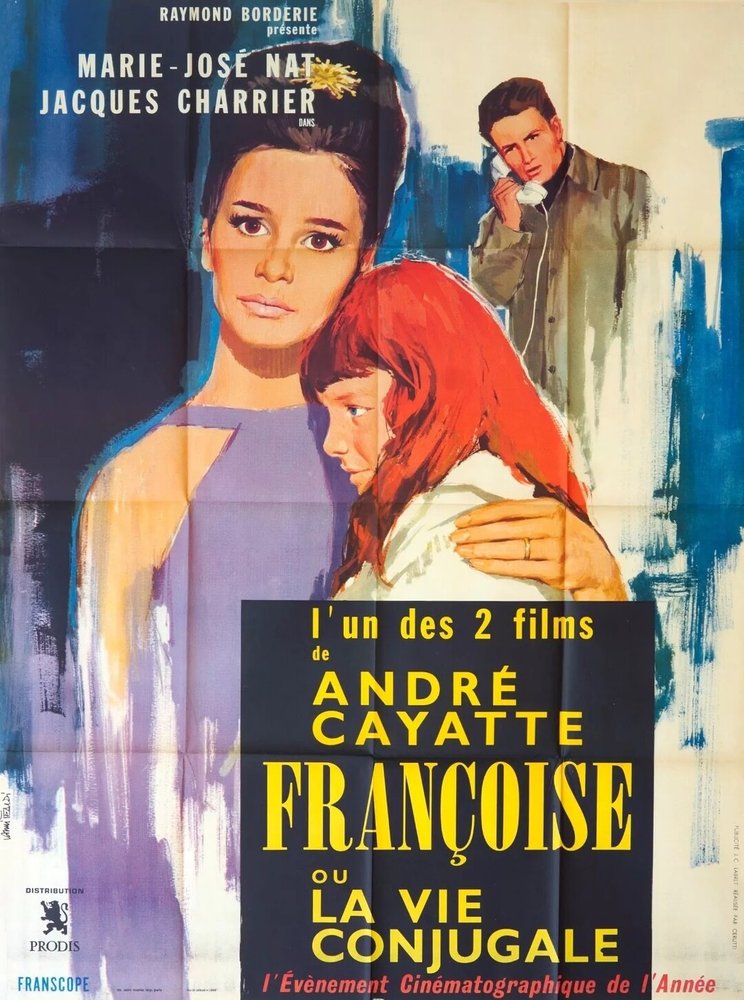
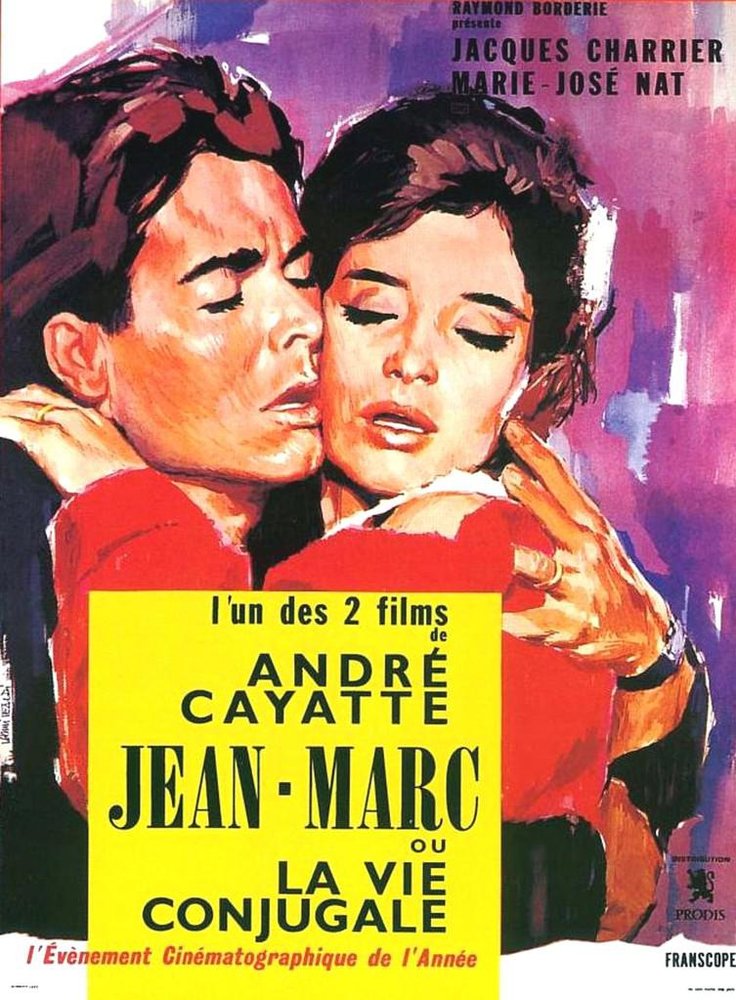
Directed and written by André Cayatte, the two-part French film La Vie conjugale (1964) tells the break-up of one marriage from two separate points of view. This film, Françoise ou la Vie conjugale in French, is the second part of the diptych and gives the wife's side; its companion, Jean-Marc ou la Vie conjugale, gives the husband's. A black-and-white co-production of France, West Germany and Italy, it combines drama with romance and runs about 112 minutes. In Germany the two parts were shown as Meine Tage mit Pierre – meine Nächte mit Jacqueline, opening in West Germany in 1964 and in East Germany in 1966.

Both films tell five important moments of a relationship, separately from the man's and the woman's perspective, so that the same marriage looks very different from each side. Marie-José Nat plays Françoise Dubreuil, Michel Subor is Roger, Macha Méril is Nicole and Alfred Adam is Fernand Aubry. Jacques Charrier stars in the husband's half. The cast also includes Blanchette Brunoy, Georges Rivière, Giani Esposito, Jacqueline Porel, Michèle Girardon, Jacques Marin and Jacques Monod.

DirectorAndré Cayatte

Reactions

You can pick up to 3 reactions.

Cast

Only cast members with a profile on this site are listed.

Jacques Monod Jacques Monod Film actor · died at 67 Henri Crémieux Henri Crémieux Actor · died at 83 Marie-José Nat Jacques Charrier Alfred Adam Blanchette Brunoy Georges Rivière Giani Esposito Jacqueline Porel Macha Méril Michel Subor Michèle Girardon Yves Vincent Robert Porte Jacques Marin
Through different eyes

Cinephile Looks at script, editing and directing choices; keeps a distance from formula films.

Cayatte's idea is bold and structural: tell five key moments of one marriage in two separate films, each from one partner's point of view. It is an interesting experiment in what subjective narration can do on screen. Yet the design is also this film's biggest limit: watched on its own, the Françoise half never quite finds its full meaning, and its choice of scenes only resonates when set against the Jean-Marc half. The black-and-white photography gives a plainness that suits the confinement of a marital drama. For anyone willing to watch both films, the structure pays off; for those who stop at one, it feels, in my view, like half an argument.

History & Society Lens Asks about the period, the social background and what the work reflects.

For 1964, devoting an entire film to a marriage's collapse from the wife's point of view was a notable decision. The mid-sixties were the years when marriage as an institution, and a woman's place within it, began to be questioned; the effort to give Françoise's story the same weight as the man's bears traces of that shift. The same events looking completely different to each side invites thought on how much a couple's failure to communicate is fed by gender roles. Still, it is worth remembering that both halves come from one male writer-director; the woman's view arrives here not in her own voice but through the interpretation of a storyteller trying to understand her.

Family Viewer Asks whether the whole household can watch it; cares about humour and heart.

An adult drama about a marriage coming apart. The subject is heavy and the telling is calm, so children are unlikely to be drawn in. It is the kind of film that couples or adult friends can watch together and then talk over. Its way of showing how the same events look different to each side makes a good starting point for conversation.

These are not reader reviews: they are short editorial takes written from different viewer perspectives with AI assistance. Reader reviews are below.

Reviews (0)

Log in Log in to write a review.

Comments