125

125 (125, rue Montmartre)

Movie · 1959 · 15 people

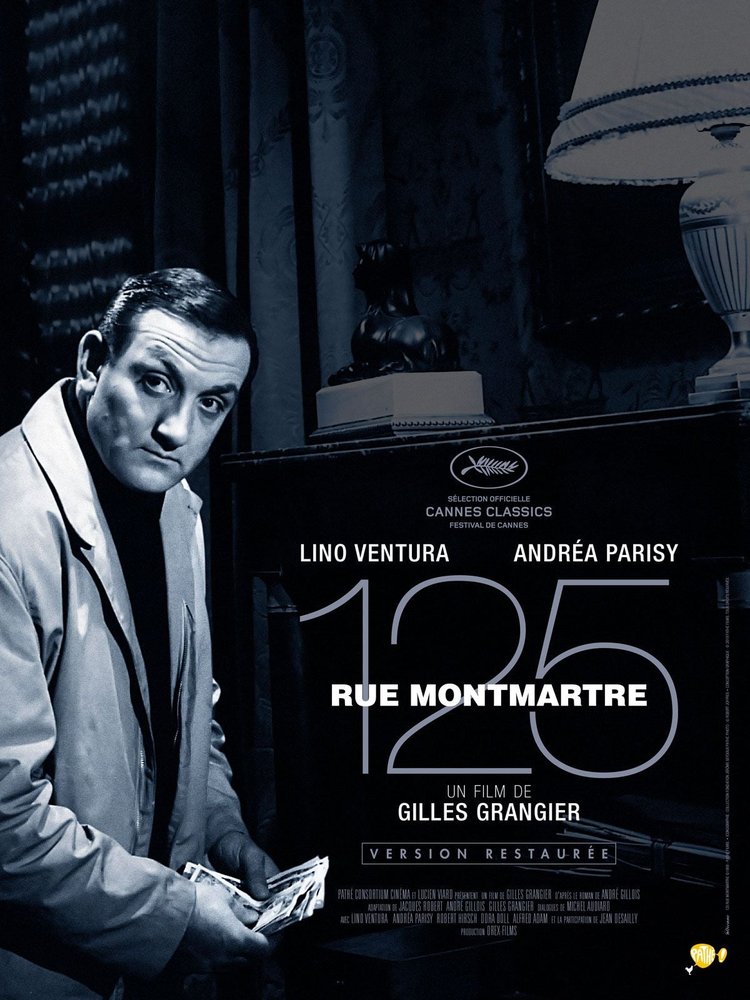
Gilles Grangier made 125 Rue Montmartre (in French, 125, rue Montmartre) in 1959, a black-and-white French crime film. Blending crime and drama, it also falls within film noir, and it runs 85 minutes. In Germany it was shown as Tatort Paris, while its Russian, Bulgarian and Greek titles render it simply as the street address, "125 Montmartre Street". The story rests on André Gillois's novel of the same name, published in 1958 and awarded the Quai des Orfèvres prize for crime fiction.

Lino Ventura stars as a newspaper seller who is pulled, against his will, into a murder case. Andréa Parisy and Robert Hirsch appear with him, and the cast also includes Alfred Adam, Charles Lemontier, Christian Lude, Dora Doll, Jean Desailly, Henri Crémieux and Jacques Monod. The dialogue is in French.

Grangier, the novel's author Gillois, Jacques Robert and Michel Audiard worked on the screenplay together, so the adaptation had the story's own creator behind it. Shooting took place at the Boulogne Studios in Paris and on location around Montmartre, with sets designed by art director Robert Bouladoux.

DirectorGilles Grangier

Reactions

You can pick up to 3 reactions.

Cast

Only cast members with a profile on this site are listed.
Henri Crémieux Henri Crémieux Actor · died at 83 Jacques Monod Jacques Monod Film actor · died at 67 Alfred Adam Andréa Parisy Charles Lemontier Christian Lude Dora Doll Émile Genevois Georges Demas Gilles Grangier Jacques Préboist Jean Desailly Jean Juillard Lino Ventura Georges Loriot
Through different eyes

Cinephile Looks at script, editing and directing choices; keeps a distance from formula films.

What makes Grangier's film interesting is how it brings film noir down to the everyday face of Paris: at its centre is not a detective or a gangster but a newspaper seller dragged unwillingly into a murder. That choice loads the genre's fatalism onto an ordinary man and puts the viewer on the side of helplessness rather than investigation. Having the novel's author Gillois and Michel Audiard at the writing table together promises an adaptation faithful to the plot and sharp in its dialogue. The meeting of Boulogne studio sets and Montmartre location work also makes the neighbourhood part of the story. In my view the film's real strength is this street-sized tension, built without showing off.

Action & Thriller Fan Puts pace, tension and set pieces first; little patience for slow drama.

An innocent man who finds himself in the middle of a murder is a set-up that always works, because the stakes are personal from the start. Still, French noir of this era usually builds tension through atmosphere and a sense of being cornered rather than chases and gunfire. For anyone used to today's speed, that measured pace may test your patience; for anyone curious about the genre's roots, it is a good stop.

History & Society Lens Asks about the period, the social background and what the work reflects.

Putting a newspaper seller at the centre is a way of looking at late-1950s Paris from below. Montmartre here comes across, I think, less as a postcard view than as a neighbourhood where ordinary people live, and shooting on those streets strengthens that feeling. A man with no influence to defend himself being drawn into a murder case carries a worry common to the crime films of the period: the vulnerability of ordinary people before the machinery of justice. The film makes that felt through the flow of the story rather than by lecturing.

These are not reader reviews: they are short editorial takes written from different viewer perspectives with AI assistance. Reader reviews are below.

Reviews (0)

Log in Log in to write a review.

Comments