Une affaire de femmes

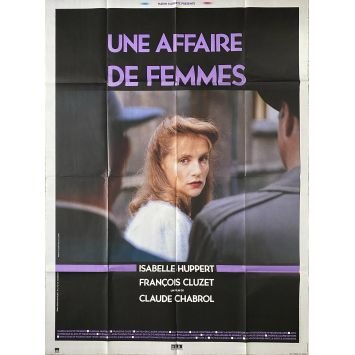
Story of Women (Une affaire de femmes)

Movie · 1988 · 15 people

Isabelle Huppert took the Best Actress prize at the 45th Venice Film Festival for Claude Chabrol's Une affaire de femmes (Story of Women in English), a 1988 French drama set in wartime. Its heroine is drawn from a real case: after carrying out 27 abortions around Cherbourg, Marie-Louise Giraud went to the guillotine on 30 July 1943, and the lawyer Francis Szpiner told her story in a 1986 book of the same name that the film also rests on.

In the chaos of Second World War France, Marie is left alone with her children and in poverty after her husband goes to war and is taken prisoner by the German army. One day she performs an abortion for a neighbour in trouble, then carries out more and keeps doing so to get by. The laws and social values of the time will not allow it. Huppert plays Marie, with François Cluzet (Paul), Marie Trintignant (Lulu) and Nils Tavernier (Lucien) in the cast.

Chabrol wrote the script with Colo Tavernier O'Hagan. It was nominated for a Golden Globe for Best Foreign Film in 1990 and appears on the list of 1001 films to see before you die. John Waters has called it a favourite and presented it as his own selection at the 2008 Maryland Film Festival.

DirectorClaude Chabrol

Reactions

You can pick up to 3 reactions.

Cast

Only cast members with a profile on this site are listed.

Claude Chabrol Claude Chabrol Director · died at 80 Henri Attal Henri Attal Actor · died at 67 Isabelle Huppert François Cluzet Marie Trintignant Dominique Blanc Nils Tavernier Lolita Chammah Dani François Maistre Anne-Marie Étienne Caroline Berg ‎Évelyne Didi‎ Fabienne Chaudat Franck de La Personne

Through different eyes

Cinephile Looks at script, editing and directing choices; keeps a distance from formula films.

Chabrol makes no attempt to either clear or condemn his heroine; the camera watches Marie's choices from a cool, almost detached distance. In my view that is the film's great strength: the audience has no ready-made verdict to lean on and has to reach one alone. Huppert's performance, which won Best Actress at Venice, works the same way and makes no concession to likeability. That coolness won't suit everyone, though. Anyone hoping for an emotional climax or a clear message may find the storytelling dry. The distance is deliberate and apt, but at times it also drains the dramatic tension; for all the weight of its subject, the film prefers to make you think rather than to shake you.

History & Society Lens Asks about the period, the social background and what the work reflects.

The film takes a hard look at how vulnerable a woman becomes in wartime when her husband is a prisoner and she is left alone with the children. Marie's story reads less as one person's crime than as the point where poverty, loneliness and strict laws over women's bodies meet. Because the real Marie-Louise Giraud went to the guillotine in 1943, the film becomes more than a period portrait: it is a record of how a state and a society at war treated women. The subject stays current at a time when abortion is still debated, and the film adds to that debate not a slogan but a concrete human story.

Family Viewer Asks whether the whole household can watch it; cares about humour and heart.

This is not one to watch with children. Abortion, poverty and a real execution case sit right at the centre of the story. The subject is heavy, and the film leaves the moral questions to the viewer. For adults and mature teenagers it is a strong drama worth a long talk afterwards. For younger children, or anyone after a light evening film, it is the wrong pick.

These are not reader reviews: they are short editorial takes written from different viewer perspectives with AI assistance. Reader reviews are below.

Reviews (0)

Log in Log in to write a review.

Comments