The Flower of Evil

The Flower of Evil (La Fleur du mal)

Movie · 2003 · 15 people

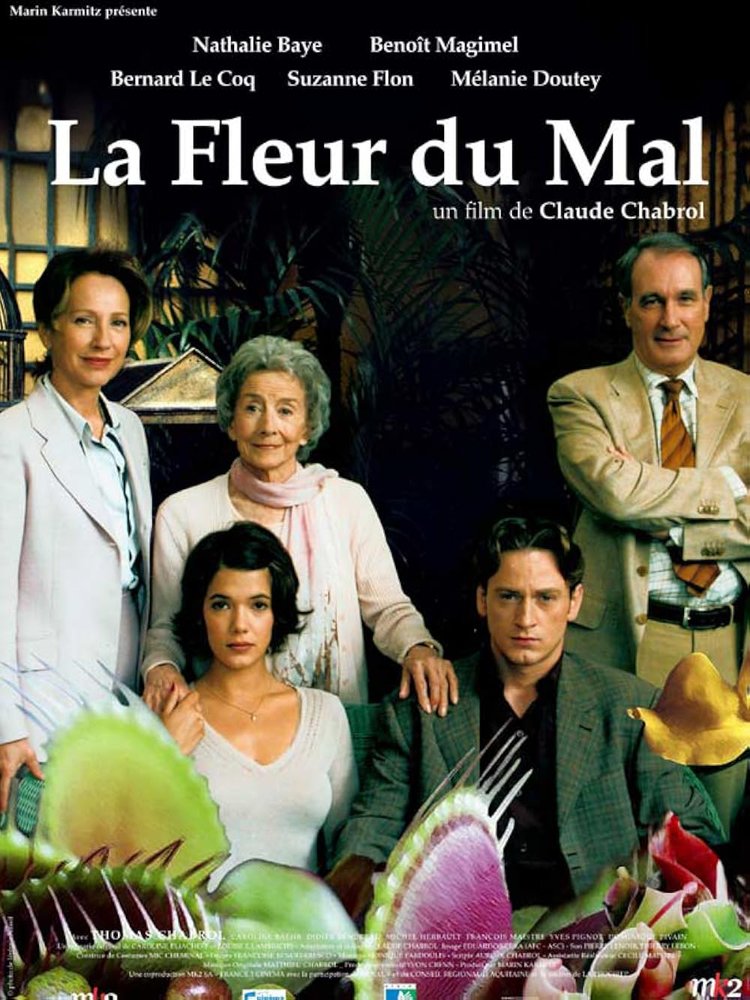
Incest, murder and betrayal inside a bourgeois household drive La Fleur du mal (The Flower of Evil), the 2003 French psychological thriller counted as Claude Chabrol's fiftieth feature. Chabrol wrote it with Caroline Eliacheff and Louise L. Lambrichs; MK2 produced. The film was selected for the main competition at the 2003 Berlin Film Festival, was nominated in 2004 for the Spanish Goya Award for best European film.

The story gathers three generations of the wealthy Charpin-Vasseur family of Bordeaux. Anne is running for mayor. Her second husband Gérard has a grown son and she has a grown daughter from her first marriage, and the two young people fall in love. Behind the family lies a darker chapter: elderly Aunt Line was once put on trial for killing her father, a Nazi sympathiser, and was acquitted. As the campaign unfolds, an anonymous pamphlet circulating through town revives the old murder scandal and the family's wartime ties. Who wrote it: the rival party, or someone close to Anne?

The cast includes Nathalie Baye, Benoît Magimel, Suzanne Flon, Bernard Le Coq, Mélanie Doutey and Thomas Chabrol, with Henri Attal also appearing. Once again Chabrol examines the bourgeoisie with a cool, barbed eye, exposing the rot beneath its polished surface.

DirectorClaude Chabrol
Production companyMK2

Reactions

You can pick up to 3 reactions.

Cast

Only cast members with a profile on this site are listed.

Nathalie Baye Nathalie Baye Actor · died at 77 Henri Attal Henri Attal Actor · died at 67 Benoît Magimel Suzanne Flon Bernard Le Coq Mélanie Doutey Thomas Chabrol Caroline Baehr Didier Bénureau François Maistre Françoise Bertin Jérôme Bertin Valérie Rojan Yves Pignot Yvon Crenn
Through different eyes

Cinephile Looks at script, editing and directing choices; keeps a distance from formula films.

Chabrol's fiftieth feature returns to ground he had long worked: the rot beneath the polished surface of the bourgeois family. Familiar territory, but this time the story is layered across three generations and two time frames, with the old murder trial and the present-day mayoral campaign linked by an anonymous pamphlet. The structure builds suspense from suspicion rather than violence, and the question of who wrote the pamphlet becomes the engine of the plot. Selection for the main competition in Berlin and a Goya nomination show the film's standing in Europe. My reservation is that, for viewers who know Chabrol, the repeated themes leave less room for surprise; his cool, barbed gaze is skilful, but whether it adds anything new to his earlier films is debatable.

History & Society Lens Asks about the period, the social background and what the work reflects.

The film's reckoning with the past touches a sensitive subject in France: the war years. Aunt Line's trial and acquittal for killing her father, a Nazi sympathiser, together with the family's wartime ties, cast a shadow over a present-day political campaign. The story asks how a family, and perhaps a society, builds respectability by burying its past. A woman running for mayor being confronted with that old scandal shows how the past can be turned into a political weapon in public life. Bordeaux's wealthy bourgeoisie makes fertile ground for that inquiry.

Action & Thriller Fan Puts pace, tension and set pieces first; little patience for slow drama.

Anyone expecting a breathless ride from the psychological thriller label may be wrong-footed. The tension comes less from chases than from a family's secrets and an anonymous pamphlet making the rounds in town. The real question is who wrote it. If you like slow-burn suspense that moves by hints, it does the job; if you want a fast pace, it may feel too calm.

These are not reader reviews: they are short editorial takes written from different viewer perspectives with AI assistance. Reader reviews are below.

Reviews (0)

Log in Log in to write a review.

Comments