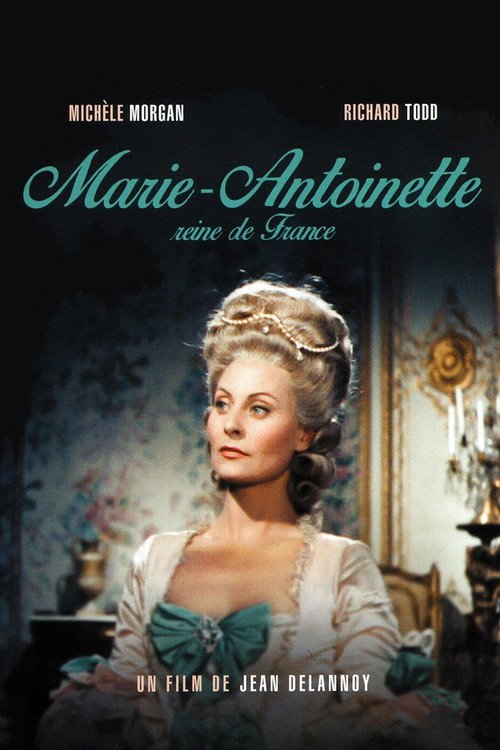
Marie Antoinette Queen of France

Marie Antoinette Queen of France (Marie-Antoinette reine de France)

Movie · 1955 · 3 people

Marie-Antoinette reine de France (released in English as Marie Antoinette Queen of France and also known as Shadow of the Guillotine; Italian title Maria Antonietta regina di Francia) is a French-Italian historical drama directed by Jean Delannoy. It was made in France in 1955 and reached cinemas in 1956. Running about two hours, it stars Michèle Morgan and Richard Todd. At the 1956 Cannes Film Festival, Delannoy was among the nominees for the Palme d'Or.

The story portrays Queen Marie Antoinette, whose court life unfolds beneath the gathering storm of the Revolution as her fate moves toward tragedy. Michèle Morgan plays the queen opposite the English actor Richard Todd. The cast also includes Marina Berti, Jacques Dufilho, Michel Piccoli, Jacques Bergerac and Bernard Musson.

Delannoy wrote the screenplay with Pierre Erlanger and Bernard Zimmer. Filming took place at the Billancourt Studios in Paris, with sets by art director René Renoux. The picture was prepared in a French and an English version; according to Todd, Nancy Mitford wrote the English script. Todd recalled that Delannoy worked out every move and gesture before rehearsal, which he and Morgan found constraining: in the English version they mostly played scenes their own way, while in the French one they tried to follow the director's instructions.

DirectorJean Delannoy

Reactions

You can pick up to 3 reactions.

Cast

Only cast members with a profile on this site are listed.

Through different eyes

History & Society Lens Asks about the period, the social background and what the work reflects.

Jean Delannoy's film sets Marie Antoinette's court life beneath the gathering storm of the Revolution. That is a strong frame for thinking about the gulf between the privileged world of the monarchy's last years and the anger building outside. The weight of the story, however, stays inside the palace, in the queen's personal tragedy; the social conditions that brought on the Revolution remain more of a distant rumble. René Renoux's sets, built at the Billancourt Studios, strive to convey the splendour of the period. It is best watched not as a full historical portrait but as the drama of a woman walking towards her fate.

Cinephile Looks at script, editing and directing choices; keeps a distance from formula films.

Delannoy's classical, rule-bound staging is both the film's strength and its limit. As Richard Todd later recalled, the director fixed every move and gesture before rehearsal; that precision gives the frames a painterly order but at times leaves the performances stiff. Michèle Morgan brings a dignified sorrow to the queen, yet across roughly two hours the narrative moves at a heavy, ceremonial pace. The fact that it was prepared in French and English versions, and that, by Todd's account, the actors mostly played scenes their own way in the English one, makes comparing the two cuts an intriguing exercise. A respectable but cold period piece that competed for the Palme d'Or at Cannes.

Yeşilçam Nostalgic A viewer raised on the classics, looking for warm storytelling and strong acting.

Michèle Morgan's noble, sorrowful bearing suits this role beautifully. The tragedy of an ill-fated queen is told with the dignified air of the old costume pictures, with an elegance rarely found in today's hurried productions. Still, it never fully won my heart: the queen's fate is always watched from a cool distance, and one cannot quite grieve alongside her. For lovers of palace sets and period atmosphere, though, it makes a pleasant evening's film.

These are not reader reviews: they are short editorial takes written from different viewer perspectives with AI assistance. Reader reviews are below.

Reviews (0)

Log in Log in to write a review.

Comments