Karpuz Kabuğundan Gemiler Yapmak

Boats Out of Watermelon Rinds (Karpuz Kabuğundan Gemiler Yapmak)

Movie · 2004 · 15 people

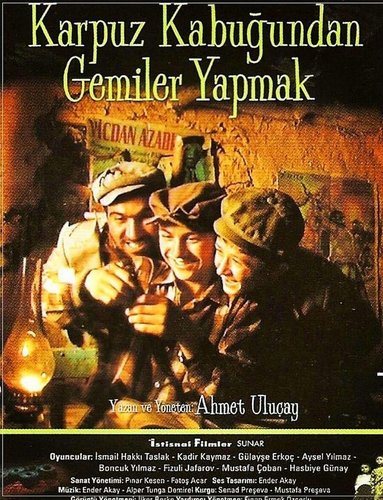
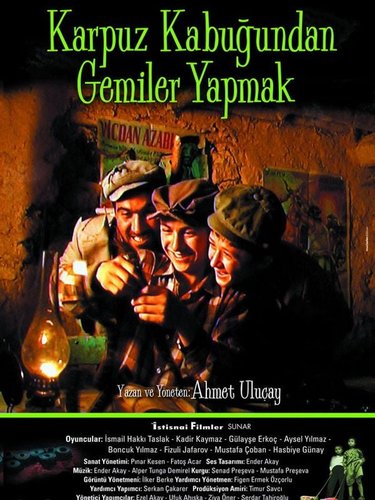
Ahmet Uluçay wrote and directed his first feature, the 2004 Turkish drama Karpuz Kabuğundan Gemiler Yapmak (Boats Out of Watermelon Rinds). The title comes from a saying about wasting effort on things that cannot work out. The film was finished in 2001 but reached audiences only on 26 November 2004. It has no famous actors, and the director plays the barber himself. Drawing on episodes from Uluçay's life, it is told in a natural, poetically realist style and won many awards.

In the 1960s, in the Anatolian village of Tepecik, Recep and Mehmet spend their summers as apprentices in the nearby town of Tavşanlı, Recep with a watermelon seller and Mehmet with a barber. Both are mad about cinema. At night, in an abandoned barn, they try to build a makeshift film projector and dream of becoming directors; their only supporter is the village eccentric, Ömer. When Recep meets Nezihe, who collects the watermelons that turned out bad, and falls in love, the summer becomes one neither will forget. İsmail Hakkı Taslak (Recep), Kadir Kaymaz (Mehmet), Gülayşe Erkoç (Nezihe) and Boncuk Yılmaz (Nihal) star.

İlker Berke shot it, with music by Ender Akay and Alper Tunga Demirel; UIP distributed. Uluçay had earlier made a short called Koltuk Değneklerinden Kanat Yapmak.

DirectorAhmet Uluçay
Production companyIFR
Boats Out of Watermelon Rinds (Karpuz Kabuğundan Gemiler Yapmak) Boats Out of Watermelon Rinds (Karpuz Kabuğundan Gemiler Yapmak)

Reactions

You can pick up to 3 reactions.

Cast

Boncuk Yılmaz Boncuk Yılmaz Actor · 45 years old Ahmet Uluçay Ismail Hakki Taslak Kadir Kaymaz Gülayse Erkoc Aysel Yılmaz Hasbiye Günay Mustafa Çoban Fizuli Caferof Cömert Agat Hasan Gülün Fikret Erden Ahmet Çakar Hakan Hüseyin Erkmen Ramazan Çalış

Through different eyes

Cinephile Looks at script, editing and directing choices; keeps a distance from formula films.

Ahmet Uluçay's first feature is one of Turkish cinema's most sincere examples of poetic realism built with a cast of unknown faces and natural locations. It ties a passion for cinema to a concrete, touching image, a makeshift projector put together in an abandoned barn; for a director telling the birth of his own art, that is a strikingly humble choice. Its weak point is a loose structure; events move with the flow of the season rather than a dramatic build, which can make the middle feel scattered. Still, when the naturalness of the cast meets the simplicity of the images, it stands out as a bright, if not flawless, debut.

History & Society Lens Asks about the period, the social background and what the work reflects.

Through two youths shuttling between village and town in 1960s Anatolia, the film conveys the social texture of the period. Spending their summers as apprentices, they cling both to the everyday economy of the watermelon stall and the barber's shop and to the dream world cinema opens up. That their only supporter is Ömer, the village eccentric, shows how lonely it is to dream of art in the provinces. Drawing on the director's own life turns the film into the testimony of a generation rather than a nostalgic tale. That it reached audiences only years after it was finished is also a reminder of how hard distribution is for independent cinema.

Family Viewer Asks whether the whole household can watch it; cares about humour and heart.

A summer story of two young people in love with cinema, with an innocent romance and big dreams. In subject, it's a film that suits family viewing. But the pace is very slow and things move gently, so young children will most likely get bored. It can be a meaningful film for teenagers and for grandparents who remember village life. A warm story about the value of dreaming.

These are not reader reviews: they are short editorial takes written from different viewer perspectives with AI assistance. Reader reviews are below.

Reviews (0)

Log in Log in to write a review.

Comments