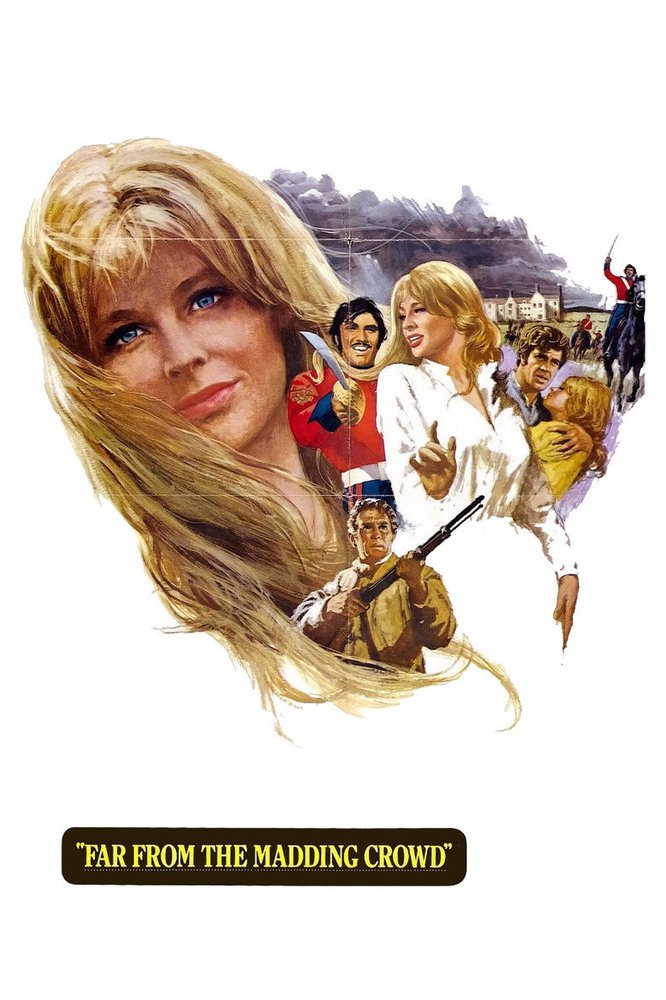
Far from the Madding Crowd

Far from the Madding Crowd

Movie · 1967 · 7 people

Thomas Hardy's 1874 novel reached the screen in 1967 as Far from the Madding Crowd, an epic British period drama by John Schlesinger, with Frederic Raphael writing the adaptation. As Schlesinger's fourth film, it marked a clear shift away from his earlier studies of contemporary urban life. The picture runs about 155 minutes, was shot in Panavision and was the first 70 mm film shown on the 75-foot screen of the brand-new Odeon Marble Arch in London.

The story is set in Victorian England, in Hardy's Wessex. Julie Christie plays the young Bathsheba Everdene, who wants to live freely in an age of strict rules for women. Three suitors enter her life: the shepherd Gabriel Oak (Alan Bates), the landowner William Boldwood (Peter Finch) and Sergeant Troy (Terence Stamp). It was Christie's third film with Schlesinger, after Billy Liar and Darling.

Nicolas Roeg was the cinematographer. Richard Rodney Bennett wrote the music, drawing on traditional folk songs in places. Filming took place in Dorset and Wiltshire. A scene in which Troy shows off his swordsmanship while Bathsheba stands still and fascinated is among the film's best remembered. It was nominated for an Oscar for Best Original Score and for two BAFTAs, for colour cinematography and costume design.

DirectorJohn Schlesinger
Production companyMetro-Goldwyn-Mayer

Reactions

You can pick up to 3 reactions.

Cast

Only cast members with a profile on this site are listed.

Julie Christie Terence Stamp Peter Finch Alan Bates Prunella Ransome Freddie Jones John Barrett

Through different eyes

Cinephile Looks at script, editing and directing choices; keeps a distance from formula films.

Moving from his urban stories to Hardy's countryside was a bold leap for Schlesinger, and its biggest payoff is Nicolas Roeg's photography. The Dorset and Wiltshire landscapes are not backdrop here but a storytelling device that carries the characters' moods. No wonder Troy's sword display is so well remembered: it fuses desire and danger in a single piece of choreography and needs no dialogue. The epic breadth does not always work in the film's favour, though. A story built around three suitors turns into an episodic sequence and grows noticeably heavy in the middle. The visual splendour never quite hides the fact that the editing could have been tighter.

History & Society Lens Asks about the period, the social background and what the work reflects.

The film treats the Victorian countryside not as a romantic postcard but as an order in which class and gender roles are tightly drawn. Bathsheba's three suitors really stand for three social positions: the shepherd, the landowner and the man in uniform. That makes the choice of a woman who wants to live independently not only an emotional decision but an economic and social one. Bringing Hardy's question, posed nearly a century earlier, back to the screen in the late 1960s also makes sense; a woman's say over her own life was a live debate in those years too. The use of traditional folk songs is a subtle touch that makes the rural community feel like a living world.

Family Viewer Asks whether the whole household can watch it; cares about humour and heart.

This is not a film you can easily put on and finish with children. The story turns on a young woman's choices in love and marriage between three suitors, so it is really aimed at adults. It is long and calmly paced. Younger children will most likely lose interest halfway. It suits teenagers who enjoy novels, watched with the grown-ups and without hurry. The landscapes and the music repay that patience to some extent.

These are not reader reviews: they are short editorial takes written from different viewer perspectives with AI assistance. Reader reviews are below.

Reviews (0)

Log in Log in to write a review.

Comments