Çılgın Pierrot

Pierrot le Fou

Movie · 1965 · 5 people

Jean-Luc Godard blended romantic drama, crime and comedy in Pierrot le Fou (in Turkish, Çılgın Pierrot), a French-Italian road film from 1965. Godard's tenth feature, it is among the best-known works of the French New Wave. It loosely adapts Lionel White's 1962 novel Obsession; Godard wrote the script with Remo Forlani.

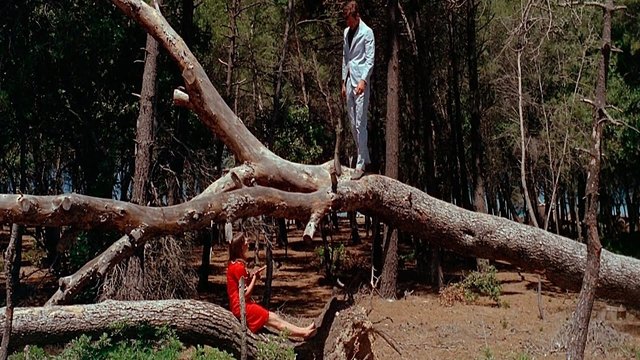
Ferdinand "Pierrot" Griffon, unhappily married, is worn down by his fashionable circle. He meets Marianne, with whom he had a relationship five years earlier; after finding a corpse in her flat and learning that Algerian gunmen are after her, they flee Paris for the Mediterranean coast. Along the way they read poetry, sing and commit crimes. Jean-Paul Belmondo plays Ferdinand and Anna Karina, then married to Godard, plays Marianne; the cast also has Jean-Pierre Léaud, Dominique Zardi, Henri Attal and Krista Nell; Samuel Fuller appears as himself.

Raoul Coutard shot the film and Antoine Duhamel composed the score, for Dino De Laurentiis Cinematografica. It was selected for the Golden Lion competition at Venice in 1965, won the Sutherland Trophy at the London Film Festival and was named best film of the year by Cahiers du cinéma. It drew over 1.3 million admissions in France and was France's foreign-language Oscar entry, though not nominated.

DirectorJean-Luc Godard
Production companyDino De Laurentiis Cinematografica

Reactions

You can pick up to 3 reactions.

Cast

Only cast members with a profile on this site are listed.
Through different eyes

Cinephile Looks at script, editing and directing choices; keeps a distance from formula films.

Pierrot le Fou is Godard's tenth feature and one of the moments when the French New Wave let itself run freest. Loosely adapted from Lionel White's novel, it takes a crime-story skeleton and rebuilds it with pieces of romantic drama, comedy and road movie. Ferdinand and Marianne's flight from Paris to the Mediterranean coast moves less by classical narrative flow than by poetry readings, songs and broken-off episodes. Raoul Coutard's images and Antoine Duhamel's score hold the collage together, and the rapport between Belmondo and Anna Karina is its heart. The deliberate ruptures in the editing will not win over every viewer, and at times the film looks like a game in love with its own cleverness. It is easy to see why Cahiers du cinéma named it film of the year, but that does not make it an easy film to love.

Yeşilçam Nostalgic A viewer raised on the classics, looking for warm storytelling and strong acting.

To an eye used to Yeşilçam's tales of love and flight, Pierrot le Fou looks familiar at first: a lover from the past, an escape, a road running down to the sea. But Godard does not tell this story with the warmth we know. Poems are read and songs are sung, yet it is hard to get close to the characters' hearts; the telling keeps putting a distance in between. Belmondo and Anna Karina bring a glow to the screen, that must be granted. I admire this game so steeped in literature, but it speaks more to the mind than to the heart. Anyone seeking the warm embrace of classic cinema may feel a little cold here.

Family Viewer Asks whether the whole household can watch it; cares about humour and heart.

Pierrot le Fou is not a family film. The story has a corpse, armed men on the couple's trail and crimes committed to get by. It is also about an unhappily married man running off with a former lover. The storytelling is unusual and comes in pieces. Children would follow neither the story nor the style. It suits older teenagers with an interest in film, or adults. Give it a try if you are ready to watch an old French film with patience.

These are not reader reviews: they are short editorial takes written from different viewer perspectives with AI assistance. Reader reviews are below.

Reviews (0)

Log in Log in to write a review.

Comments