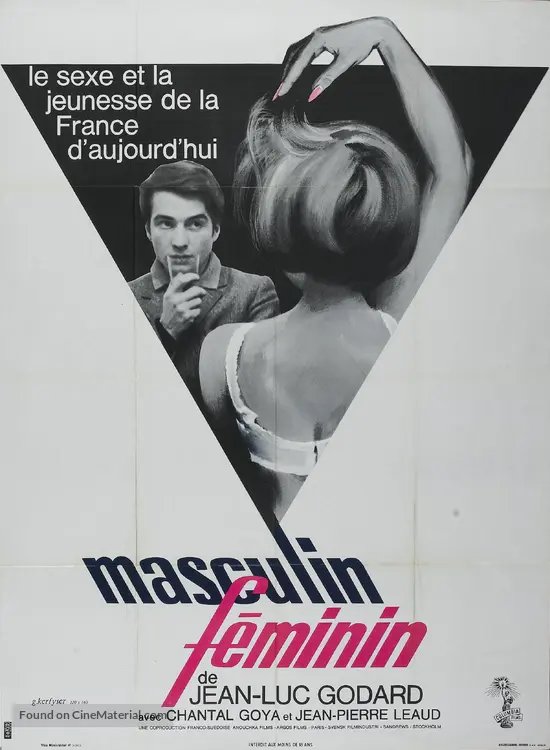
Masculin – féminin: 15 faits précis

Masculin Féminin

Movie · 1966 · 3 people

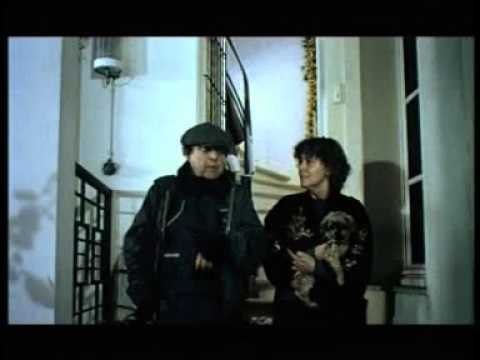
Jean-Luc Godard wrote and directed Masculin féminin: 15 faits précis, a black-and-white French New Wave comedy-drama of 1966 and a Franco-Swedish co-production. It loosely adapts Maupassant's Le Signe and La Femme de Paul. The film is widely seen as a portrait of 1960s France and Paris, and is remembered for an intertitle calling it "The Children of Marx and Coca-Cola." Jean-Pierre Léaud won the Silver Bear at the 1966 Berlin Film Festival for his role.

The story follows Paul (Léaud), an idealistic young man just out of military service who looks for work while protesting the Vietnam War. He falls for Madeleine (Chantal Goya), a young pop singer focused on her career. A four-way household forms with Madeleine's roommates Catherine (Catherine-Isabelle Duport) and Elisabeth (Marlène Jobert). The camera probes the young cast in vérité-style interviews about love, sex and politics, and the story is interrupted by sequences such as a scene adapted from LeRoi Jones's play Dutchman.

The film references Charles de Gaulle, André Malraux, James Bond and Bob Dylan, and Brigitte Bardot appears as herself. It is counted among the works marking Godard's move from the New Wave toward a more political cinema.

DirectorJean-Luc Godard

Reactions

You can pick up to 3 reactions.

Cast

Only cast members with a profile on this site are listed.
Through different eyes

Cinephile Looks at script, editing and directing choices; keeps a distance from formula films.

Godard is less interested in telling a story here than in taking an X-ray of a generation. Paul's search, swinging between love and politics, is constantly broken up by vérité-style interviews, intertitles and sequences that cut into the main thread, and that fragmentation is both the film's strength and its limit. The intertitle about "the children of Marx and Coca-Cola" sums up an era in a single line. Jean-Pierre Léaud's Silver Bear-winning performance carries the character's indecision with a natural restlessness. The density of references, though, can leave viewers unfamiliar with 1960s France on the outside. For anyone tracing Godard's move toward a more political cinema, it is an essential stop.

History & Society Lens Asks about the period, the social background and what the work reflects.

The film observes the youth of 1960s Paris almost like a piece of fieldwork. The gap between Paul, who takes to the streets against the Vietnam War, and Madeleine, a pop singer who puts her career first, shows how political awareness and consumer culture lived side by side within one generation. References stretching from de Gaulle to Bob Dylan and from James Bond to Malraux capture both the confusion and the colour of the time. As the camera questions young people about love, sex and politics, it avoids firm verdicts, and that turns the film into a document of its era. An interesting source for anyone trying to understand the spirit of 1960s youth.

Action & Thriller Fan Puts pace, tension and set pieces first; little patience for slow drama.

Honestly, this one did not match my pace at all. There is barely a plot; long conversations, interview-like scenes and intertitles keep breaking the flow. If you want tension or a conflict that builds, you will not find it here. Léaud's energy and the short, quick scenes make it a little easier going. Curious about film history? Give it a try. Looking for weekend thrills? Pick something else.

These are not reader reviews: they are short editorial takes written from different viewer perspectives with AI assistance. Reader reviews are below.

Reviews (0)

Log in Log in to write a review.

Comments