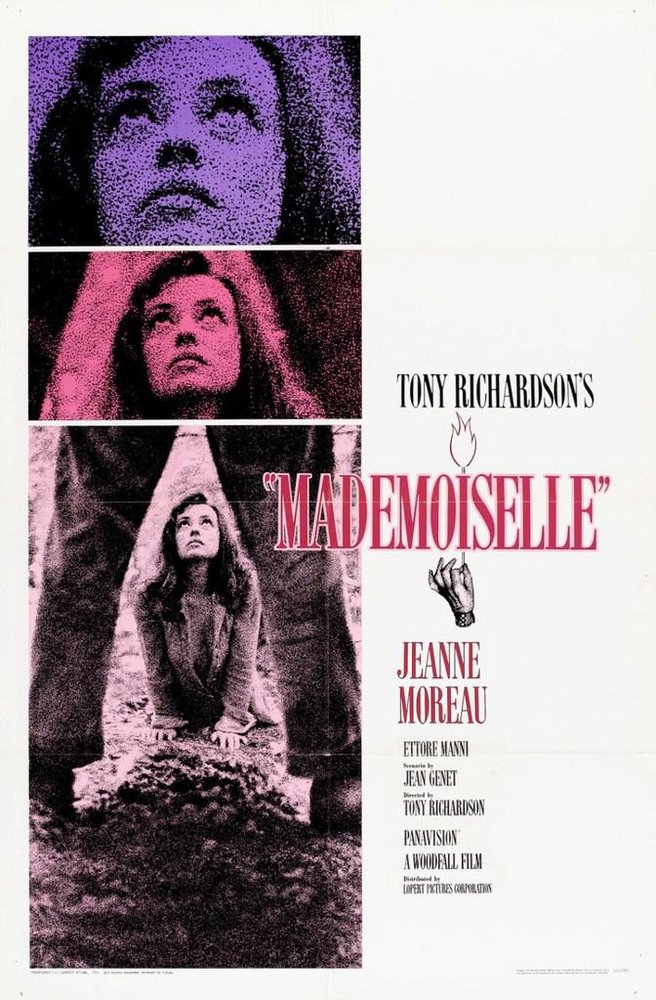
Mademoiselle

Mademoiselle

Movie · 1966 · 14 people

Mademoiselle is a black-and-white French-British co-production that Tony Richardson directed in 1966. It is usually described as a psychological thriller, and some accounts call it a dark romantic drama. The screenplay is credited to Marguerite Duras and Jean Genet: the film rests on a Genet story that Duras adapted for the screen. A Woodfall Film Productions release, it runs 100 minutes and is known in the Spanish-speaking world as Fuegos de verano.

At its centre is Jeanne Moreau, who plays a seemingly respectable Parisian schoolteacher in a small French village. In truth she is an undetected psychopath, and the disturbing events that unsettle the village trace back to that hidden side. Moreau is joined by Ettore Manni, Umberto Orsini, Paul Barge, Pierre Collet, Georges Aubert, Georges Douking, Gérard Darrieu, Jacques Monod and Jean Gras.

The film was nominated for the Palme d'Or at the 1966 Cannes Film Festival and opened in France on 3 June 1966. Jocelyn Rickards won the BAFTA for Best Costume Design for her work on it. Its first reviews were sharply divided, and the dispute left it overlooked for years. In later years it has been called an underrated, misunderstood masterpiece, and Moreau's performance has been described as one of the finest by an actress in film history.

DirectorTony Richardson
Production companyWoodfall Film Productions

Reactions

You can pick up to 3 reactions.

Cast

Only cast members with a profile on this site are listed.

Jeanne Moreau Jeanne Moreau Film actor · died at 89 Jacques Monod Jacques Monod Film actor · died at 67 Ettore Manni Umberto Orsini Paul Barge Pierre Collet Antoine Marin Gabriel Gobin Georges Aubert Georges Douking Gérard Darrieu Jean Gras Keith Skinner Rosine Luguet
Through different eyes

Cinephile Looks at script, editing and directing choices; keeps a distance from formula films.

Mademoiselle is one of those films that split critics on release and was rediscovered in later years. Marguerite Duras's script, adapted from a Jean Genet story, builds tension less from plot than from a character's hidden face. Tony Richardson's black-and-white choice sharpens the contrast between the village's still surface and the unease beneath it. Jeanne Moreau's performance is the film's load-bearing column; it is understandable that later assessments count it among the finest by an actress in film history. My reservation is that the film opts for a cold, distant style, which does not make it easy to love. That distance may explain why the first reviews were so divided.

Action & Thriller Fan Puts pace, tension and set pieces first; little patience for slow drama.

It is labelled a psychological thriller, but do not look for chases or big set pieces here. The tension comes from knowing who is behind the events shaking the village, and from silence. It is a slow burn: if you are patient you will find an unsettling atmosphere; if you want fast pace, you will struggle.

History & Society Lens Asks about the period, the social background and what the work reflects.

Through the figure of a seemingly respectable teacher in a small French village, the film questions how misleading the surface a community trusts can be. In village life the teacher is seen as a representative of morality and order; the film's unsettling power comes from that trust cracking at its most unquestioned point. A Parisian teacher living in the provinces also places the distance between city and countryside in the background of the story. The signatures of two writers like Genet and Duras suggest a gaze that questions what lies behind social respectability. In my view the film is a harsh portrait of how much provincial society of the time leaned on appearances.

These are not reader reviews: they are short editorial takes written from different viewer perspectives with AI assistance. Reader reviews are below.

Reviews (0)

Log in Log in to write a review.

Comments