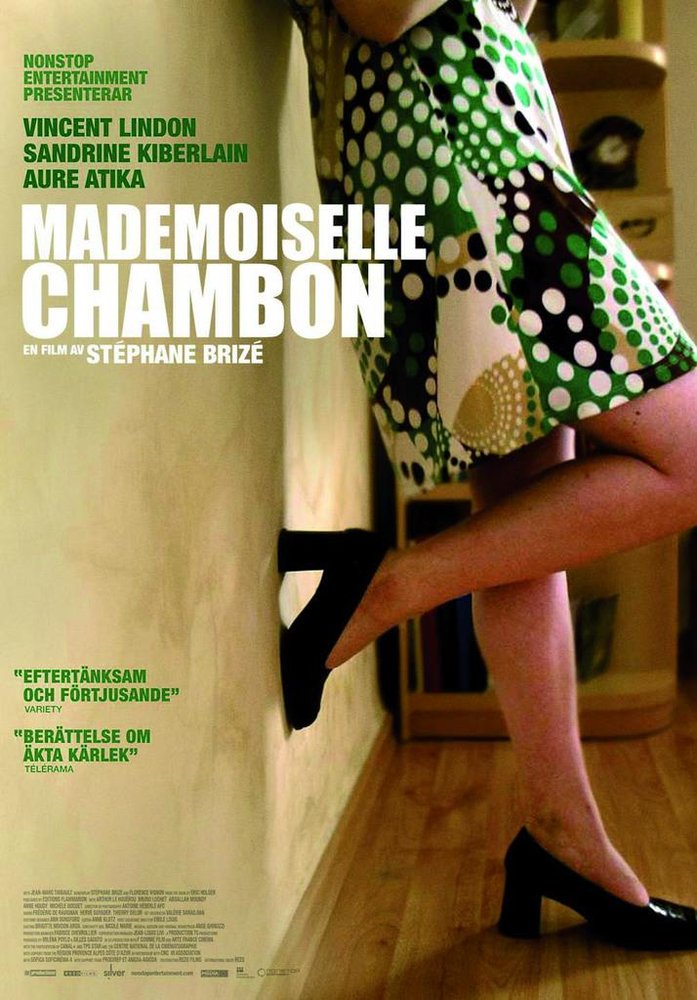
Mademoiselle Chambon

Mademoiselle Chambon

Movie · 2009 · 8 people

Stéphane Brizé directed the 2009 French drama and love story Mademoiselle Chambon. It adapts Éric Holder's novel of the same name, published by Flammarion in 1996, with a screenplay by Florence Vignon, Brizé and Holder. The film opened in France on 14 October 2009 and won the César Award for Best Adaptation. Its budget is reported at around 2.6 million euros.

The story follows Jean, a construction worker whose life is orderly and plain. He is content with his family, including his young son Jérémy, and with his job. One day he turns up at his son's school, to talk about his trade or to collect the boy, and meets the child's substitute teacher, the unmarried Véronique Chambon. They come from very different social worlds; she is elegant and enigmatic, and Jean finds himself unexpectedly drawn to her. A quiet, tender closeness grows between them, a love at first sight that forces Jean to weigh the life he has built against feelings he did not expect. The film asks whether this is a chance for change or a folly he will regret.

Vincent Lindon plays Jean and Sandrine Kiberlain plays Véronique Chambon; Aure Atika appears as Anne-Marie and Jean-Marc Thibault as Jean's father.

DirectorStéphane Brizé

Reactions

You can pick up to 3 reactions.

Cast

Only cast members with a profile on this site are listed.

Vincent Lindon Vincent Lindon Actor · 67 years old Sandrine Kiberlain Sandrine Kiberlain Film actor · 58 years old Aure Atika Jean-Marc Thibault Michelle Goddet Bruno Lochet Geneviève Mnich Jean-François Malet
Through different eyes

Cinephile Looks at script, editing and directing choices; keeps a distance from formula films.

Brizé's strength is carrying what goes unsaid with real restraint: feeling builds less in dialogue than in glances, pauses and silences. That choice gives the film a mature gravity and keeps it off melodrama's easy roads. The César-winning adaptation treats love at first sight not as an explosion but as a slowly growing unease, which is the right call. Still, the same restraint sometimes hardens into a repetitive stillness; some scenes keep going well after they have made their point. A delicate but narrow chamber piece that rewards a patient viewer and can easily lose an impatient one.

History & Society Lens Asks about the period, the social background and what the work reflects.

What makes the film interesting is that it builds a love story on class difference. The distance between Jean, a construction worker, and Véronique, a substitute teacher, is not only about marriage; it exposes the gap in language, taste and expectation between two social worlds. Making the school the one place where those worlds meet is a telling choice. The film portrays a working-class man's inner life without condescension, granting him deep and complicated feelings, a respect cinema does not often show. His choice between the life he has built and a new one reads as a social question as much as a private dilemma.

Family Viewer Asks whether the whole household can watch it; cares about humour and heart.

This is not one to watch with the children. Its subject is a married man drawn to another woman, a thoroughly grown-up concern. The pace is very calm too, so children and teenagers will most likely get bored. For adults who want to talk about marriage, loyalty and choices, it is a quiet drama that fits. Save it for after the kids are in bed.

These are not reader reviews: they are short editorial takes written from different viewer perspectives with AI assistance. Reader reviews are below.

Reviews (0)

Log in Log in to write a review.

Comments