Le streghe

The Witches (Le streghe)

Movie · 1967 · 15 people

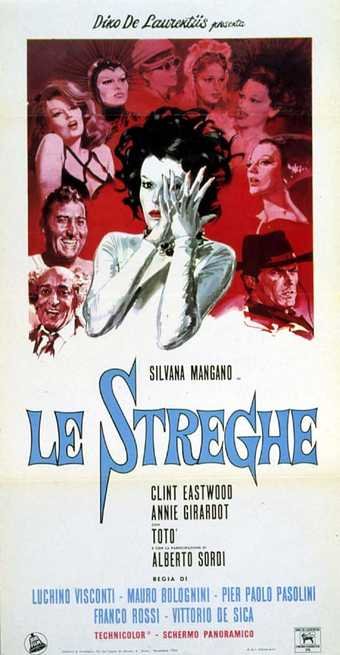
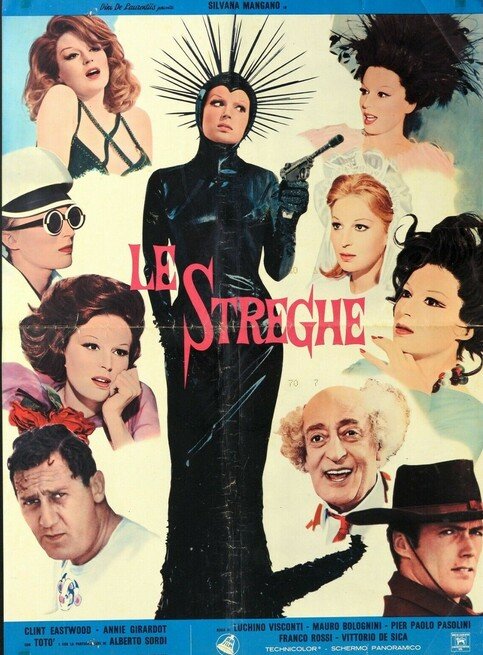
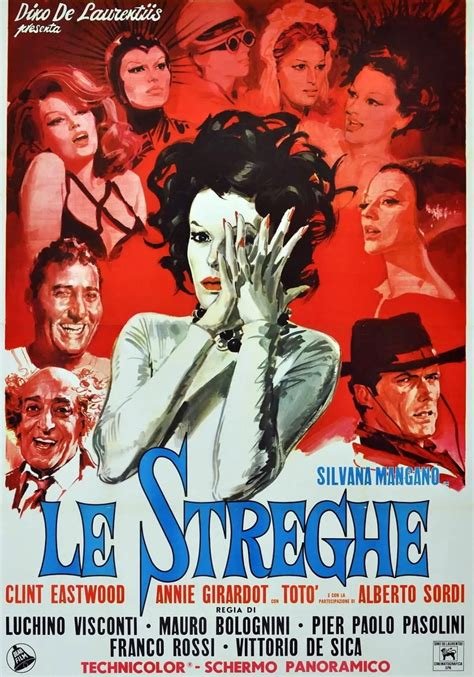
Gathering five short stories in the tradition of Italian comedy, Le streghe (The Witches), a 1967 Italian-French anthology film, moves between comedy and drama. Dino De Laurentiis produced it; the production dates from 1965 and it premiered on 22 February 1967. The stories have no plot connection; what they share is the position of women in Italian society and the figure of the witch.

Each segment has a different director: Luchino Visconti made La strega bruciata viva, Mauro Bolognini Senso civico, Pier Paolo Pasolini La Terra vista dalla luna, Franco Rossi La siciliana and Vittorio De Sica Una sera come le altre. Silvana Mangano stars in all five, each time playing the witch in the guise of a different woman. Alberto Sordi, Totò, Annie Girardot, Massimo Girotti, Francisco Rabal, Helmut Berger and Ninetto Davoli are also in the cast, while Clint Eastwood appears only in the last segment, De Sica's story.

The screenwriting credits include Cesare Zavattini, Pier Paolo Pasolini and Fabio Carpi, and the music is by Piero Piccioni and Ennio Morricone. The film is counted among De Laurentiis's eclectic productions and was the last Totò film released in his lifetime.

DirectorMauro Bolognini, Vittorio De Sica
Production companyDino De Laurentiis Cinematografica
The Witches (Le streghe) The Witches (Le streghe)

Reactions

You can pick up to 3 reactions.

Cast

Only cast members with a profile on this site are listed.

Silvana Mangano Silvana Mangano Actor · died at 59 Alberto Sordi Alberto Sordi Film actor · died at 82 Annie Girardot Francisco Rabal Massimo Girotti Véronique Vendell Elsa Albani Clara Calamai Marilù Tolo Nora Ricci Dino Mele Helmut Berger Bruno Filippini Leslie French Totò

Through different eyes

Cinephile Looks at script, editing and directing choices; keeps a distance from formula films.

Five directors, one star: Le streghe carries both the appeal and the risk of the anthology film. Seeing Visconti, Pasolini, De Sica, Bolognini and Rossi within one frame is a lesson in itself for anyone interested in differences of style. Silvana Mangano playing a different woman in each of the five segments is what really holds the film together. But with no plot link between the stories, the sense of a whole is weak; the segments are uneven in quality and tone, and some never get beyond a sketch. Given the music by Piero Piccioni and Ennio Morricone and the writers involved, it works less as a masterpiece than as a colourful catalogue of Italian cinema of its day.

History & Society Lens Asks about the period, the social background and what the work reflects.

What the stories share is not a plot but a question: where does a woman stand in Italian society? The witch is an old image that carries the suspicion, desire and fear projected onto women all at once, and the five directors bring it into the Italy of their own day. Having the same actress play five different women can be read as a deliberate choice: whatever guise society puts a woman in, the patterns of the gaze upon her stay the same. Seen from today, some segments may seem to reproduce the male gaze of the time more than they criticise it, and that tension makes the film all the more interesting as a document of its era.

Family Viewer Asks whether the whole household can watch it; cares about humour and heart.

Being made up of five short stories, it is easy to watch one segment at a time. But this is not a family comedy. Its subject is the place of women in society and the figure of the witch, and its humour is aimed at adults. Children will not get much out of these stories and may grow bored. It is a better pick for grown-ups who enjoy older Italian cinema.

These are not reader reviews: they are short editorial takes written from different viewer perspectives with AI assistance. Reader reviews are below.

Reviews (0)

Log in Log in to write a review.

Comments