Hayat Kavgası

The Struggle for Life (Hayat Kavgası) (translated)

Movie · 1969 · 3 people

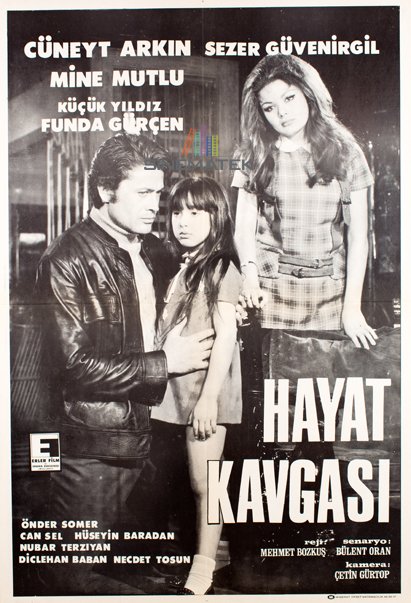
Turkish melodrama of about 85 minutes, Hayat Kavgası (The Struggle for Life) was filmed in black and white in 1969. Mehmet Bozkuş directed it from a screenplay by Bülent Oran, with Türker İnanoğlu as producer. Cüneyt Arkın and Mine Mutlu play the leads in a love story built on poverty, class difference and family ties.

Murat (Arkın) lost his parents in a bus accident, left school to work and now holds a steady job at an automotive plant in Gebze. His one concern is his sister Nil (Sezer Güvenirgil), who has a weak heart. Nil's friend Filiz (Mutlu), who studies music, is the daughter of the millionaire Osman Bey (Nubar Terziyan) and is made miserable at home by her stepmother Lale Hanım (Diclehan Baban), stepbrother Recep (Önder Somer) and Şule (Feri Cansel). Murat and Filiz fall in love, but he keeps pointing to the gulf in wealth between them. The money for Nil's operation never comes; Murat swears revenge for his sister and marries Filiz. Years later Osman Bey meets his granddaughter Funda and the family's rift begins to heal.

The film was first planned under the title 'Acı Günler'. Çetin Gürtop was the cinematographer and Erler Film handled production. The cast also includes Necdet Tosun, Hüseyin Baradan and Aynur Aydan.

DirectorMehmet Bozkuş
Production companyErler Film

Reactions

You can pick up to 3 reactions.

Cast

Through different eyes

Yeşilçam Nostalgic A viewer raised on the classics, looking for warm storytelling and strong acting.

A Bülent Oran script, Türker İnanoğlu producing, Cüneyt Arkın and Mine Mutlu in the leads: a familiar recipe from Yeşilçam's golden years. A sister with a weak heart, a poor but proud young man in love with a rich girl, a stepmother standing in the way... Today this may look old-fashioned, but for audiences of the time these were stories in which honesty and honour were put to the test. Murat's constant insistence on the gap in wealth lifts him above a simple hero and makes him someone wrestling with his own pride. A warm keepsake for lovers of black-and-white melodrama.

History & Society Lens Asks about the period, the social background and what the work reflects.

The film catches the changing face of late-1960s Turkey in small details: a young man who loses his parents and drops out of high school becomes a worker at a car factory in Gebze. A romance between someone from the new industrial workforce and a millionaire's daughter puts the class divide of the time squarely on the table. Even so, the film treats this conflict as a matter of personal pride rather than a social problem, and looks for reconciliation in family ties. That is the general tendency of Yeşilçam melodrama: show the inequality, then soften it with an emotional coming-together. An instructive example for anyone trying to understand how the era saw class.

Cinephile Looks at script, editing and directing choices; keeps a distance from formula films.

Hayat Kavgası uses nearly every mould of Yeşilçam melodrama: the sister with a heart condition, the operation money that cannot be found, the scheming stepmother and step-siblings, a love made to seem impossible by the class gulf. Bülent Oran assembles these pieces skilfully but has little interest in surprising anyone; the story advances through big emotional ruptures and familiar coincidences. Fitting so many events, plus a time jump spanning years, into one film leaves little room for the characters' inner lives. A vow of revenge sitting right next to a marriage is, on paper, a strong source of tension; in my view the habits of the genre once again put sentiment ahead of conflict. A representative example for anyone curious about the genre's history, not a work that breaks out of it.

These are not reader reviews: they are short editorial takes written from different viewer perspectives with AI assistance. Reader reviews are below.

Reviews (0)

Log in Log in to write a review.

Comments