Gülünç ilişkiler

Ridicule

Movie · 1996 · 15 people

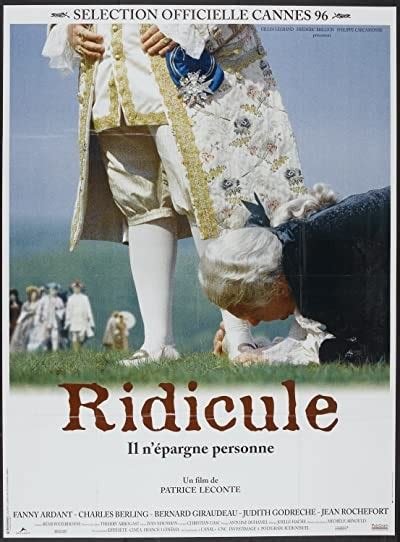
Patrice Leconte directed Ridicule, a 1996 French period drama written by Rémi Waterhouse. The story unfolds among the decadent nobility surrounding King Louis XVI at Versailles, a world where social standing depends on landing sharp verbal jabs at rivals while never becoming a laughingstock yourself.

At its center stands Grégoire Ponceludon de Malavoy, a modest provincial nobleman troubled by the wretched conditions of the peasants on his land, who are dying because its marshes have never been drained. With little money of his own, he travels to court hoping to win royal backing for a fix. There he crosses paths with the seasoned Marquis de Bellegarde, the formidable Madame de Blayac, and Bellegarde's daughter Mathilde, and these encounters shape much of the drama that follows.

The film also casts a critical eye on the aristocracy's vanity and indifference toward the suffering of ordinary people. Submitted by France for the Academy Award race, it competed for best foreign language film at the 69th Oscars and picked up several prizes at that year's César ceremony.

DirectorPatrice Leconte

Reactions

You can pick up to 3 reactions.

Cast

Only cast members with a profile on this site are listed.

Fanny Ardant Fanny Ardant Actor · 77 years old Jacques Mathou Jacques Mathou Actor Charles Berling Jean Rochefort Judith Godrèche Bernard Giraudeau Albert Delpy Antonin Lebas-Joly Bernard Dhéran Carlo Brandt Fabrice Eberhard Laurent Valo Marie Pillet Maurice Chevit Philippe du Janerand

Through different eyes

Cinephile Looks at script, editing and directing choices; keeps a distance from formula films.

Patrice Leconte stages Versailles as a drawing-room battlefield where the weapon is wit, not the sword. Rémi Waterhouse's script uses Ponceludon's campaign to drain the marshes as a moral anchor and drops him into the middle of court games; that plain but solid structure keeps the film from scattering. The dialogue is sharp and the scenes are kept short and rhythmic. Fanny Ardant's Madame de Blayac holds coldness and allure at the same time. My reservation: some of the wit can lose its edge in subtitles, and for viewers unused to period pieces the story at times becomes a string of verbal duels. Still, the Oscar nomination and the César wins were earned.

History & Society Lens Asks about the period, the social background and what the work reflects.

The film shows a society at Louis XVI's Versailles where reputation hangs on wordplay, and its real strength is setting that glitter against the misery of peasants in the provinces. While people die because the marshes have never been drained, the court is busy working out who can humiliate whom most cleverly. A provincial nobleman of modest means travelling to court for help also exposes the divisions within the class itself: being noble is not enough to get a hearing. Its critique of the aristocracy's vanity and indifference to ordinary suffering comes through irony rather than lecturing, which turns it from a dry history lesson into a lively portrait of an era.

Action & Thriller Fan Puts pace, tension and set pieces first; little patience for slow drama.

Let me say it up front: this one is not my territory. No fights, no chases; the whole war is fought with words. The palace salons and long conversations early on really tested my patience. I'll admit, though, that the duels of put-downs build real tension after a while, because losing here means being finished socially. Slow if you want pace, fun if you enjoy verbal sparring.

These are not reader reviews: they are short editorial takes written from different viewer perspectives with AI assistance. Reader reviews are below.

Reviews (0)

Log in Log in to write a review.

Comments