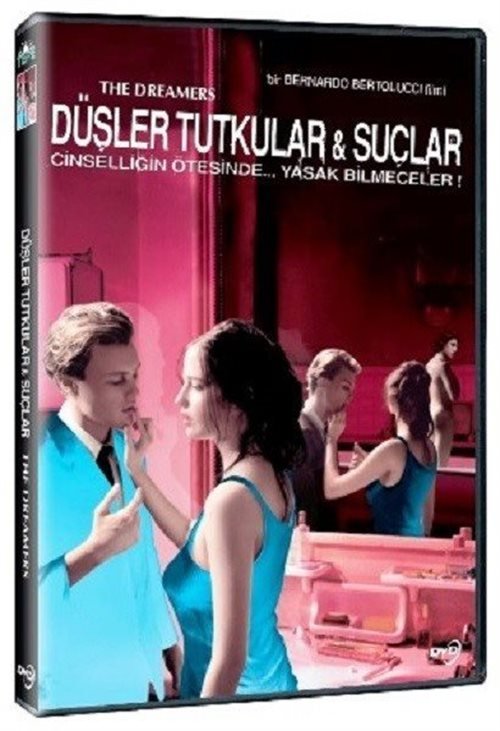
Düşler, Tutkular ve Suçlar

The Dreamers

Movie · 2003 · 13 people

Bernardo Bertolucci directed the 2003 romantic drama The Dreamers (released in Turkey as Düşler, Tutkular ve Suçlar). A co-production of companies from France, the United Kingdom and Italy, it was shot from Gilbert Adair's own screenplay, adapted from his 1988 book The Holy Innocents. After its Venice Film Festival screening it caused a scandal over its explicit sex scenes and controversial political context, and critics were divided.

The story is set in May 1968, as student unrest shakes Paris. Film-obsessed siblings Isabelle (Eva Green) and Théo (Louis Garrel) are left alone in the city when their parents go on holiday, and they invite Matthew (Michael Pitt), an American student, into their home. While revolution rages outside, passion ignites inside, and the friendship turns into an erotic triangle.

The film makes countless references to classical Hollywood and French New Wave cinema, and the actors re-enact scenes from films such as Queen Christina and Scarface. It is regarded as Bertolucci's love letter to cinema and to 1960s Paris, and it was Eva Green's first credited screen role. It opened in France on 10 December 2003 and exists in two cuts: an uncut NC-17 version and an R-rated one about three minutes shorter.

DirectorBernardo Bertolucci
Production companyRecorded Picture Company

Reactions

You can pick up to 3 reactions.

Cast

Only cast members with a profile on this site are listed.
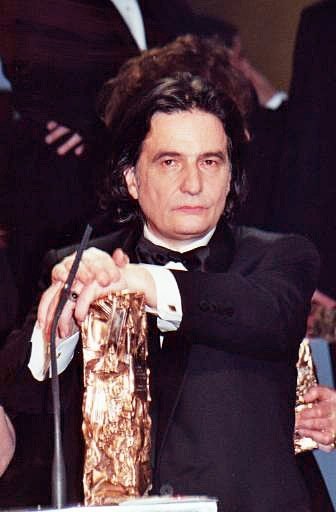
Jean-Pierre Léaud Jean-Pierre Léaud Film actor · 82 years old Jean-Paul Belmondo Jean-Paul Belmondo Film actor · died at 88 Michael Pitt Eva Green Louis Garrel Anna Chancellor Robin Renucci Jean-Pierre Kalfon François Truffaut Jean Seberg Henri Langlois Valentin Merlet Gilbert Adair
Through different eyes

Cinephile Looks at script, editing and directing choices; keeps a distance from formula films.

There's good reason it's called Bertolucci's love letter to cinema. The re-enacted scenes, from Queen Christina to Scarface, are a clever device for characters who can only grasp the world through films, and that play between classical Hollywood and the New Wave is the film's most enjoyable layer. The Venice scandal centred on the sex scenes, but in my view the film's lasting value lies in this texture of quotation. Its weakness is the closed structure of Gilbert Adair's adaptation of his own novel: a story that shuts three characters inside a flat sometimes circles itself and struggles to renew its tension. Still, few films take the passion for cinema as their subject so openly.

History & Society Lens Asks about the period, the social background and what the work reflects.

May 1968 Paris, shaken by student unrest, is the backdrop, and the film's interesting choice is to watch that upheaval less from the barricades than from inside the home of two siblings whose parents have gone on holiday. That frame is a fruitful way to think about how that generation intertwined political revolt with personal and sexual liberation. On the other hand, in my view this is the gaze of privileged young people standing at the edge of history rather than inside it; the story of the wider crowd in the streets is not this film's subject. Having an American student enter this world from outside holds up an apt mirror to how 68 looked to a foreigner.

Family Viewer Asks whether the whole household can watch it; cares about humour and heart.

Let's be plain: this isn't a family film. The sex scenes are very explicit and caused a scandal in Venice. The uncut version is rated NC-17, meaning adults only, and even the version a few minutes shorter is rated R. It isn't suitable for watching with children, teenagers or grandparents. Adults with an interest in cinema may choose to watch it on their own.

These are not reader reviews: they are short editorial takes written from different viewer perspectives with AI assistance. Reader reviews are below.

Reviews (0)

Log in Log in to write a review.

Comments