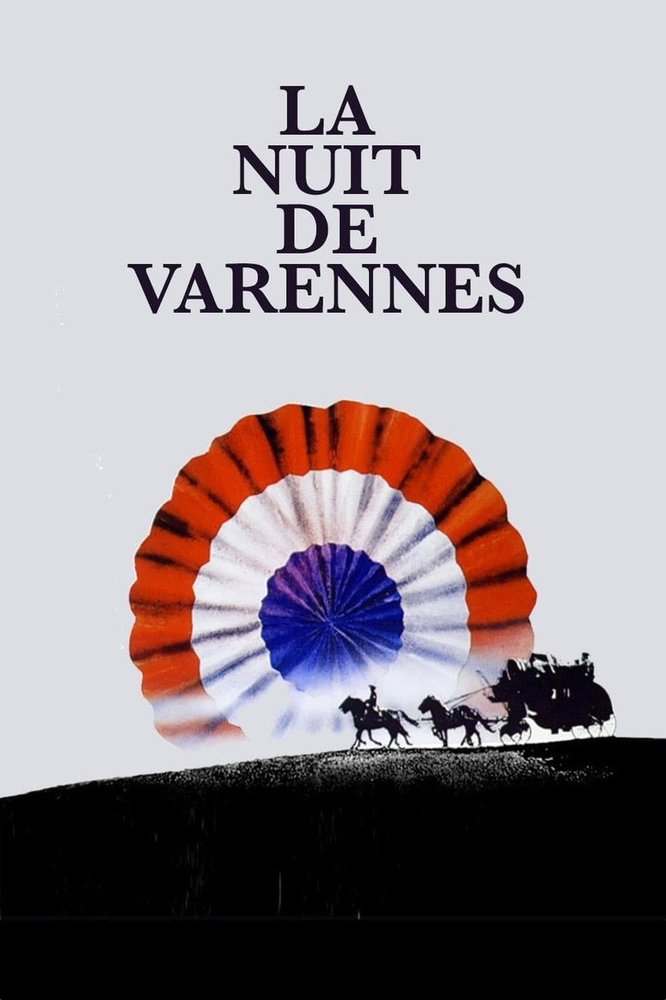
Varennes Gecesi

That Night in Varennes (La Nuit de Varennes)

Movie · 1982 · 4 people

Ettore Scola directed the 1982 French-Italian historical drama Varennes Gecesi (La Nuit de Varennes; in English That Night in Varennes). In Italy it was called Il Mondo Nuovo, after a travelling river theatre seen at the opening. It competed for the Palme d'Or at the 1982 Cannes Film Festival and won David di Donatello awards for screenplay, art direction and costume. It was shown in Türkiye at the 1984 Istanbul Film Days.

The story unfolds around the Varennes Affair of June 1791, early in the French Revolution. King Louis XVI (Michel Piccoli) and Queen Marie Antoinette (Eléonore Hirt) flee Paris disguised as servants but are caught at Varennes. Scola adds invention: a coach a few hours behind the convoy carries historical figures. Among the passengers are writer-publisher Restif de la Bretonne (Jean-Louis Barrault), the adventurer Casanova (Marcello Mastroianni), the American revolutionary thinker Thomas Paine (Harvey Keitel) and the queen's lady-in-waiting Sophie de la Borde. They stand for a collapsing aristocracy or rising bourgeoisie and debate the age. Hanna Schygulla, Jean-Claude Brialy, Andréa Ferréol and Jean-Louis Trintignant also star.

The script is Scola and Sergio Amidei's adaptation of Catherine Rihoit's 1982 novel. Scola had written 87 screenplays before directing; Armando Trovajoli composed the music.

DirectorEttore Scola
Production companyGaumont Yapımevi

Reactions

You can pick up to 3 reactions.

Cast

Only cast members with a profile on this site are listed.

Through different eyes

Cinephile Looks at script, editing and directing choices; keeps a distance from formula films.

In telling the story of Louis XVI's flight towards Varennes, Ettore Scola puts the real weight on an imagined journey in a coach a few hours behind the convoy. That shift is the film's cleverest decision: history runs on down the road while the drama is built in the passengers' arguments. Mastroianni's Casanova, Harvey Keitel's Thomas Paine and Jean-Louis Barrault's Restif de la Bretonne are well balanced as carriers of ideas. The screenplay by Scola and Sergio Amidei places great trust in dialogue; that trust usually pays off, but at times it pushes the film close to stage theatre. Armando Trovajoli's score is an elegant companion on the road. The Cannes competition slot and the David di Donatello awards for screenplay, art direction and costume come as no surprise.

History & Society Lens Asks about the period, the social background and what the work reflects.

June 1791 is a moment when the French Revolution has not yet fully found its direction. The film fits that uncertainty into a single coach: passengers who stand for a collapsing aristocracy or a rising bourgeoisie debate the age even as it changes before their eyes. Putting Thomas Paine, a thinker of the American Revolution, on the same journey as Casanova, an adventurer who became a symbol of the old world, turns the encounter into a historical conversation. Bringing these real historical figures together in one coach is Scola's own invention, so the film is best read as an essay of ideas rather than a documentary. Rich viewing for anyone curious about how the classes looked at one another and at the order to come.

Action & Thriller Fan Puts pace, tension and set pieces first; little patience for slow drama.

A king on the run, a coach a few hours behind him: on paper, everything is set for tension. But this isn't a chase film, it's one long conversation on the road. The passengers debate the age non-stop, and the pace moves at the speed of that talk. Far too static if you're hoping for the thrill of pursuit. If you enjoy debates and costume drama, fine; if you want action, adjust your expectations from the start.

These are not reader reviews: they are short editorial takes written from different viewer perspectives with AI assistance. Reader reviews are below.

Reviews (0)

Log in Log in to write a review.

Comments