Un témoin dans la ville

Un témoin dans la ville

Movie · 1959 · 6 people

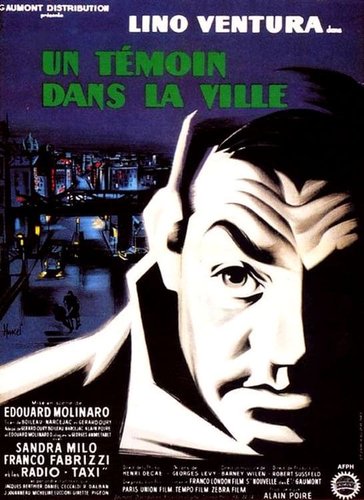
A French-Italian crime thriller from 1959, Un témoin dans la ville was directed by Édouard Molinaro. The screenplay is adapted from the novel of the same name by the French crime-writing duo Boileau-Narcejac, whose screen adaptations include Les Diaboliques (1954), Vertigo (1958) and Eyes Without a Face (1960). Rooted in film noir, it stands out for its black-and-white photography, its night shooting and a cool jazz score.

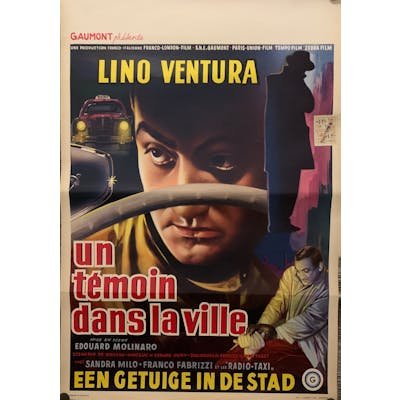
Lino Ventura stars, and this time he is not the one chasing the criminal but the one being hunted. The story unfolds at night in Paris: after a murder, radio-linked taxi drivers set out to track the killer. A radio-dispatched taxi network is one of the film's key devices, used by the characters to communicate and, at the crucial moment, to follow the criminal from the dispatch office. The drivers appear as one united body able to catch a criminal in the vast night-time city. Sandra Milo, Franco Fabrizi, Françoise Brion and Jacques Berthier are also in the cast.

Molinaro wrote the script with Gérard Oury and Alain Poiré, and draws on methods from expressionist cinema and film noir: unusual camera angles, strong light-and-shadow contrasts and night scenes lit by neon signs.

DirectorÉdouard Molinaro
Un témoin dans la ville Un témoin dans la ville

Reactions

You can pick up to 3 reactions.

Cast

Only cast members with a profile on this site are listed.

Through different eyes

Cinephile Looks at script, editing and directing choices; keeps a distance from formula films.

Un témoin dans la ville shows just how stylish French noir can be. The story, drawn from a Boileau-Narcejac novel, takes Lino Ventura out of his familiar role as the pursuer and puts him on the hunted side, a reversal that makes the structure interesting from the start. Molinaro uses tools borrowed from expressionism and film noir with clear intent: unusual camera angles, harsh contrasts of light and shadow, night scenes lit by neon signs. The radio-taxi network is both a storytelling device and a visual system, turning the city into a web of linked voices. The cool jazz score completes the atmosphere, and the tight eighty-six minutes suit the economy the genre demands.

Action & Thriller Fan Puts pace, tension and set pieces first; little patience for slow drama.

A killer, night-time Paris and an army of taxi drivers talking to each other by radio: it is hard to find a better setup for a chase. Lino Ventura being the hunted one this time builds the tension from the opposite direction, which is a great idea. Just remember it is from 1959; anyone expecting today's fast cutting may find the pace slow. At eighty-six minutes, though, it is short and tight.

History & Society Lens Asks about the period, the social background and what the work reflects.

Socially, the most interesting thing about the film is that it hands heroism not to a lone detective but to a working community. The taxi drivers who talk by radio across night-time Paris are drawn not as scattered individuals but as a body that can catch a criminal when it moves together. The radio-taxi network becomes a web of solidarity against the city's darkness. It is a view that sets the shared strength of ordinary workers against the image of people left alone in a big city. Still, since it is a crime film first and foremost, do not expect it to explore the drivers' everyday lives or working conditions in any depth.

These are not reader reviews: they are short editorial takes written from different viewer perspectives with AI assistance. Reader reviews are below.

Reviews (0)

Log in Log in to write a review.

Comments