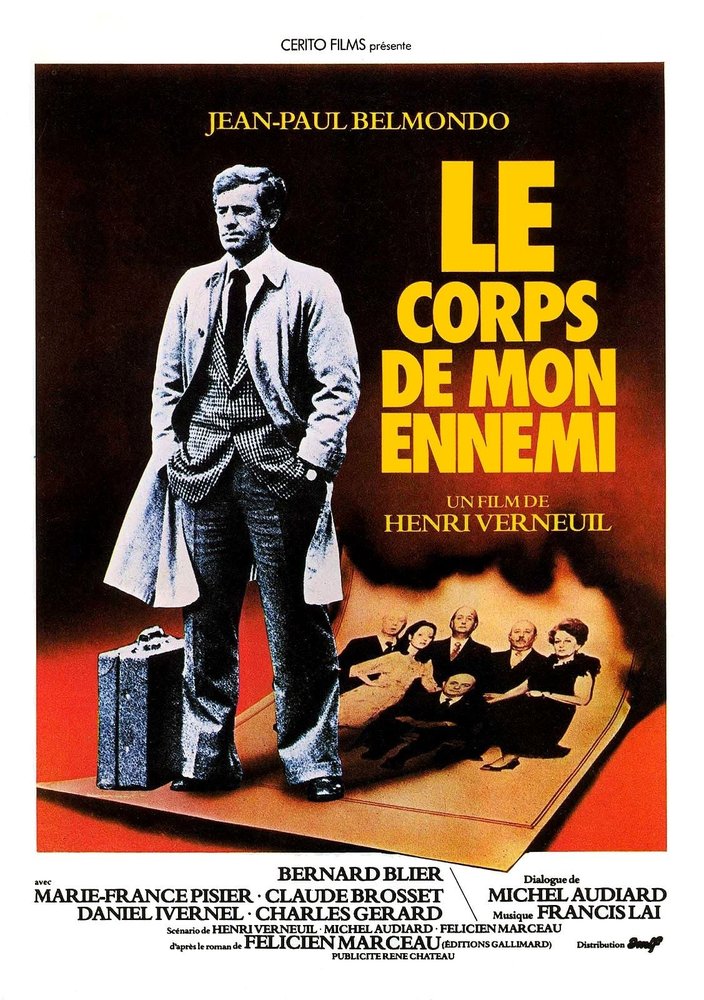
Le Corps de mon ennemi

Le Corps de mon ennemi

Movie · 1976 · 15 people

Henri Verneuil directed Le Corps de mon ennemi (Body of My Enemy in English), a French-Italian film from 1976. Counted as a crime film and a drama, it also carries detective and thriller elements. Made in French for Cerito Films, it runs 116 minutes. The screenplay was prepared jointly by Verneuil, Michel Audiard and Félicien Marceau, the author of the novel of the same name from which the film is adapted.

The story opens as François Leclercq comes back to his hometown of Cournai after a seven-year prison term. Cournai, near Lille, is a town wholly tied to the textile industry, home to an old-established textile bourgeoisie. François was convicted of a double murder he did not commit. On his return his aim is to bring the dark affair to light, find out who held the strings of the plot that made him its victim, and take revenge for the years lost in prison, so he sets off after the real culprits. Jean-Paul Belmondo plays Leclercq.

Marie-France Pisier, Bernard Blier and François Perrot are the other prominent names in the cast. The list also includes André Reybaz, Charles Gérard, Daniel Ivernel, André Thorent, Bernard-Pierre Donnadieu, Charles Charras, Claude Brosset, Élisabeth Margoni, Fernand Berset and Florence Cayrol.

DirectorHenri Verneuil
Production companyCerito Films

Reactions

You can pick up to 3 reactions.

Cast

Only cast members with a profile on this site are listed.

Jean-Paul Belmondo Jean-Paul Belmondo Film actor · died at 88 Henri Attal Henri Attal Actor · died at 67 Bernard Blier Marie-France Pisier André Reybaz André Thorent Bernard-Pierre Donnadieu Charles Charras Charles Gérard Claude Brosset Daniel Breton Daniel Ivernel Elisabeth Margoni Fernand Berset Florence Cayrol
Through different eyes

Cinephile Looks at script, editing and directing choices; keeps a distance from formula films.

Henri Verneuil's film takes a familiar revenge pattern, the return of a man wrongly imprisoned, and tries to carry it somewhere more complex through a script written with Michel Audiard and Félicien Marceau, the author of the novel. Its structure, shifting between crime thriller and social drama, is both the film's richness and its weakness; viewers who arrive with genre expectations may take the weight of the drama for slowness. The contrast between Jean-Paul Belmondo's star image and this dark story of digging into a provincial town's secrets is one of the film's most intriguing tensions. Audiard's name on the script is a key element that brings sharpness to the dialogue.

History & Society Lens Asks about the period, the social background and what the work reflects.

The most interesting thing about the film is its setting: a town near Lille wholly bound to the textile industry, with an old-established textile bourgeoisie. François's search for the plot behind his wrongful conviction also becomes an inquiry into this small community's power structure and what it hides behind its mask of respectability. The question of who holds sway in an industrial town, and who pays the price, gives the revenge story a class dimension. It is a good example of the criticism French cinema of the 1970s aimed at the provincial bourgeoisie.

Action & Thriller Fan Puts pace, tension and set pieces first; little patience for slow drama.

Belmondo, revenge, a man back from prison: that trio instantly sets you up to expect action. But at its core the story is an investigation: bringing the town's secrets to light and finding who set up the plot. The stakes are big and personal, yet the film blends its genre with drama. If you love Belmondo's action films, adjust your expectations; if you want revenge and a crime story, you're in the right place.

These are not reader reviews: they are short editorial takes written from different viewer perspectives with AI assistance. Reader reviews are below.

Reviews (0)

Log in Log in to write a review.

Comments