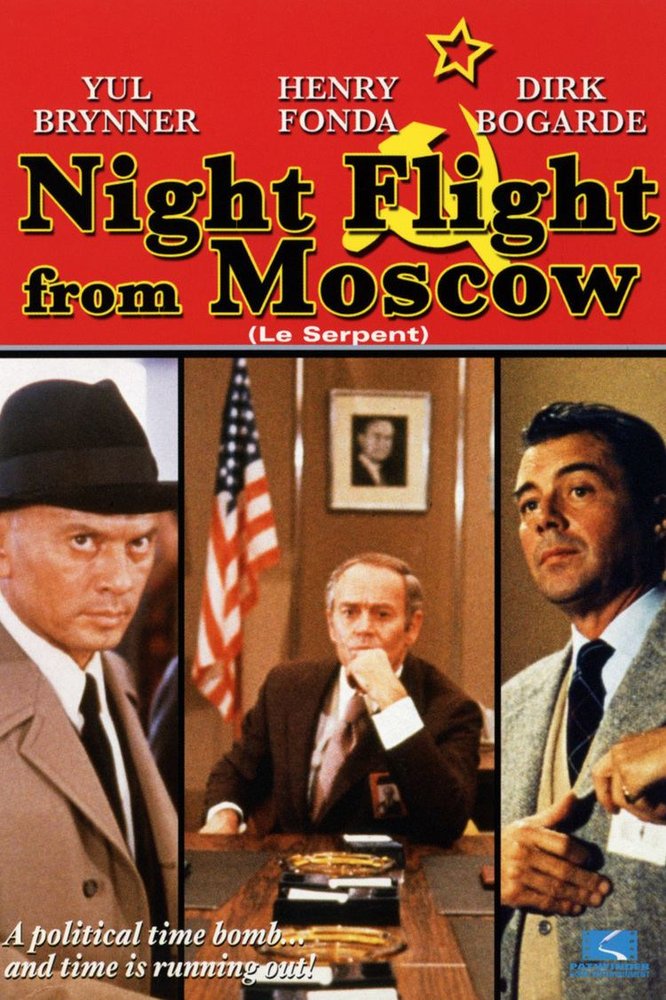
Night Flight from Moscow

Night Flight from Moscow (Le serpent)

Movie · 1973 · 15 people

France, Italy and West Germany co-produced this 1973 Cold War spy thriller, which Henri Verneuil produced and directed from a screenplay he wrote with Gilles Perrault. In English it is called Night Flight from Moscow or The Serpent; the French original title is Le Serpent and the German one Die Schlange. It runs about 119 minutes, and Ennio Morricone composed the score.

The film is adapted from Pierre Nord's novel Le Treizième Suicidé. The story unfolds in the middle of the Cold War around a KGB official trying to reach the West by way of France. As Soviet state security hunts American spy networks, the defection draws French, American and Soviet intelligence into a tense confrontation.

The cast is a broad one: Yul Brynner, Henry Fonda, Dirk Bogarde, Philippe Noiret and Michel Bouquet share the leading roles, and Virna Lisi, Paola Pitagora, Elga Andersen, Luigi Diberti, Robert Alda, Farley Granger, François Maistre, André Falcon, François Dyrek and Guy Tréjan also appear. It is regarded as a notable example of 1970s European spy cinema.

DirectorHenri Verneuil
Production companyEIA

Reactions

You can pick up to 3 reactions.

Cast

Only cast members with a profile on this site are listed.

Luigi Diberti Luigi Diberti Actor · 87 years old Farley Granger Farley Granger Film actor · died at 85 Yul Brynner Henry Fonda Philippe Noiret Dirk Bogarde Michel Bouquet Virna Lisi Paola Pitagora Elga Andersen Robert Alda François Maistre André Falcon François Dyrek Guy Tréjan

Through different eyes

Cinephile Looks at script, editing and directing choices; keeps a distance from formula films.

Henri Verneuil's Cold War thriller is a typical product of the 1970s international co-production model: Yul Brynner, Henry Fonda, Dirk Bogarde, Philippe Noiret and Michel Bouquet on the same poster. That density of stars is an asset but also a burden, since making room on screen for so many big names pushes the story into a fragmented structure. At heart the story is less an escape than mutual distrust among three intelligence services, which sets it up to lean on a game of information rather than on chases. Ennio Morricone's score supports that cold, guarded atmosphere. It is easy to see why it is counted among the notable examples of European spy cinema; still, viewers with no patience for the genre's slow, dialogue-heavy side may struggle.

Action & Thriller Fan Puts pace, tension and set pieces first; little patience for slow drama.

A KGB official defects to the West and three intelligence services get tangled up with each other: on paper, a great idea. But don't mistake this for an action movie. At the heart of the story is not fists but a reckoning between services and the question of who trusts whom. For anyone after a fast pace, this kind of Cold War espionage is like a chess match that needs patience. If you love Cold War intrigue it's worth it; if you want explosions, steer clear.

History & Society Lens Asks about the period, the social background and what the work reflects.

The film puts one of the Cold War's most talked-about figures at its centre, the Soviet intelligence man seeking refuge in the West, and tells the story by way of France. That choice matters: France is both stage and party here, caught between two superpowers. The fact that it was a French, Italian and West German co-production also reflects a wish in the Europe of the day to see this conflict through its own eyes. 1973 fell in the years of détente, and an atmosphere of mutual suspicion built at such a time makes the film an interesting document of that era's anxieties.

These are not reader reviews: they are short editorial takes written from different viewer perspectives with AI assistance. Reader reviews are below.

Reviews (0)

Log in Log in to write a review.

Comments