The Law of the Wolf (Kurt Kanunu)

The Law of the Wolf (Kurt Kanunu) (translated)

Movie · 1991 · 10 people

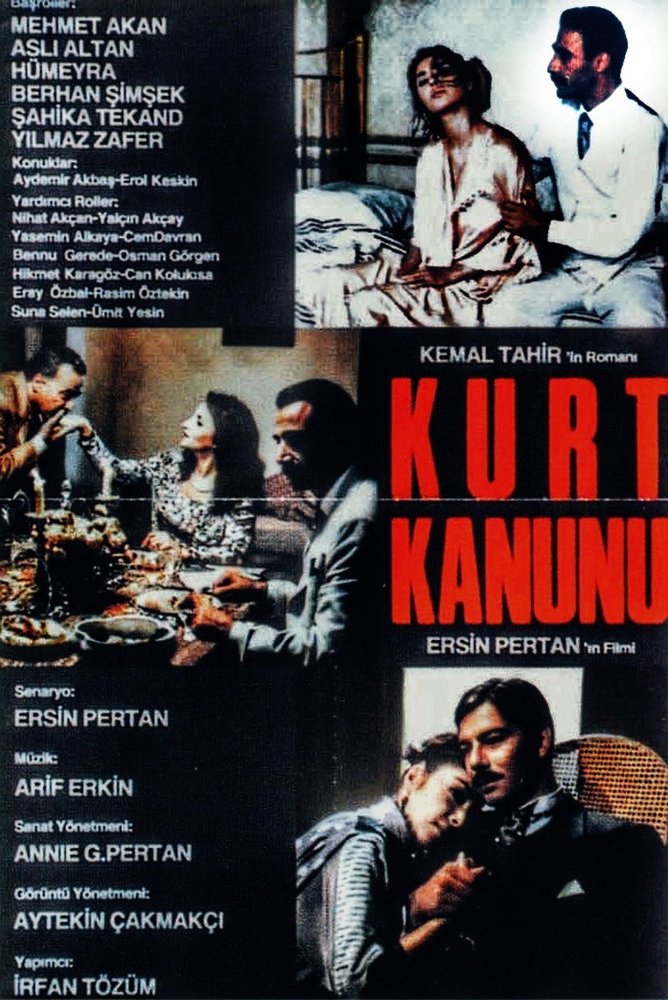
Ersin Pertan directed Kurt Kanunu (The Law of the Wolf), a Turkish historical drama. It was made in 1991. The film is adapted from Kemal Tahir's 1969 novel of the same name and deals with the planned assassination attempt on President Mustafa Kemal Pasha in İzmir in 1926. Pertan prepared the screenplay, and he and İrfan Tözüm produced it.

The story is set in Turkey in 1926. Anatolia is passing through a turbulent, uncertain and harsh period: while firm and deliberate steps are taken to build the new state's infrastructure, resistance and wounds that do not close easily also surface. Its key elements include the early years of the Republic, the preparations for the assassination and the plans behind it. Against this political backdrop, individual stories and personal conflicts carry on.

The leads are shared by Mehmet Akan, Aslı Altan, Hümeyra, Berhan Şimşek, Şahika Tekand and Yılmaz Zafer, with Rasim Öztekin, Bennu Gerede, Can Kolukısa and Yasemin Alkaya also in the cast. Music is by Arif Erkin, cinematography by Aytekin Çakmakçı, editing by Ayhan Ergürsel and art direction by Annie G. Pertan. The production company is Sarmal Aş.

DirectorErsin Pertan
Production companySarmal Aş

Reactions

You can pick up to 3 reactions.

Cast

Also in the cast: Bennu Gerede, Yasemin Alkaya, Aslı Altan (Ballı Naciye), Yılmaz Zafer

Through different eyes

AI-assisted editorial takes written from different viewer perspectives. They are not reader reviews; those are below.

History & Society Lens Asks about the period, the social background and what the work reflects.

Kurt Kanunu uses the assassination attempt planned against Mustafa Kemal Pasha in İzmir in 1926 as its backdrop and reads the early years of the Republic through the resistance the new state met as it was being built. What stands out is that the film does not tell the great political event head-on, focusing instead on the stories and personal conflicts of individuals living in its shadow. That approach lets us think about history not only through decisions and leaders but through people forced to live with uncertainty. It is a worthwhile angle for anyone wanting to talk about the period's slow-healing wounds; those expecting a history lesson will find the era's atmosphere more than the details of events.

Cinephile Looks at script, editing and directing choices; keeps a distance from formula films.

Bringing a Kemal Tahir novel to the screen means fitting a dense political backdrop and a large number of characters into a single film. With Ersin Pertan writing the script himself and co-producing, the adaptation sits in one pair of hands; that can bring consistency, but it can also deny the film the trimming an outside eye would provide. The large ensemble raises the question of whether each personal conflict gets enough room. The film's real test is keeping its rhythm between the tension of the assassination plot and the individual dramas; where the two layers fail to feed each other, the narrative looks scattered and the weight of the period drama slows the pace.

Yeşilçam Nostalgic A viewer raised on the classics, looking for warm storytelling and strong acting.

For an eye shaped by literature, seeing a Kemal Tahir novel brought to the screen is valuable in itself; every meeting of our literature and our cinema gives a viewer devoted to the classics an extra joy. Still, anyone who has read the novel cannot help asking how much of the depth on the page and the characters' inner lives a single film can hold; in adaptations like this, the weight of the book rarely makes it fully onto the screen. For those who do not know the book, the film can be an inviting door into the novel.

Reviews (0)

Log in Log in to write a review.

Comments