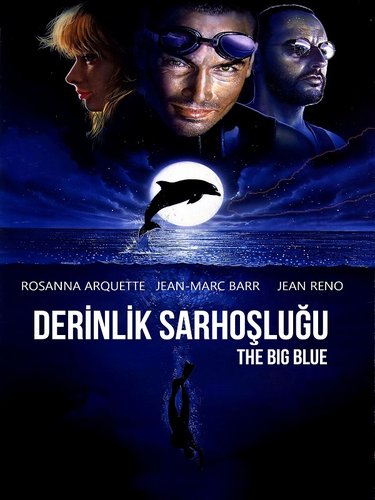
Derinlik Sarhoşluğu

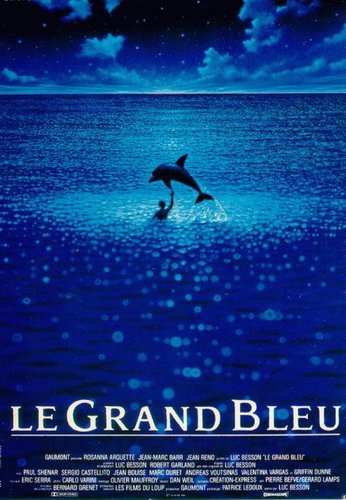
The Big Blue (Le Grand Bleu)

Movie · 1988 · 15 people

Luc Besson directed and co-wrote The Big Blue (Le Grand Bleu), a French-Italian-American drama from 1988. It was his first English-language film, and it draws on the rivalry between two celebrated free-diving champions, Jacques Mayol and Enzo Maiorca and on Besson's own childhood, but it is largely fiction. Chosen to open the 1988 Cannes Festival, it met a chilly press yet drew more than nine million viewers in France.

The story opens in 1960s Greece, where Jacques loses his father in a diving accident and the Italian boy Enzo sizes him up as a rival. Years later Enzo (Jean Reno, surnamed Molinari in the film) finds the grown Jacques (Jean-Marc Barr) in Peru and lures him to the no-limits world championship in Taormina, Sicily. A fictional romance brings Johana (Rosanna Arquette), a New York insurance agent, into his life and leaves him torn between the sea and life on land. In reality the two divers were never direct competitors and neither reached the 120 metres shown on screen.

The film earned six César nominations and won for Éric Serra's score and for sound. A director's cut followed in 1989. When Mayol died in 2001, Jacques Chirac named him a symbol of the "Big Blue" generation.

DirectorLuc Besson
Production companyGaumont Yapımevi
The Big Blue (Le Grand Bleu) The Big Blue (Le Grand Bleu)

Reactions

You can pick up to 3 reactions.

Cast

Only cast members with a profile on this site are listed.

Jean-Marc Barr Jean-Marc Barr Actor · 66 years old Jean Reno Rosanna Arquette Sergio Castellitto Marc Duret Jean Bouise Paul Shenar Griffin Dunne Andréas Voutsinas Valentina Vargas Kimberly Beck Luc Besson Paul Herman Pierre Semmler Sheila McLaughlin

Through different eyes

Cinephile Looks at script, editing and directing choices; keeps a distance from formula films.

Le Grand Bleu is a textbook case of critics and audiences parting ways: the press was cool at its Cannes opening, yet the film drew more than 9 million admissions in France. In my view the gap lies in the film's priorities. Besson invests in atmosphere more than story; with Éric Serra's award-winning score and the sound work, the sea becomes almost a character in its own right. The script, by contrast, settles for using the two divers' rivalry and the invented relationship with Johana as an emotional frame; the characters carry a mood more than they deepen. The long director's cut released later is a choice that risks stretching an already slow-moving story even further.

History & Society Lens Asks about the period, the social background and what the work reflects.

The thing to keep in mind with Le Grand Bleu is that, although it draws on real names, it is not a biography. Jacques Mayol and Enzo Maiorca were never direct rivals and never reached the 120 metres shown in the film; even changing Enzo's surname to Molinari signals that distance. Yet the film's social impact seems to have outgrown its fiction: when Mayol died in 2001, Jacques Chirac remembered him as the symbol of the "Grand Bleu" generation, which shows how a film can give a name to an entire generation's dream of the sea. That slippage between fact and legend is as interesting a subject as the film itself.

Family Viewer Asks whether the whole household can watch it; cares about humour and heart.

This is not an easy pick for the family. The story begins with young Jacques losing his father in a diving accident, which is a heavy opening for small children. The pace is slow, too, with more sea and feeling than action. It suits patient teenagers and adults who love the sea. If younger children watch, have an adult there to talk it through.

These are not reader reviews: they are short editorial takes written from different viewer perspectives with AI assistance. Reader reviews are below.

Reviews (0)

Log in Log in to write a review.

Comments