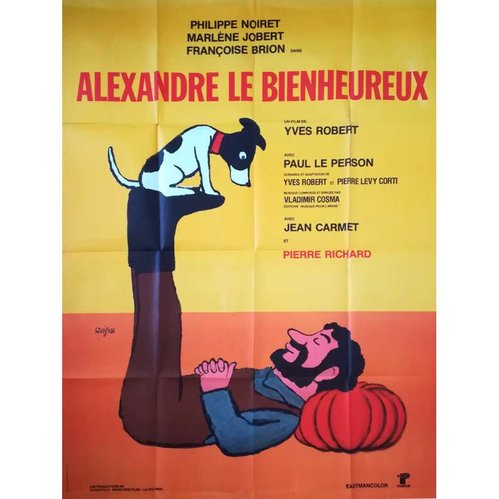
Alexandre le bienheureux

Alexandre le bienheureux

Movie · 1968 · 15 people

Yves Robert directed the 1968 French comedy Alexandre le bienheureux (Very Happy Alexander) and wrote the script with Pierre Lévy-Corti. It grew out of Robert's own story. It was produced by Madeleine Films and Les Productions de la Guéville, with music by Vladimir Cosma, and runs 95 minutes. It opened in France on 9 February 1968. German release title: Alexander, der Lebenskünstler.

The story is set in France's farming region of Beauce. A childless farmer works his land alone under the thumb of his domineering wife. When she dies in a car accident, he decides to enjoy life: he lets his animals loose and takes to his bed. For a village that treats work as a virtue, this is a scandal. Philippe Noiret stars, with Marlène Jobert and Françoise Brion; Tsilla Chelton and Jean Carmet are also in the cast. Pierre Richard appears in a small supporting part, one of his early screen roles.

Noiret's change from a meek peasant to a cheerful bon vivant, something of a hippie, matched the spirit of 1968 and made him a star in France. It played in East German cinemas from August 1969, aired on ARD in 1971 and reached West German cinemas in 1973. The DVD followed on 4 May 2004.

DirectorYves Robert
Production companyMadeleine Films

Reactions

You can pick up to 3 reactions.

Cast

Only cast members with a profile on this site are listed.

Françoise Brion Françoise Brion Actor · died at 92 Tsilla Chelton Actor · died at 93 Philippe Noiret Marlène Jobert Pierre Richard Jean Carmet Antoinette Moya Bernard Charlan François Vibert Jean Saudray Léonce Corne Madeleine Damien Marc Dudicourt Marcel Bernier Paul Le Person
Through different eyes

Cinephile Looks at script, editing and directing choices; keeps a distance from formula films.

Yves Robert's film rests on almost a single idea: a farmer who loses his domineering wife lets his animals loose and takes to his bed. Whether such a slim premise can carry a feature depends largely on Philippe Noiret's change from meek peasant to cheerful bon vivant; that change made him a star in France, and it is not hard to see why. The anecdotal structure, however, runs the risk of a situation comedy built on the village's outrage striking the same note after a while. Still, it is a bold and likeable comedy for its time, defending the refusal to work almost as a philosophy of life.

History & Society Lens Asks about the period, the social background and what the work reflects.

The film carries the spirit of 1968 to the edge of a field. In a village where work counts as a virtue, a man downing tools is like a calm, comic rural echo of the protest against the established order. The life of a childless farmer working his land alone in a farming region like the Beauce also shows how marriage and labour are intertwined; with the death of his domineering wife, that order comes apart. The village's reaction makes you ask why one person's decision about their own life can count as a scandal for a community. Seen today, it sits surprisingly close to current debates about work-life balance.

Family Viewer Asks whether the whole household can watch it; cares about humour and heart.

A comedy that speaks more to grown-ups by its very subject: a man deciding to stop working and enjoy life is an idea aimed at adults rather than children. The story starts with his wife dying in a car accident, which may need explaining to younger children. Moments like the animals being set loose may amuse the little ones. A better pick for parents and grandparents.

These are not reader reviews: they are short editorial takes written from different viewer perspectives with AI assistance. Reader reviews are below.

Reviews (0)

Log in Log in to write a review.

Comments