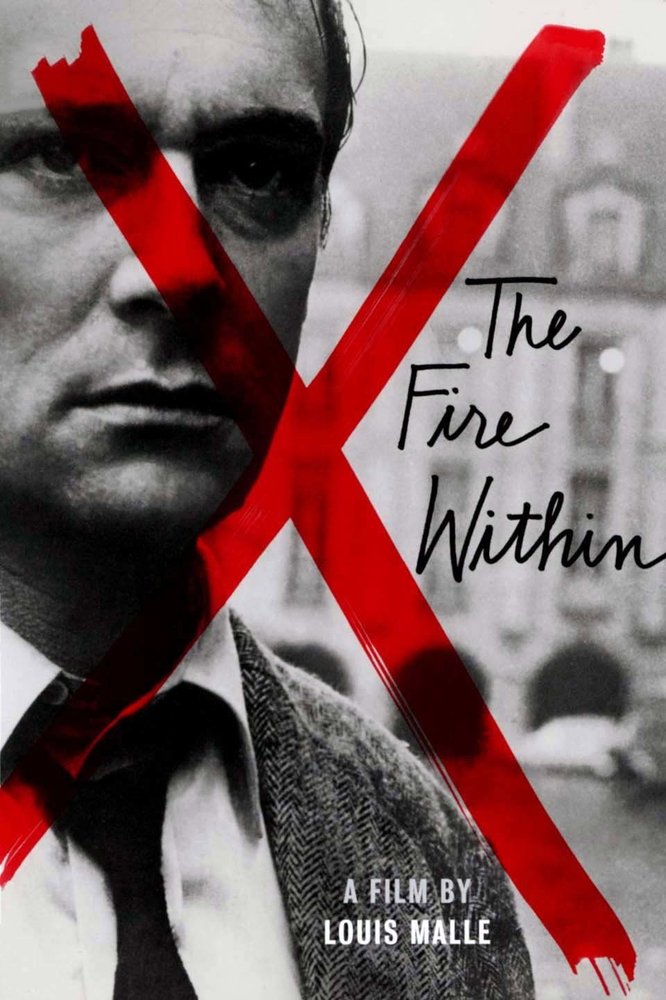
The Fire Within

The Fire Within (Le Feu follet)

Movie · 1963 · 3 people

Louis Malle made Le Feu follet (The Fire Within, literally "will-o'-the-wisp") in 1963, a black-and-white drama and French-Italian co-production. Malle also wrote the screenplay. The French-language film runs about 108 minutes and won the Grand Jury Prize at the Venice Film Festival. It opened in France on 15 October 1963 and reached West Germany only three years later, on 7 October 1966.

The story is drawn from Pierre Drieu La Rochelle's 1931 novel of the same name, itself inspired by the poet Jacques Rigaut. Maurice Ronet stars as Alain Leroy, who after a stay in a clinic wants to end his life. In his final days he settles his affairs and meets various people in Paris, hoping to find something worth living for. Instead he finds those around him hollow, almost already dead. Alongside Jeanne Moreau, Alexandra Stewart and Jacques Sereys, the cast includes Léna Skerla, Bernard Noël, Bernard Tiphaine and Hubert Deschamps. Moreau had earlier worked with both Ronet and Malle on Elevator to the Gallows.

The score consists of Erik Satie's compositions, played by pianist Claude Helffer. The film also took the French Film Academy's 1964 Crystal Star in the best-actor category.

DirectorLouis Malle

Reactions

You can pick up to 3 reactions.

Cast

Only cast members with a profile on this site are listed.

Through different eyes

Cinephile Looks at script, editing and directing choices; keeps a distance from formula films.

Louis Malle strips Drieu La Rochelle's novel down to a spare structure: one man, his last days, a series of encounters in Paris. The black-and-white images and Erik Satie's pieces, played by Claude Helffer, give the film a cold but mesmerising rhythm; the music doesn't impose emotion here, it makes the emptiness audible. Maurice Ronet carries Alain Leroy's exhaustion without ever overplaying it, and the film's weight rests largely on his shoulders. The Grand Jury Prize at Venice feels like a fitting reward for that disciplined simplicity. The episodic structure repeats itself in some encounters, though this can also be read as a deliberate monotony matching the character's sense that everyone around him is hollow. Heavy, demanding and honest.

Family Viewer Asks whether the whole household can watch it; cares about humour and heart.

Don't watch this one with the kids. The main character is a man thinking of ending his life, and the whole film stays inside that dark feeling. The subject is heavy and sad. It's black-and-white and slow, so even teenagers may get bored. Fine for adults who enjoy art films, not for a family night.

These are not reader reviews: they are short editorial takes written from different viewer perspectives with AI assistance. Reader reviews are below.

Reviews (0)

Log in Log in to write a review.

Comments