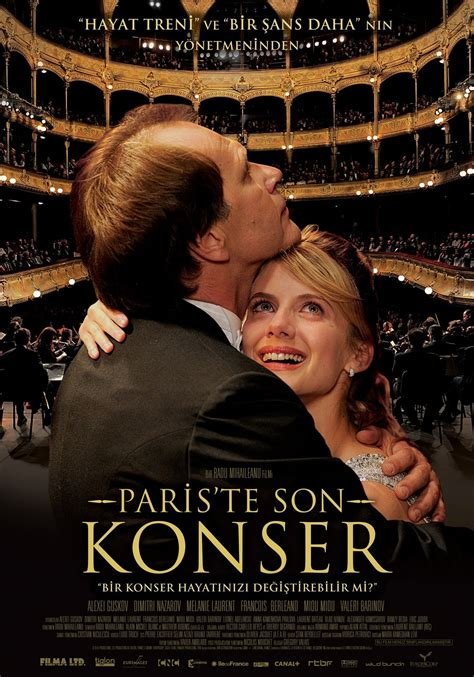
Paris'te Son Konser

Le Concert

Movie · 2009 · 3 people

Radu Mihăileanu directed Le Concert (Paris'te Son Konser in Turkish), a comedy-drama from 2009. Tchaikovsky's Violin Concerto in D major plays over the final scene. Released in France on 4 November 2009, it was warmly received by critics and audiences. It follows the director's earlier light dramas Yaşam Treni and Bir Şans Daha.

The story centres on Andrei Filipov, once the master conductor of the Bolshoi Orchestra, dismissed in the Soviet era for refusing to drop his Jewish musicians. Thirty years later he finds a chance to bring the old orchestra together. The plan is simple: travel from Moscow to Paris for a single concert and pass themselves off as the Bolshoi Philharmonic. But Filipov has a personal errand in Paris, a meeting with their young solo violinist tied to dark secrets from the past, and the real Bolshoi is on their heels. Aleksei Guskov, Mélanie Laurent and Miou-Miou star, with François Berléand, Lionel Abelanski and Ramzy Bedia.

Filming began on 23 May 2008, mostly in Romania, with some scenes in Paris and Moscow. It won the 2010 Césars for Best Score and Best Sound, the David di Donatello for Best European Film, and was nominated for Best Foreign Film at the 68th Golden Globes.

DirectorRadu Mihaileanu
Production companyBiM Distribuzione

Reactions

You can pick up to 3 reactions.

Cast

Only cast members with a profile on this site are listed.

Through different eyes

Cinephile Looks at script, editing and directing choices; keeps a distance from formula films.

Radu Mihăileanu chooses to build the fake orchestra's Paris adventure as both farce and a reckoning with the past, and that double tone is at once the film's strength and its weak spot. The chaos of the troupe leaving Moscow at times slides into broadly drawn comic types that sit uneasily with the dramatic weight behind Filipov's meeting with the young violinist. Aleksei Guskov, though, carries the tired, stubborn conductor with restraint, and Mélanie Laurent answers him with poise. The film's trump card is its finale: the sequence built on Tchaikovsky's Violin Concerto in D major largely redeems the earlier sprawl. Its César wins for score and sound come as no surprise.

History & Society Lens Asks about the period, the social background and what the work reflects.

The film's starting point is a conductor dismissed in the Soviet era for refusing to drop his Jewish musicians. That detail lifts the story beyond simple comedy and turns it into a question about how political pressure wounds art. The old orchestra regrouping thirty years later can also be read as a generation whose careers were cut short chasing its lost years. In folding this heavy legacy into comedy the film sometimes lightens the load; even so, the journey from Moscow to Paris brings to mind the old distance between East and West and the marks it left behind.

Yeşilçam Nostalgic A viewer raised on the classics, looking for warm storytelling and strong acting.

For a heart raised on classical music, this film is a small gift. The longing of a conductor once considered the Bolshoi's master to gather his scattered orchestra thirty years on recalls one of Yeşilçam's favourite themes: going after what was lost, loyalty and a second chance. The comic scenes can get a little too noisy, but the story has a genuine heart. As Tchaikovsky's Violin Concerto in D major rises in the final scene, it tells without words how music brings people together.

These are not reader reviews: they are short editorial takes written from different viewer perspectives with AI assistance. Reader reviews are below.

Reviews (0)

Log in Log in to write a review.

Comments