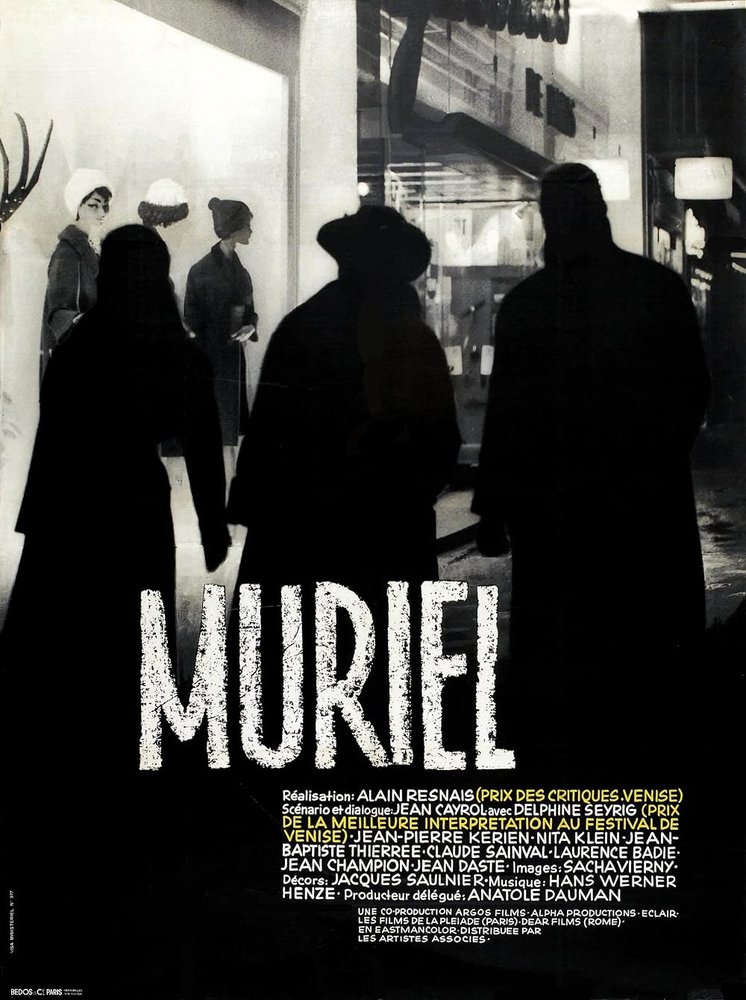
Muriel ou le Temps d'un retour

Muriel (Muriel ou le Temps d'un retour)

Movie · 1963 · 15 people

A French-Italian psychological drama from 1963, Muriel ou le Temps d'un retour (Muriel, or the Time of a Return) was directed by Alain Resnais. Running about 106 minutes, it is his third feature, after Hiroshima mon amour (1959) and Last Year at Marienbad (1961). Like those two films, it explores how hard it is to bring a remembered or imagined past together with the life of the present, and it won two festival prizes.

The story moves through the remembering and forgetting of four people in the northern French port town of Boulogne-sur-Mer, and touches on illusions, self-deceiving lies and a trauma. Hélène, a middle-aged widow, wants to renew her tie with her former lover Alphonse, who comes to visit with his young girlfriend. Her stepson Bernard has come back from military service in the Algerian War and cannot shake the memory of Muriel, a young Arab girl he saw die. The film refers obliquely to the Algerian War, which had only just ended.

Delphine Seyrig, Jean-Pierre Kérien, Jean-Baptiste Thiérrée and Nita Klein lead the cast, with Françoise Bertin, Philippe Laudenbach, Jean Dasté, Nelly Borgeaud and Laure Paillette. The screenplay was Resnais's second collaboration with Jean Cayrol, who had also written Night and Fog.

DirectorAlain Resnais

Reactions

You can pick up to 3 reactions.

Cast

Only cast members with a profile on this site are listed.
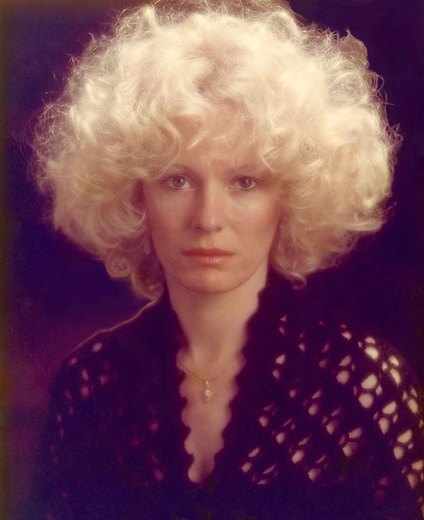
Delphine Seyrig Delphine Seyrig Actor · died at 58 Laure Paillette Laure Paillette Film actor · died at 71 Jean-Baptiste Thierrée Jean-Pierre Kérien Claude Sainval Françoise Bertin Gérard Lorin Jean Champion Jean Dasté Jean-Jacques Lagarde Laurence Badie Martine Vatel Nelly Borgeaud Nita Klein Philippe Laudenbach
Through different eyes

Cinephile Looks at script, editing and directing choices; keeps a distance from formula films.

Muriel is the third link in Resnais's inquiry into memory after Hiroshima mon amour and Last Year at Marienbad, and in my view the most demanding. Where the earlier films made the past the open subject of the story, here it seeps into everyday life; the ordinary places of Boulogne-sur-Mer become carriers of what four characters are trying to forget and remember. That it is his second collaboration with Jean Cayrol matters too: the pair who traced the war in Night and Fog ask a similar question here by a more indirect route. But that indirection has a cost. The film is stingy with an emotional centre to hold on to, and its distant structure hides the characters' pain more than it makes it legible.

History & Society Lens Asks about the period, the social background and what the work reflects.

Muriel has to be placed in its own time: it was made when the Algerian War had only just ended and was still a contested subject in France. Its choice to refer to the war obliquely rather than show it can be read as an expression of how hard it is for a society to face the violence of its recent past. Bernard's inability to put behind him the death he witnessed carries the weight of a collective silence more than a private trauma. In that sense the film is a valuable testimony for anyone who wants to understand how wars go on inside everyday life long after they end.

Family Viewer Asks whether the whole household can watch it; cares about humour and heart.

This film is not for children. War trauma, a soldier who saw a young girl die, lies and resentments are heavy subjects. The storytelling is indirect and asks for patience, which may test even teenagers. It is one for adults interested in cinema, best watched attentively on a quiet evening at home.

These are not reader reviews: they are short editorial takes written from different viewer perspectives with AI assistance. Reader reviews are below.

Reviews (0)

Log in Log in to write a review.

Comments