Massacre in Rome

Massacre in Rome

Movie · 1973 · 15 people

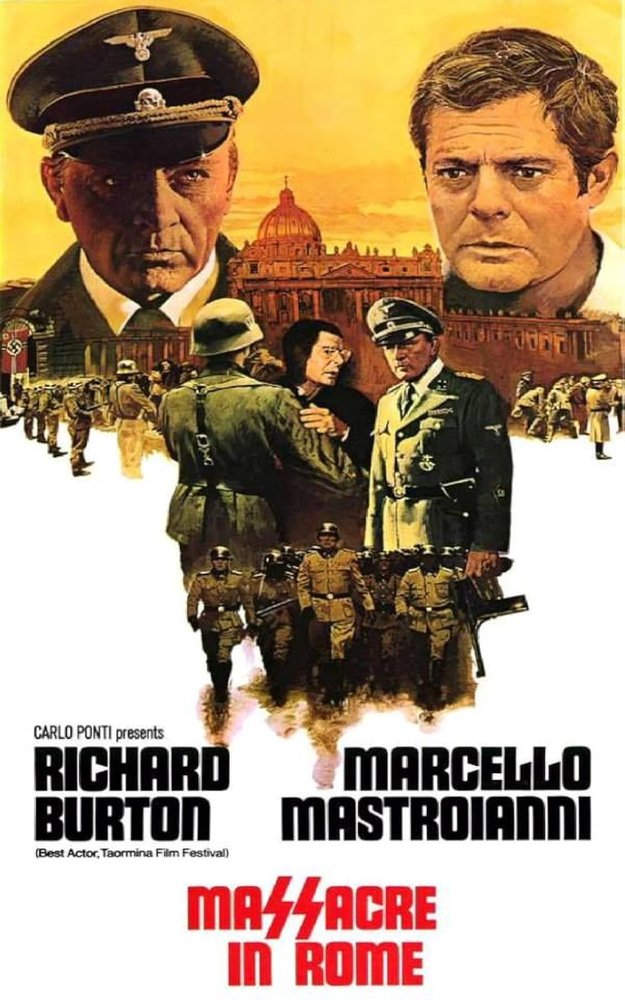
George P. Cosmatos directed Massacre in Rome, a 1973 war drama in documentary style whose Italian title, Rappresaglia, means "reprisal". Carlo Ponti produced the Italian-French film in English; its subject is the killing of hostages by the German occupiers in the Ardeatine caves outside Rome on 24 March 1944.

The story follows the German response to a partisan attack on the SS Police Regiment Bozen in Via Rasella, Rome. Richard Burton plays Herbert Kappler, commander of the SS in Rome, who is charged with carrying out the reprisal. Marcello Mastroianni plays Father Pietro Antonelli, a fictional priest who tries to prevent bloodshed; the character is a composite based on different Vatican officials. The supporting cast includes Leo McKern, John Steiner, Renzo Montagnani and Delia Boccardo. The victims' names appear in the end credits.

Cosmatos and Robert Katz co-wrote the screenplay, based on Katz's 1967 book Death in Rome. On release it caused great controversy over its claim that Pope Pius XII knew of the execution of Italian hostages and did nothing. In a libel suit brought by the late Pope's family, Ponti, Cosmatos and Katz received six-month suspended sentences, later dropped on appeal. The film runs about 110 minutes.

DirectorGeorge P. Cosmatos

Reactions

You can pick up to 3 reactions.

Cast

Only cast members with a profile on this site are listed.

Marcello Mastroianni Marcello Mastroianni Actor · died at 72 Giancarlo Prete Giancarlo Prete Actor · died at 58 Richard Burton John Steiner Delia Boccardo Renzo Montagnani Peter Vaughan Renzo Palmer Leo McKern Duilio Del Prete Massimo Sarchielli Anthony Dawson Enzo Consoli Luigi Antonio Guerra Adolfo Lastretti

Through different eyes

History & Society Lens Asks about the period, the social background and what the work reflects.

In telling a real tragedy like the Ardeatine massacre, the film's most contentious choice is to include the claim that Pope Pius XII knew of the hostages' execution in advance and did nothing. The libel suit brought by the Pope's family, and sentences later dropped on appeal, show how sensitive that claim is. It also matters that the priest Mastroianni plays is fictional, a composite of several Vatican officials: for all its documentary feel, the film offers an interpreted version of history. Putting the victims' names in the end credits, though, is a respectful gesture that reaches beyond any interpretation and recalls the real people behind the event.

Cinephile Looks at script, editing and directing choices; keeps a distance from formula films.

Cosmatos's film has a clear tension between its documentary style and its star cast. The structure that follows the reprisal through its stages of decision captures the bureaucratic coldness well; the most chilling thing about it is that the massacre appears not as an outburst of rage but as a procedure run on orders and lists. Pitting two big names like Richard Burton and Marcello Mastroianni against each other, however, sometimes pulls the film away from docudrama towards a conventional character duel. Being an Italian production shot in English also lends the Rome-set story an occasional foreign distance. Still, its effort to show the horror without embellishment sets it apart from many war dramas of its day.

Action & Thriller Fan Puts pace, tension and set pieces first; little patience for slow drama.

Put this on expecting combat and you may be disappointed. The partisan attack is the starting point, but the real weight lies in how the reprisal is decided and in the priest's attempts to stop the bloodshed. The tension comes not from guns but from decisions made behind closed doors. If that kind of suspense is your thing, it holds interest; if you want action, it may feel heavy.

These are not reader reviews: they are short editorial takes written from different viewer perspectives with AI assistance. Reader reviews are below.

Reviews (0)

Log in Log in to write a review.

Comments