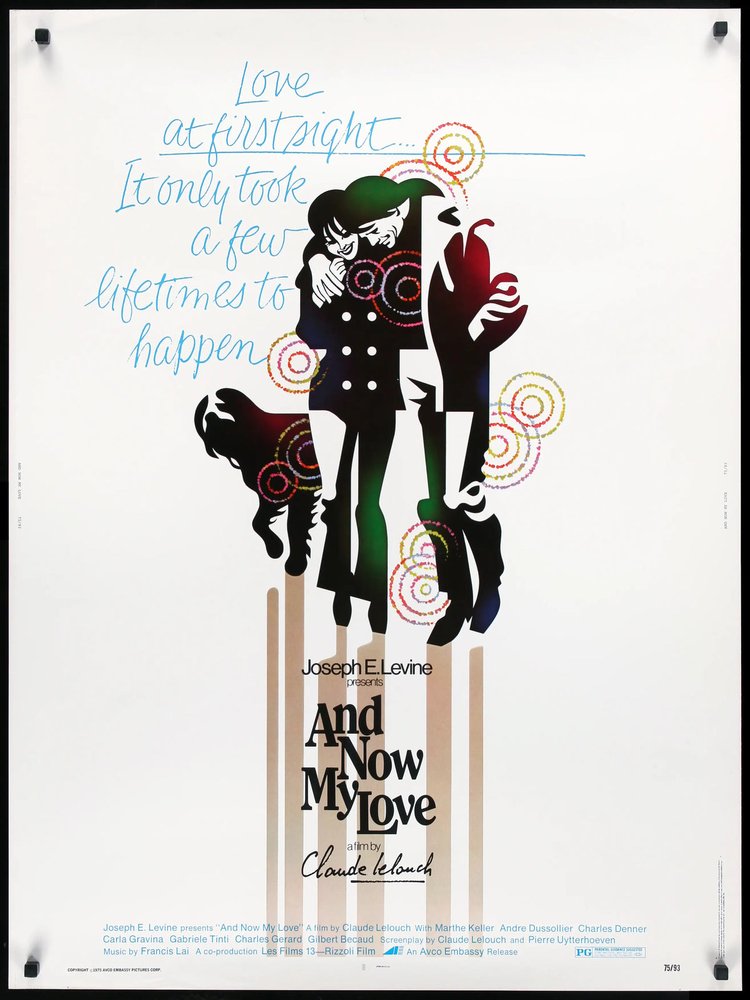
And Now My Love

And Now My Love (Toute une vie)

Movie · 1974 · 3 people

Claude Lelouch directed And Now My Love, a French-Italian drama from 1974, and wrote the story and screenplay with Pierre Uytterhoeven. Its original French title is Toute une vie, it was shown in Germany as Ein Leben lang and in Australia as A Whole Lifetime, and it runs 150 minutes. The leads are Marthe Keller, André Dussollier, Charles Denner and Charles Gérard, with Carla Gravina, Angelo Infanti and André Falcon also in the cast.

The story follows a woman and a man through earlier generations, covering roughly a century and several continents. Lelouch described the film as a tribute "to life, to love and to the 20th century". It is set in three different moments of that century, and for each one he tried to use the filming techniques associated with it.

The American title comes from Gilbert Bécaud's song "Et Maintenant", heard at the film's climax. The title means "And Now", and the song became a worldwide hit when recorded with English lyrics as "What Now My Love". The film was nominated for the Best Original Screenplay Oscar in 1975 and was shown at the 1974 Cannes Film Festival, though not in the main competition.

DirectorClaude Lelouch

Reactions

You can pick up to 3 reactions.

Cast

Only cast members with a profile on this site are listed.

Through different eyes

Cinephile Looks at script, editing and directing choices; keeps a distance from formula films.

And Now My Love looks like one of Lelouch's most ambitious narrative experiments: it tells the story of a woman and a man through earlier generations, stretching across roughly a century and several continents. The most interesting idea is the formal one; trying to use, for each of three moments in the century, the filming techniques associated with that period writes film history into the texture of the film. Marthe Keller, André Dussollier and Charles Denner are the names that carry this wide structure. Yet 150 minutes is demanding for something this diffuse, and some sections feel more like ornament than contributions to the whole. Gilbert Bécaud's "Et Maintenant" ties a strong emotional knot at the climax. The screenplay's Oscar nomination shows the ambition was taken seriously.

History & Society Lens Asks about the period, the social background and what the work reflects.

Described by Lelouch as a tribute "to life, to love and to the 20th century", the film passes a love story through generations and continents and turns the century itself into a character. What is interesting from a social angle is its attempt to show how individual destinies are shaped by the traces of earlier generations. The idea of rendering three different periods with the filming techniques of those periods is a reminder that cinema, too, is a record of history. But the film concentrates on its romantic thread rather than filling in the social background of each era, so anyone expecting a historical panorama may find it shallow.

Family Viewer Asks whether the whole household can watch it; cares about humour and heart.

The film runs two and a half hours, which is far too long for children. The story follows a love across generations, so grown-ups, especially fans of romantic films, may well enjoy it. Little ones will most likely get bored. Grandparents who know the Gilbert Bécaud song are in for a nice surprise. It speaks mostly to adults; save it for a quiet weekend evening.

These are not reader reviews: they are short editorial takes written from different viewer perspectives with AI assistance. Reader reviews are below.

Reviews (0)

Log in Log in to write a review.

Comments