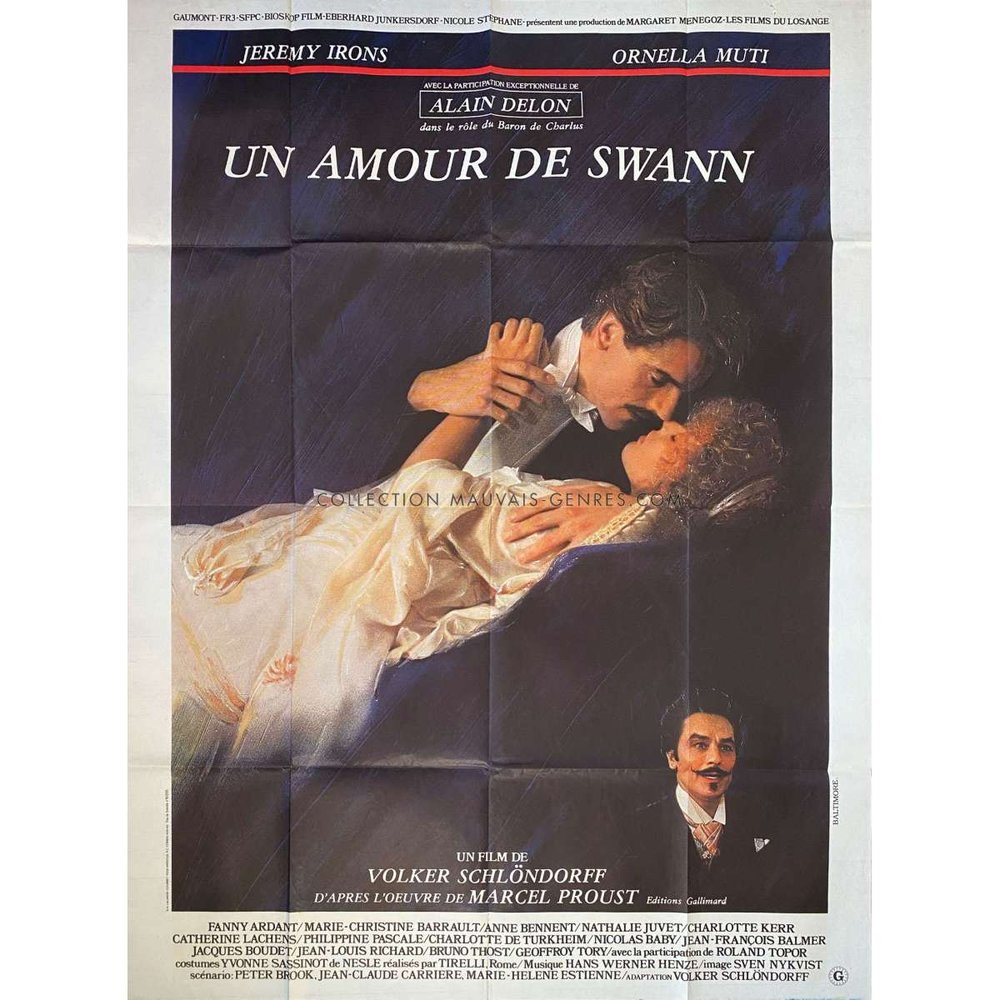
Un amour de Swann

Swann in Love (Un amour de Swann) (translated)

Movie · 1984 · 15 people

Volker Schlöndorff directed the 1984 French-German drama Un amour de Swann (Swann in Love in English; in Turkey Swann'ın Aşkı). It brings to the screen a self-contained section of the first volume of Marcel Proust's seven-volume sequence In Search of Lost Time, usually translated as Swann's Way. It earned two BAFTA nominations.

The story follows Charles Swann, who has won a place in Parisian high society through his wit and fortune. He becomes obsessively attached to the alluring Odette de Crécy, who uses men for money and status, and by the time he realises that what he took for love is desire fed by jealousy, it is too late. Odette's past threatens his social standing and friendships and pushes him toward a decisive choice. Jeremy Irons plays Swann, Ornella Muti is Odette, Alain Delon is Baron de Charlus and Fanny Ardant is the Duchesse de Guermantes. Anne Bennent, Charlotte de Turckheim, Jean-François Balmer and Jacques Boudet are also in the cast.

Schlöndorff, a founder of New German Cinema and an Oscar and Palme d'Or winner, is best known for literary adaptations. Jean-Claude Carrière and Peter Brook wrote the screenplay, Eberhard Junkersdorf produced and the film runs about 110 minutes.

DirectorVolker Schlöndorff
Production companyGaumont Yapımevi

Reactions

You can pick up to 3 reactions.

Cast

Only cast members with a profile on this site are listed.

Fanny Ardant Fanny Ardant Actor · 77 years old Jacques Boudet Jacques Boudet Actor · died at 89 Jeremy Irons Ornella Muti Alain Delon Anne Bennent Bernadette Le Saché Catherine Lachens Charlotte de Turckheim François Weigel Humbert Balsan Ivry Gitlis Jean Aurenche Jean-François Balmer Jean-Gabriel Nordmann

Through different eyes

Cinephile Looks at script, editing and directing choices; keeps a distance from formula films.

Adapting Proust is hard because the novel's power lies not in events but in the narrator's memory and inner voice. Jean-Claude Carrière and Peter Brook's choice of the self-contained Swann section is a smart structural decision: instead of a scattered journey through time, you get a closed drama about jealousy. The price is clear too: the jealousy story survives, while Proust's winding, reflective voice is bound to stay largely outside. A cast drawn from French, Italian and British actors carries the ambition of a European co-production, but with several languages in the mix, getting the performances into one register is no small task. An intriguing reading for those who know the novel; on its own, a film that risks being elegant but cold.

History & Society Lens Asks about the period, the social background and what the work reflects.

The film pictures Parisian high society as an entrance exam: Swann has been admitted thanks to his wit and fortune, yet that acceptance can be withdrawn at any moment. That Odette's past can endanger his friendships shows how, in this circle, reputation outweighs private feeling. It is easy to see Odette simply as a woman who uses men; but in a society where money and status were rarely open to women by other routes, her conduct can also be read as a survival strategy. Figures such as the Baron de Charlus and the Duchesse de Guermantes are the on-screen faces of that rigid hierarchy.

Family Viewer Asks whether the whole household can watch it; cares about humour and heart.

This is not one to watch with the children. It is about obsessive love, jealousy and a woman who uses men for money and status; adult relationships sit right at the centre. Built more on feelings and relationships than on events, it may test teenagers' patience as well. Better suited to literature-loving adults watching on their own once the house is quiet.

These are not reader reviews: they are short editorial takes written from different viewer perspectives with AI assistance. Reader reviews are below.

Reviews (0)

Log in Log in to write a review.

Comments