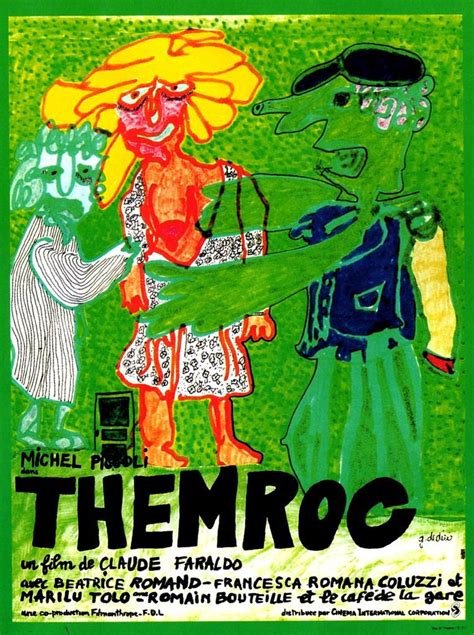
Themroc

Themroc

Movie · 1973 · 15 people

Themroc is a French satire written and directed by Claude Faraldo and released in March 1973. Made on a low budget, it has next to no intelligible dialogue: the characters speak in grunts, screams and howls. Even so, the situations and context are built so well that every exchange comes across clearly and the film hangs together as a coherent whole. It runs 110 minutes and has since come to be regarded as a cult film.

The story concerns a French blue-collar worker, the Themroc of the title, who rebels against modern society. He gradually leaves civilisation behind and turns into a caveman living in the middle of the city. The film brings together most of the actors of the Café de la Gare theatre. The cast includes Coluche, Michel Piccoli, Miou-Miou, Patrick Dewaere, Henri Guybet, Jeanne Herviale, Béatrice Romand, Francesca Romana Coluzzi, Marilù Tolo, François Dyrek and Michel Fortin.

François de Lannurien and Hélène Vager produced it, and Harald Maury composed the original score. Its scenes of incest and cannibalism earned it adults-only ratings where it was shown. In 1986 it became the first film screened in the red triangle series that Britain's Channel 4 devoted to controversial films.

DirectorClaude Faraldo

Reactions

You can pick up to 3 reactions.

Cast

Only cast members with a profile on this site are listed.

Coluche Coluche Film actor · died at 41 Jeanne Herviale Jeanne Herviale Actor · died at 80 Michel Piccoli Béatrice Romand Francesca Romana Coluzzi Marilù Tolo Patrick Dewaere Miou-Miou François Dyrek François Joxe Henri Guybet Madeleine Damien Mark Lesser Michel Fortin Philippe Manesse
Through different eyes

Cinephile Looks at script, editing and directing choices; keeps a distance from formula films.

Themroc's boldest decision is to strip out almost all dialogue and leave it to grunts and screams. This works less like a limit imposed by a low budget and more like the film's thesis itself: if language is part of civilisation, breaking away from it starts with breaking away from words. Situations and context are set up so clearly that words become unnecessary, which makes it a good lesson in staging and physical acting, carried by the ensemble energy of the Café de la Gare troupe. Even so, 110 minutes is long for a satire built on a single idea; once the initial shock wears off, the film starts repeating itself.

History & Society Lens Asks about the period, the social background and what the work reflects.

A French worker in 1973 turning his back on modern society, work and order, and becoming a caveman in the middle of the city, is a harsh critique of working life and modern living in that period. The film turns the question of class into a body rather than a speech: Themroc's revolt advances through behaviour, not ideas. In that sense it can also be read as a document that captures the counter-cultural mood of the early 1970s. Still, its provocation deliberately pushes every limit, which is exactly why it is counted among controversial films.

Family Viewer Asks whether the whole household can watch it; cares about humour and heart.

This is not a film for family viewing. Its scenes of incest and cannibalism earned it adults-only ratings wherever it was shown. Instead of talking there is shouting and grunting, which children could find both disturbing and frightening. Adults curious about cinema's extremes can watch it, but not with children in the house.

These are not reader reviews: they are short editorial takes written from different viewer perspectives with AI assistance. Reader reviews are below.

Reviews (0)

Log in Log in to write a review.

Comments