The Crime of Monsieur Lange

The Crime of Monsieur Lange (Le Crime de monsieur Lange)

Movie · 1936 · 15 people

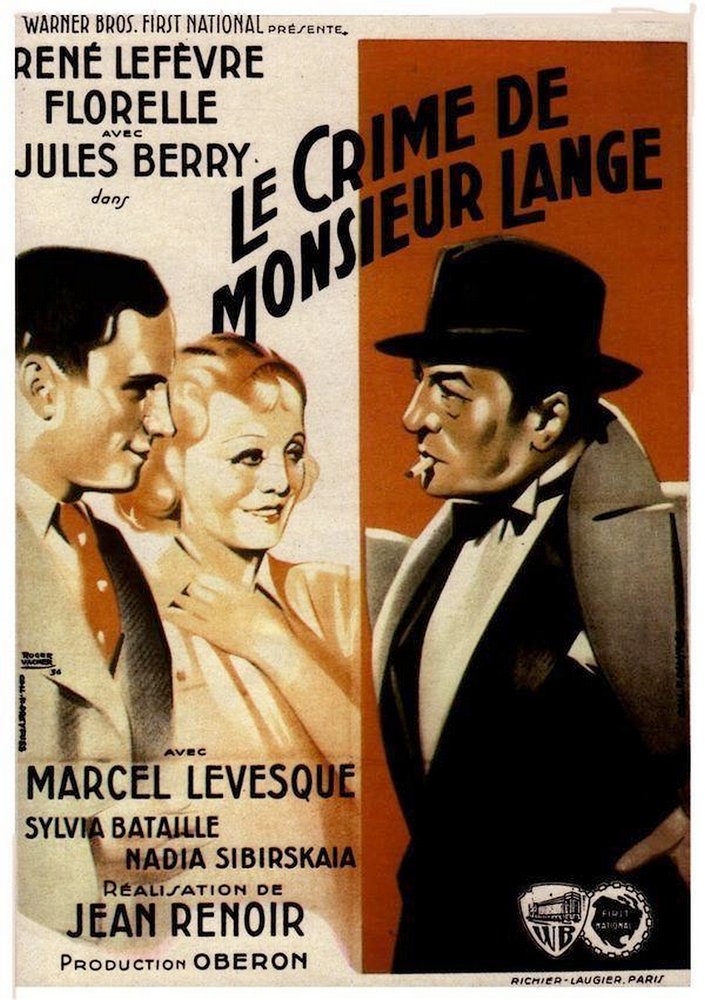
Jean Renoir set his 1936 French drama The Crime of Monsieur Lange inside a publishing cooperative, blending crime and romance with a touch of light comedy. The film breathes the outlook of the left-wing Popular Front of communists and socialists, and it works at once as a love story and as social commentary. It opened in France on 24 January 1936 and is regarded as the first libertarian film in French cinemas, and one of very few.

At its centre is Amédée Lange, a gentle employee of a small Paris publisher who writes 'Arizona Jim' western tales. When the irresponsible owner, Batala, disappears, the staff run the firm as a cooperative, kept afloat by the success of Lange's stories. When Batala returns to regain control, Lange is driven to commit the crime of the title. René Lefèvre, Florelle, Jules Berry and Henri Guisol lead the cast, with Maurice Baquet, Jean Dasté and Paul Grimault.

Renoir wrote the screenplay with Jacques Prévert, from a story by Jean Castanier; it was Prévert's only collaboration with him. The film was shot at the Billancourt Studios in Paris with sets by Robert Gys, and the French arm of Warner Brothers distributed it. It took about 164,000 dollars in 1936, with an estimated 1.4 million viewers worldwide.

DirectorJean Renoir

Reactions

You can pick up to 3 reactions.

Cast

Only cast members with a profile on this site are listed.

Edmond Beauchamp Actor · died at 85 Guy Decomble Guy Decomble Actor · died at 53 Florelle Jules Berry Maurice Baquet Marcel Duhamel Jean Dasté Paul Grimault Claire Gérard Dora Maar Henri Guisol Jacques Beauvais Jacques Brunius Marcel Lévesque Marcel Lupovici
Through different eyes

History & Society Lens Asks about the period, the social background and what the work reflects.

The film carries the mood of the year the Popular Front marched to a major election victory. Staff running the firm as a cooperative in the owner's absence, and succeeding, turns the left's hopes of the time into a story. What is interesting is that this small utopia is kept afloat by the imagination of a writer of cowboy tales: labour and creativity meet under one roof. Seen from today the message sometimes reads like an open thesis, yet what it says about class, ownership and solidarity still holds. A valuable document for anyone curious about how a political moment found its way onto the screen.

Cinephile Looks at script, editing and directing choices; keeps a distance from formula films.

Being the only collaboration between Renoir and Prévert makes the film a meeting point in itself. A tone that moves easily between drama, crime and light comedy saves a heavy political subject from sounding like a sermon, and the sense of community is built around a small workplace where the characters' lives intertwine. The script's cleverest touch is the echo it sets up between Lange's cowboy adventures and the moral choice in his own life: fictional heroism turns into a real act. Today's viewers may find the rhythm slow in places, but a narrative that shifts so freely between genres was bold for its time.

Family Viewer Asks whether the whole household can watch it; cares about humour and heart.

There is a light comic touch, but at its heart are a crime and a power struggle at work, so it suits adults and older teenagers. Young children will struggle to connect with a story set in a 1930s publishing house. Watched with high-school students who like classic films, it can open a good conversation about solidarity and standing up to injustice. Being an old film, its pace differs from what people are used to today.

These are not reader reviews: they are short editorial takes written from different viewer perspectives with AI assistance. Reader reviews are below.

Reviews (0)

Log in Log in to write a review.

Comments