Postacı

Il Postino: The Postman

Movie · 1994 · 8 people

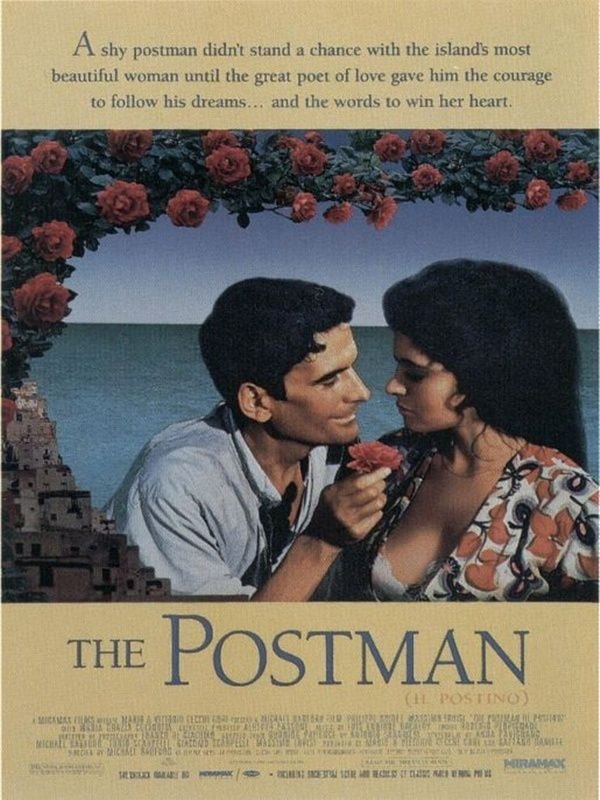
English filmmaker Michael Radford directed Il Postino: The Postman, a 1994 French-Belgian-Italian comedy-drama. Based on Antonio Skármeta's Ardiente paciencia (Burning Patience), it is a warm story of friendship between a poet and a postman. It premiered at the Venice Film Festival on September 1, 1994, and opened in Turkey on January 5, 1996.

The poet is the exiled Chilean Pablo Neruda (Philippe Noiret), living on a small Italian island because of his political views. Mario Ruoppolo (Massimo Troisi), the simple postman who bikes his letters to him, grows close to him, slowly learns to love poetry and uses it to win over the beautiful Beatrice (Maria Grazia Cucinotta). Skármeta's story is set in Chile; the film moves it to 1950s Italy and shot on the islands of Procida and Salina.

Radford, Troisi, Anna Pavignano, Furio Scarpelli and Giacomo Scarpelli wrote the screenplay. Troisi, both co-writer and lead, postponed heart surgery to finish the film and died of a heart attack as soon as shooting ended; the film is dedicated to him. It earned five Oscar nominations, for Best Picture, Director, Actor and Adapted Screenplay, and Luis Bacalov won for Best Original Dramatic Score. It also took three BAFTA Awards.

DirectorMichael Radford
Production companyCecchi Gori Group

Reactions

You can pick up to 3 reactions.

Cast

Only cast members with a profile on this site are listed.

Maria Grazia Cucinotta Maria Grazia Cucinotta Actor · 58 years old Renato Scarpa Renato Scarpa Actor · died at 82 Philippe Noiret Massimo Troisi Linda Moretti Mariano Rigillo Anna Bonaiuto Simona Caparrini

Through different eyes

Yeşilçam Nostalgic A viewer raised on the classics, looking for warm storytelling and strong acting.

Built on the friendship between a poet and a postman, this is one of those rare films that carry the patience of the old masters. In showing how poetry can enter an ordinary person's life, it neither lectures nor overplays the emotion. Luis Bacalov's Oscar-winning score is the element that best carries its spirit. For an eye raised on the classics, here is storytelling that takes its time and gives its characters room. That Troisi postponed his surgery in order to finish the film lends the work an added, poignant meaning.

Cinephile Looks at script, editing and directing choices; keeps a distance from formula films.

Radford's smartest decision is to move Skármeta's Chilean story to 1950s Italy and to the islands of Procida and Salina. The change places Neruda as an outsider and sets the postman Mario's world on a smaller, more enclosed scale. The screenplay, written by five people, builds a patient structure that traces Mario's discovery of poetry step by step. That patience is not always an asset, though; in my view the middle stretch stalls at times because the relationship stays in one register, and the line about winning Beatrice slides into a familiar romantic-comedy pattern. Still, the Oscar nominations for Best Picture and Adapted Screenplay show how widely the success of the adaptation was recognised.

History & Society Lens Asks about the period, the social background and what the work reflects.

By pairing a poet exiled for his political views with the postman of a small island, the film explores the distance between education, language and class. Mario's learning of poetry is a reminder that owning words is a kind of power, and that the gulf between the educated and the unschooled can narrow through friendship. The 1950s Italian island makes a backdrop for the closed-in lives of post-war provincial Europe. Even so, in my view the film's political dimension stays in the background, because it leans more on the island's poetic atmosphere than on the conditions that produced Neruda's exile.

These are not reader reviews: they are short editorial takes written from different viewer perspectives with AI assistance. Reader reviews are below.

Reviews (0)

Log in Log in to write a review.

Comments