Indochine

Indochine

Movie · 1992 · 12 people

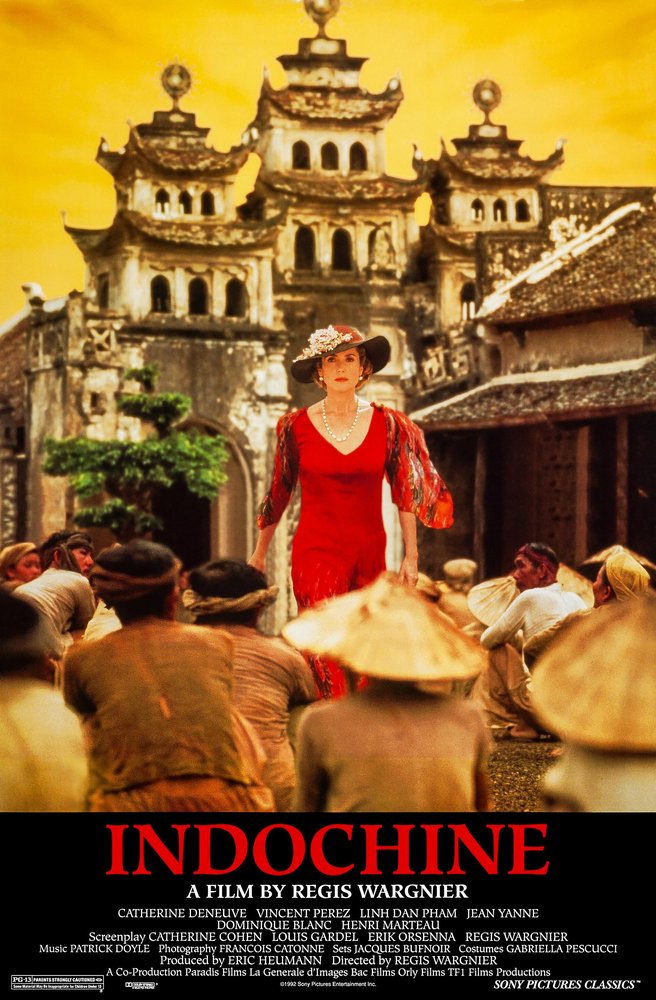
Régis Wargnier directed Indochine, a 1992 French period drama and romance. A co-production between France, Malaysia and Vietnam, it was made with the close involvement of Vietnamese filmmakers. It won the Academy Award for Best Foreign Language Film at the 65th Academy Awards, along with the Golden Globe, and Catherine Deneuve received a Best Actress Oscar nomination.

The story is set in colonial French Indochina from the 1930s into the 1950s. Éliane Devries (Catherine Deneuve) owns a rubber plantation near Saigon and lives there with her father and her adopted Vietnamese daughter, Camille (Linh Dan Pham). When a young French naval officer, Jean-Baptiste (Vincent Pérez), becomes involved first with Éliane and then with Camille, the bond between mother and daughter fractures. Events unfold against the final years of French rule and the rise of Vietnamese nationalism.

Wargnier wrote the screenplay with novelist Érik Orsenna, Louis Gardel and Catherine Cohen. The producers were Paradis Films, La Générale d'Images, Bac Films, Orly Films and Ciné Cinq. The dialogue is in French and Vietnamese. At the Césars it won Best Actress (Deneuve), Best Supporting Actress (Blanc) and awards for cinematography, production design and sound; it was also nominated for a BAFTA and took the Goya for Best European Film.

DirectorRégis Wargnier
Production companyParadis Films, La Générale d'Images, Bac Films, Orly Films, Ciné Cinq

Reactions

You can pick up to 3 reactions.

Cast

Only cast members with a profile on this site are listed.

Catherine Deneuve Catherine Deneuve Film actor · 83 years old Vincent Perez Vincent Perez Film actor · 62 years old Linh-Dan Pham Jean Yanne Dominique Blanc Alain Fromager Andrzej Seweryn Carlo Brandt Gérard Lartigau Henri Marteau Hubert Saint-Macary Thibault de Montalembert
Through different eyes

Cinephile Looks at script, editing and directing choices; keeps a distance from formula films.

Indochine uses every tool of the big-budget European period film: a wide time span, grand locations, and cinematography and production design that won Césars. Wargnier's real achievement is tying colonial history to a personal drama through the breaking of a mother-daughter bond. But that choice is also the film's limit: when the melodrama takes over, the historical backdrop at times becomes a handsome set, and the love triangle pulls the story's centre of gravity too far towards itself. The central performance, which earned both a César and an Oscar nomination, holds the film together; still, in my view the story never quite rises to the scale of the history it wants to tell.

History & Society Lens Asks about the period, the social background and what the work reflects.

The film tells the last years of colonial rule in French Indochina from inside the colonist's house, through the eyes of the owner of a rubber plantation near Saigon. That viewpoint is a limitation, but also a deliberate choice: the rupture between Éliane and her adopted Vietnamese daughter Camille carries, at a symbolic level, the unravelling of the bond between coloniser and colonised. The rise of Vietnamese nationalism stays mostly in the background, yet the close involvement of Vietnamese filmmakers and the use of two languages make it hard to read the film as mere French nostalgia.

Family Viewer Asks whether the whole household can watch it; cares about humour and heart.

A slow-paced period film aimed at adults. At the heart of the story is a love affair that comes between a mother and her adopted daughter. Young children won't be interested and would find it hard to follow. It's better suited to high-school students curious about history and to adults. Fans of romantic drama can comfortably set aside an evening for it as a family.

These are not reader reviews: they are short editorial takes written from different viewer perspectives with AI assistance. Reader reviews are below.

Reviews (0)

Log in Log in to write a review.

Comments